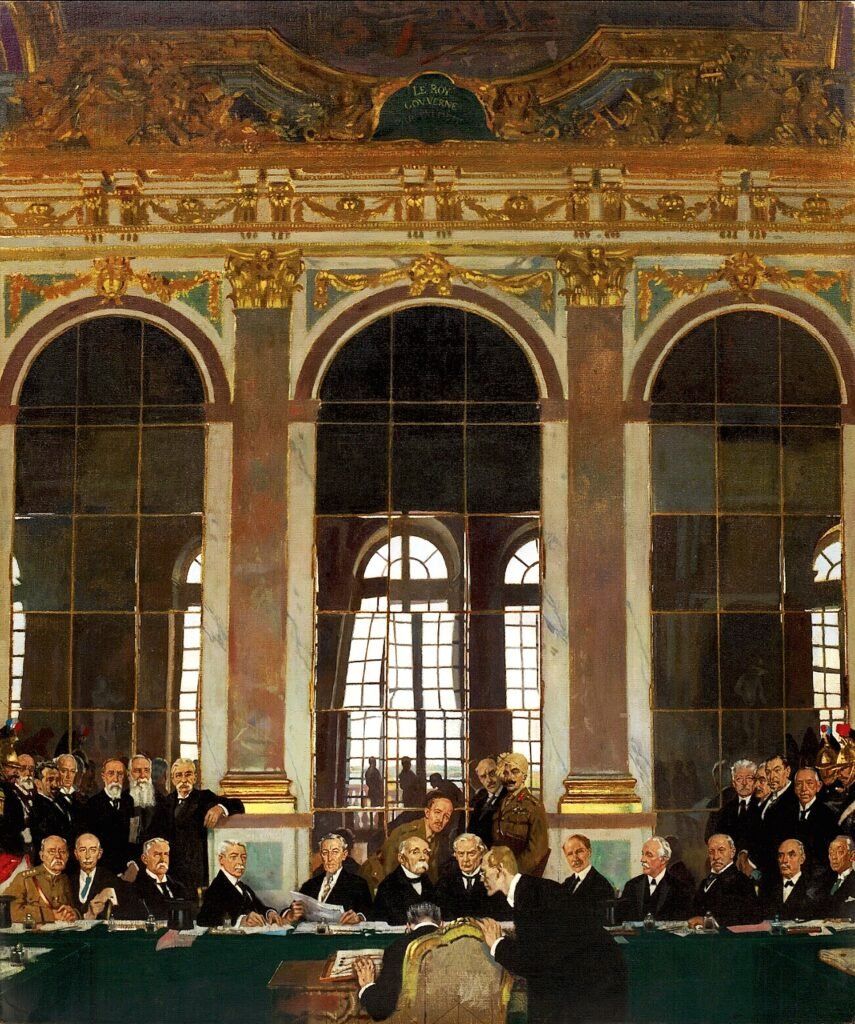
The Treaty of Versailles was the peace agreement that formally ended World War I between Germany and the Allied powers. It was signed on 28 June 1919 in the Hall of Mirrors at the Palace of Versailles outside Paris. The treaty reduced German territory, limited its army, created the League of Nations and made Germany accept responsibility for the war and pay reparations.
Background to the Treaty of Versailles
Fighting stopped with an armistice on 11 November 1918. The victors, especially Britain and France, then wanted terms that would keep Germany from threatening the peace of Europe again, according to the World History Encyclopedia. They also wanted compensation for the huge material costs of the war.
The Paris Peace Conference opened on 12 January 1919. The U.S. Department of State’s Office of the Historian notes that nearly thirty nations took part, but four dominated the talks: the United Kingdom, France, the United States and Italy. The leaders at the center were the British prime minister David Lloyd George, the French prime minister Georges Clemenceau, U.S. president Woodrow Wilson and the Italian prime minister Vittorio Orlando. Russia was not invited because the Allies refused to recognize its Bolshevik government, and the defeated Central Powers were excluded from the negotiations.
Course of events
The negotiations were difficult. Wilson wanted a peace that was not punitive, and the Oxford University Press blog on the signing says that Clemenceau, whose country had suffered heavily, was less inclined to mercy. Germany took part only at the end. The World History Encyclopedia says its delegates were invited to read the terms and sign. They had three weeks to discuss the draft and suggest small changes, and then one week to sign the final text. An Allied army occupied the Rhineland and a naval blockade was still in place, so the real alternative to signing was a resumption of the war.
The treaty was signed on 28 June 1919. More than a thousand dignitaries and members of the press gathered in the Hall of Mirrors, and the German delegates were the first to sign. Outside, cannons boomed in celebration.
Terms of the treaty
The treaty required Germany to give up about 10 percent of its prewar European territory and all of its overseas possessions. France regained Alsace and Lorraine, and Poland received the industrial region of Upper Silesia and a corridor to the Baltic Sea. The coal-rich Saar region and the port of Danzig, now Gdansk, were placed under the administration of the League of Nations. Belgium and Denmark also received small border areas.
Military limits were strict. The German army was capped at 100,000 men, the Rhineland was to be demilitarized, and Germany could not build tanks, aircraft, submarines or battleships. The treaty also allowed for the trial of Kaiser Wilhelm II and other senior officials as war criminals.
Article 231, often called the guilt clause, said that Germany and its ally Austria-Hungary had caused the war and were responsible for the resulting damage. This became the basis for reparations. The treaty set the principle but not the amount. A reparations committee fixed the total in 1921. The State Department gives the figure as 132 billion gold marks, or about 32 billion U.S. dollars, on top of an initial payment, while the World History Encyclopedia gives it as 6.6 billion pounds, so the totals depend on the unit and conversion used. The treaty also called for the creation of the League of Nations as an international forum and a system of collective security.
Aftermath
Many Germans found the guilt clause and the terms in general dishonorable. According to the World History Encyclopedia, the German government released nearly 16,000 official documents during the interwar years to argue that it was not solely to blame, and by the 1930s many observers accepted that responsibility for the war was shared. Reparations were reduced in 1929 and cancelled in 1932, and Germany often paid less than it owed. A plebiscite in the Saar in 1935 returned the region to Germany by a vote of about 90 percent.
In the United States, the treaty ran into resistance in the Senate. The State Department describes two groups of opponents: Irreconcilables, who rejected the League of Nations entirely, and Reservationists, led by Senator Henry Cabot Lodge, who wanted changes before ratification. The Senate objected most strongly to Article 10, which dealt with collective security. A final vote on 19 March 1920 fell seven votes short of ratification. The United States signed a separate peace treaty with Germany in August 1921 and never joined the League.
Significance and legacy
The treaty is among the most debated settlements in modern history. France and Belgium in particular wanted Germany to help pay for damage to property, railways, farms and industry. Critics, including the economist John Maynard Keynes, who was part of the British delegation, argued that the reparations were too harsh. The World History Encyclopedia notes that the treaty relied on German cooperation for many of its terms, and that the victors were unable to enforce them in practice.
The resentment it caused was used politically. The World History Encyclopedia reports that overturning the harsher points became a goal of successive German chancellors and then of Adolf Hitler, and it describes the treaty’s ill feeling as one of several causes of the rise of Nazism and ultimately of World War II. Historians therefore usually avoid blaming the treaty alone, but they treat it as a key part of the story of how a peace settlement can shape the next conflict. For students of diplomacy, it remains a standard case study in how a peace settlement can shape the years that follow. A century earlier, the Congress of Vienna had also redrawn the map of Europe after a long war.
Key facts
- The treaty was signed on 28 June 1919 in the Hall of Mirrors at the Palace of Versailles.13
- Germany had to surrender about 10 percent of its prewar European territory and all overseas possessions.2
- Article 231 made Germany accept responsibility for the war, which was the basis for reparations.23
- The treaty limited the German army to 100,000 men and created the League of Nations.12
- The U.S. Senate rejected ratification in a final vote on 19 March 1920, seven votes short.2
- Reparations were reduced in 1929 and cancelled in 1932.1
Related concepts
In the news
Quick checkWhat did Article 231 of the Treaty of Versailles say?Show answer
It held that Germany and its ally Austria-Hungary caused the war and were responsible for the damage, which became the basis for German reparations.
Sources
- World History Encyclopedia, Treaty of Versailles, https://www.worldhistory.org/Treaty_of_Versailles/
- U.S. Department of State, Office of the Historian, The Paris Peace Conference and the Treaty of Versailles, https://history.state.gov/milestones/1914-1920/paris-peace
- Oxford University Press blog, Treaty of Versailles signed (28 June 2012), https://blog.oup.com/2012/06/treaty-of-versailles-signed/
Editorially reviewed by Specialty Digest Editorial TeamLast reviewed November 4, 2026Researched and drafted with AI assistanceReport an issue