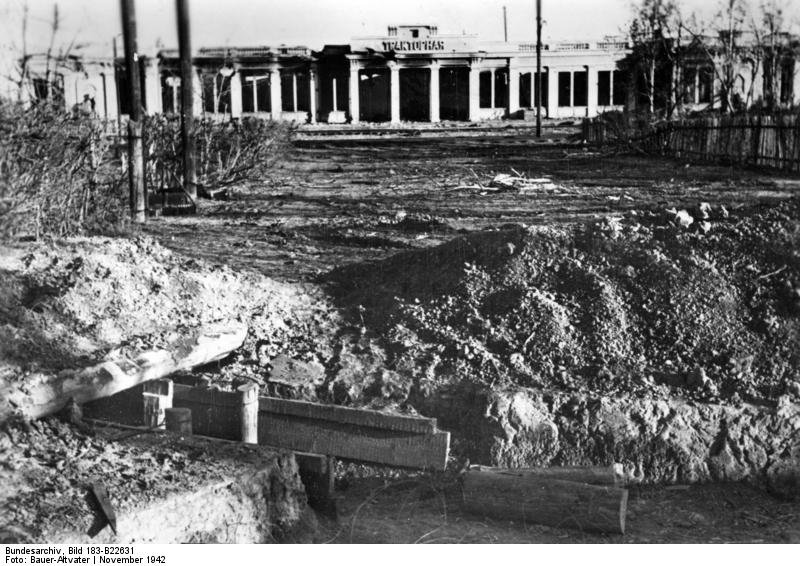
The Battle of Stalingrad was a major battle of World War II fought from 17 July 1942 to 2 February 1943 between German-led Axis forces and the Soviet Red Army for control of the city of Stalingrad, now Volgograd, on the Volga River in the Soviet Union. It ended with the surrender of the German Sixth Army. The Imperial War Museums (IWM) call it one of the most decisive battles on the Eastern Front, and many historians count it among the bloodiest battles in history.
Background of the Battle of Stalingrad
Adolf Hitler launched the invasion of the Soviet Union, known as Operation Barbarossa, in June 1941. By the spring of 1942, German forces were still deep inside Soviet territory, and Hitler planned a new offensive aimed at the Donets industrial basin in Ukraine and the Caucasus oil fields in southern Russia. In the summer, he sent his armies into southern Russia to destroy what was left of the Soviet army and to seize those oilfields. The initial advance went well, according to the IWM, and the Sixth Army was then ordered to capture the city on the Volga.
Stalingrad was an industrial city on the Volga, and its capture would help cut Soviet supply routes along the river. The German Sixth Army under General Friedrich Paulus was ordered to take the city and the riverfront. The city carried the name of Soviet leader Joseph Stalin, who demanded that it be defended at all costs. Every available soldier and civilian was mobilized.
Course of the Battle of Stalingrad
The IWM dates the start of the battle to 17 July 1942. German aircraft heavily bombed the city, and the ruins became the setting for months of bitter street fighting. By October, German troops held most of the city, but Soviet defenders clung to the banks of the Volga. They ferried in vital reserves across the river, which kept the fight alive.
Meanwhile, Soviet commanders prepared a counterstroke. The IWM credits General Georgy Zhukov with building up fresh forces on either side of the city. According to EBSCO, these included two armies under generals Andrey Yeremenko and Konstantin Rokossovsky, whose task was to encircle the Germans. The Sixth Army was overextended, and its long flank was hard to defend, which gave the plan a good chance of success.
The counteroffensive began on 19 November 1942. Within days, Soviet armies had closed a ring around Paulus and his men. EBSCO says that about 250,000 men were trapped by 24 November, while the United States Holocaust Memorial Museum (USHMM) says more than 220,000. The difference reflects how hard it is to count troops in a shifting pocket.
Hitler forbade the Sixth Army to break out. Hermann Goering, the head of the Luftwaffe, promised to supply the pocket by air, but bad weather and logistical problems made that impossible. Field Marshal Erich von Manstein led a relief attempt that came within thirty miles of the city but could get no closer. Manstein asked Hitler to authorize a breakout, but Hitler refused, since holding Stalingrad had become a matter of prestige. By early January 1943, Paulus had lost any chance of escape.
Soviet attacks, growing casualties and freezing weather wore down the Germans in the pocket. Hitler still ordered Paulus to fight to the last man, and he promoted him to field marshal on the theory that no German officer of such rank had ever surrendered. Even so, the Sixth Army capitulated on 2 February 1943.
Casualties and aftermath
Casualty figures for Stalingrad are uncertain and will probably never be known precisely. These figures count different groups, such as killed, wounded, missing and captured, so they cannot be added together or compared directly. The IWM says the Germans lost a total of 500,000 men during the campaign, including 91,000 taken prisoner. The USHMM likewise puts the surviving German force that surrendered at about 91,000. EBSCO says that Germany and its allies Hungary, Italy and Romania may have suffered as many as one million casualties in the overall campaign, and that Soviet military casualties are estimated at a minimum of 750,000 killed, wounded and missing. Estimates of combined losses reach up to two million, including civilians.
After the victory, the Soviet army stayed on the offensive. During 1943, according to the USHMM, it liberated most of Ukraine, almost all of Russia and eastern Belorussia. The battle ended a string of German successes in the summer of 1942 and began a long German retreat to the west.
The fighting reduced much of Stalingrad to rubble, and the city is known today as Volgograd.
Significance and legacy of the Battle of Stalingrad
The Battle of Stalingrad is widely seen as a turning point in World War II. The USHMM calls it a decisive psychological turning point, and EBSCO describes the German surrender as a permanent shift of momentum in the invasion of the Soviet Union.
The battle is also a case study in strategy and in the dangers of rigid command. Hitler’s refusal to allow a breakout, and the failure of the promised air supply, left the Sixth Army without a way to survive. Soviet planners, by contrast, accepted heavy losses in the city while preparing a counterstroke on the flanks. Historians continue to discuss how much credit belongs to specific commanders, and how much to the harsh winter, the overstretched German supply lines and Hitler’s decisions.
The same city had seen fighting once before. During the Russian Revolution and its civil war in 1918, a battle was fought for control of Tsaritsyn, the city that was later renamed Stalingrad.
For students of World War II, Stalingrad is a reminder of the scale of the Eastern Front. The battle lasted more than six months, and its human cost remains among the highest of any single battle in history.
Key facts
- The battle began on 17 July 1942 and ended with the German surrender on 2 February 1943.13
- The Soviet counteroffensive began on 19 November 1942 and trapped between 220,000 and 250,000 Axis soldiers.23
- About 91,000 German soldiers surrendered, and the Germans lost about 500,000 men during the campaign.12
- Soviet military casualties are estimated at a minimum of 750,000 killed, wounded and missing.3
- The Soviet army stayed on the offensive in 1943 and liberated most of Ukraine.2
Related concepts
Quick checkWhy did Hitler refuse to let the Sixth Army break out of Stalingrad?Show answer
Holding Stalingrad had become a matter of prestige, and the Luftwaffe had promised to supply the trapped army by air, although bad weather and logistics made that impossible.
Sources
- Imperial War Museums, What you need to know about the Battle of Stalingrad, https://www.iwm.org.uk/history/what-you-need-to-know-about-the-battle-of-stalingrad
- United States Holocaust Memorial Museum, German Defeat at Stalingrad, https://encyclopedia.ushmm.org/content/en/timeline-event/holocaust/1942-1945/german-defeat-at-stalingrad
- EBSCO Research Starters, Battle of Stalingrad, https://www.ebsco.com/research-starters/military-history-and-science/battle-stalingrad/
Editorially reviewed by Specialty Digest Editorial TeamLast reviewed November 4, 2026Researched and drafted with AI assistanceReport an issue