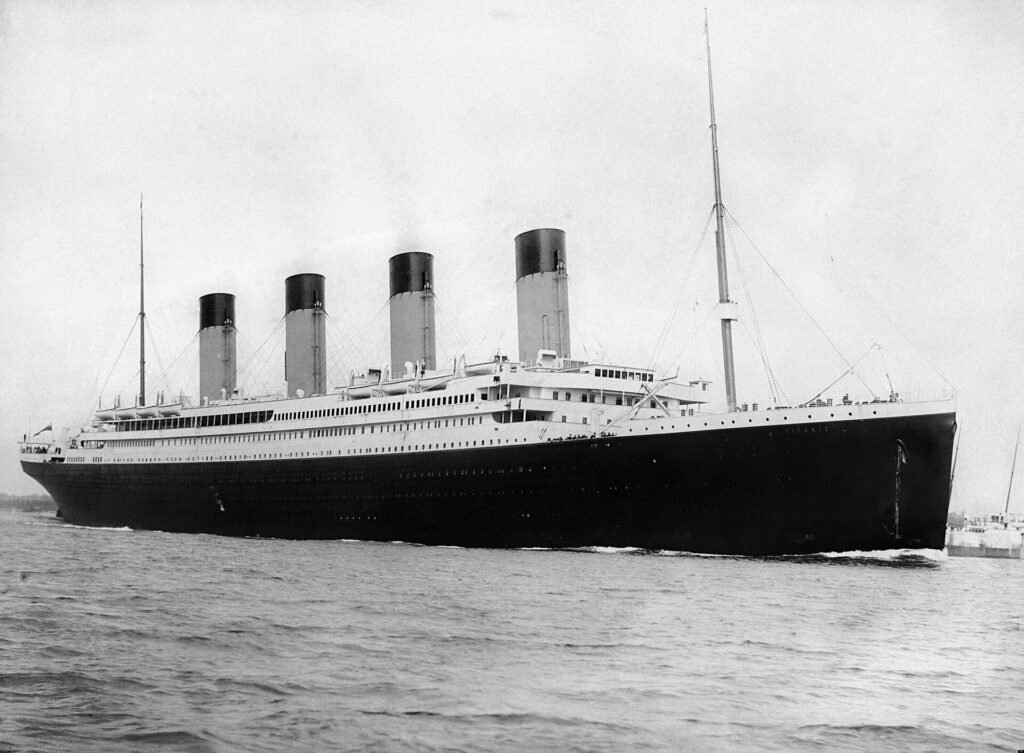
The sinking of the Titanic was a maritime disaster in the North Atlantic on 15 April 1912. The British passenger liner RMS Titanic struck an iceberg late on 14 April, on its maiden voyage from Southampton, England, to New York City, and sank in the early hours of the next morning. More than 1,500 people died, making it one of the deadliest peacetime sinkings in maritime shipping history.
Background to the sinking of the Titanic
The Titanic belonged to the White Star Line, a leading transatlantic shipping company that competed on size and elegance rather than speed alone. In 1907 the line’s managing director, J. Bruce Ismay, and Lord Pirrie, chairman of the shipbuilder Harland and Wolff, planned three large steamships: Olympic, Titanic and Britannic. Ismay chose the name Titanic to suggest overwhelming size and strength.
Designing the first two ships took a year. Construction of the Olympic began in December 1908, followed by the Titanic in March 1909. The Belfast yards had to be rebuilt to hold the ships, and the White Star pier in New York had to be lengthened. The steel hull was launched on 31 May 1911, and the ship was then fitted out with its facilities and decoration.
The National Oceanic and Atmospheric Administration (NOAA) describes the Titanic as the largest and most luxurious passenger ship of its time, reported to be unsinkable. The ship left Southampton on 10 April 1912. NOAA gives the number of people on board as 2,240, while the US National Archives gives 2,223, a small difference of the kind that appears in many accounts.
Course of the sinking
The crew spotted an iceberg at 11:40 p.m. on 14 April, and the ship sank at 2:20 a.m. on 15 April, less than three hours later. The US Senate inquiry asked why warnings of icebergs had been ignored. Claimants later argued that the crew had received wireless messages about ice yet the ship kept its speed and course, added no lookouts and gave the lookouts no binoculars. Ismay denied that the ship had been rushed, but other witnesses contradicted him.
The lack of lifeboat space was the main reason cited for the heavy loss of life. The Titanic carried more lifeboats than the regulations of the time required, yet there were still not enough places for most passengers and crew. The National Archives says that the highest share of victims came from third class, or steerage, passengers, who were mostly poor emigrants bound for the United States. The question of why first-class passengers reached lifeboats before others was raised in the investigations.
The liner Carpathia was the only ship to answer the distress signals, and it crossed a field of icebergs to reach the scene. Captain Arthur Rostron reached the first lifeboat at 4:10 a.m. and picked up the last at 8:30 a.m. The Carpathia’s manifest lists 706 survivors, although GovInfo says 703 were rescued. The ship brought them to New York on 18 April.
Aftermath of the sinking
Public reaction was strong. Dozens of letters reached President William Howard Taft from citizens who demanded an investigation or expressed sympathy for the death of his military aide, Major Archibald Butt, who had been returning from a vacation aboard the ship. Within days the US Senate began an inquiry. A Commerce subcommittee led by Senator William Alden Smith opened hearings on 19 April 1912. Over 17 days it heard 82 witnesses, including Ismay, and produced 1,042 pages of testimony. The Senate received its final report on 28 May 1912. Its criticism of unsafe practices led to changes in the shipping industry. Similar investigations were held in the United Kingdom.
Legislation followed. The inquiry led to new rules about the number of lifeboats and lifejackets on passenger ships. In 1914 the International Ice Patrol was formed, and a branch of the US Coast Guard that scouts for icebergs in the Atlantic is now supported by 13 nations. The international community also agreed the Convention for the Safety of Life at Sea, known as SOLAS, which NOAA describes as the most important of all agreements on the safety of merchant ships.
Survivors and the families of victims also sought compensation. Under an 1851 US law limiting the liability of shipowners, the White Star Line could have owed only about $91,805 in total, based on passenger fares, cargo payments and salvaged lifeboats. In October 1912 the company petitioned a New York court to limit its liability, claiming the collision was an unavoidable accident. Hundreds of claims worldwide, totaling $16,604,731.63, were filed against it. The American Red Cross raised $161,600.95 for relief, and a British fund raised $2,250,000.
Significance and legacy of the sinking
The Titanic became a lasting symbol of the limits of technology and a catalyst for safety reform. The disaster showed how confidence in new engineering could outrun safety planning, and the changes that followed on lifeboats, lifejackets and ice reporting became part of modern safety culture at sea. NOAA also notes that the search for ways to detect underwater hazards after the sinking contributed to the development of sonar.
The wreck was found on 1 September 1985 by a joint American and French expedition led by Robert Ballard of the Woods Hole Oceanographic Institution and Jean-Louis Michel of the French research institute IFREMER. It lies about 350 nautical miles off Newfoundland, about 12,500 feet (3,800 meters) below the surface. In July 1986 a plaque was placed on it asking that the wreck be left undisturbed.
The United States Congress passed the RMS Titanic Maritime Memorial Act, which President Reagan signed on 21 October 1986. The act called for the site to be recognized as an international maritime memorial and for guidelines on research and salvage. NOAA issued such guidelines in 2001. Some artifacts have been salvaged since 1987, but most of the ship remains where it sank. Memorials to those who died stand in Washington and New York, among other places.
More in Maritime and Rail Transport
Key facts
- The iceberg was spotted at 11:40 p.m. on 14 April 1912, and the ship sank at 2:20 a.m. on 15 April.2
- The National Archives gives 2,223 people aboard and 1,517 dead; NOAA gives 2,240 aboard and more than 1,500 dead.1
- The Carpathia rescued 706 survivors, or 703 according to GovInfo.1
- The US Senate subcommittee heard 82 witnesses over 17 days and reported on 28 May 1912.1
- The International Ice Patrol was formed in 1914 as a result of the disaster.1
- The wreck was found on 1 September 1985 about 350 nautical miles off Newfoundland, at about 12,500 feet.3
Related concepts
Quick checkWhy were there not enough lifeboats on the Titanic?Show answer
The ship carried more lifeboats than the regulations of the time required, but the rules were outdated and the boats could hold only part of those aboard, which investigators cited as a main cause of the loss of life.
Sources
- US National Archives, Prologue: They Said It Couldnt Sink (Spring 2012), https://www.archives.gov/publications/prologue/2012/spring/titanic.html
- GovInfo, Sinking of the R.M.S. Titanic, https://www.govinfo.gov/features/featured-content/sinking-of-titanic
- NOAA Office of General Counsel, R.M.S. Titanic: History and Significance, https://www.noaa.gov/office-of-general-counsel/gc-international-section/rms-titanic-history-and-significance
- Woods Hole Oceanographic Institution, History of RMS Titanic, https://www.whoi.edu/ocean-learning-hub/ocean-topics/ocean-human-lives/underwater-archaeology/rms-titanic/history-of-rms-titanic/
Editorially reviewed by Specialty Digest Editorial TeamLast reviewed November 4, 2026Researched and drafted with AI assistanceReport an issue