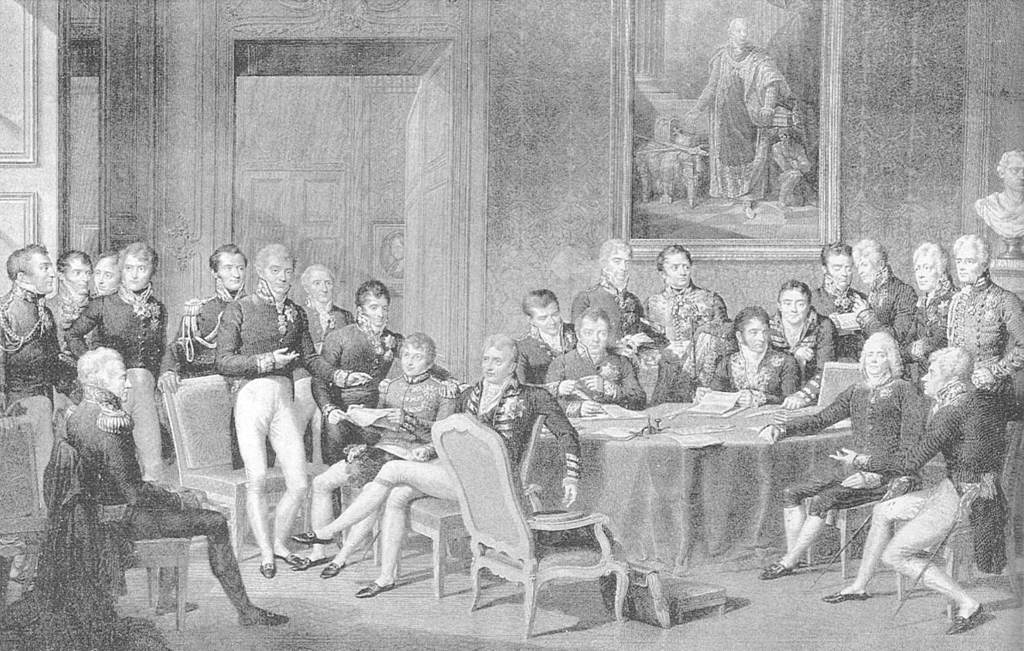
The Congress of Vienna was a diplomatic conference held in Vienna from September 1814 to June 1815 to settle the political order of Europe after the defeat of Napoleon Bonaparte. Its Final Act, signed on 9 June 1815, redrew borders, restored several ruling dynasties and set up a system of cooperation among the great powers that helped keep general peace in Europe for decades.
Background to the Congress of Vienna
Europe had just come through a twenty-year struggle with France and Napoleon. On 10 March 1814, a month before Napoleon’s defeat, the four powers signed the Treaty of Chaumont, agreeing to stay allied until victory and then to hold a general congress to secure the peace. The first Peace of Paris, signed on 30 May 1814 with the restored Bourbon monarchy of France, repeated the plan for a congress in Vienna, according to the EBSCO Research Starters entry written by Edward P. Keleher and Michael Witkoski.
The main figures were Czar Alexander I of Russia, the Prussian chancellor Karl von Hardenberg, the Austrian foreign minister Klemens von Metternich, the British foreign secretary Viscount Castlereagh and the French foreign minister Talleyrand. Metternich played a vital role in the process, as UNESCO’s description of the Final Act also notes.
Course of events
Informal discussions began on 15 September 1814. Even though many rulers and diplomats came to Vienna, the congress remained almost entirely a meeting of the great powers. EBSCO notes that smaller states were summoned only to discuss matters that concerned them, and that a plenary session of all the powers involved in the Napoleonic Wars was never held.
The hardest dispute concerned Poland and Saxony. Alexander I wanted to recreate a Polish state under Russian control, and Prussia was ready to give up its Polish lands if Russia would support its claim to the whole of Saxony. Metternich and Castlereagh saw both demands as threats to the balance of power, since Russia would move deeper into central Europe than ever before.
The EBSCO entry adds that Metternich, the leading figure in the talks, was for some weeks distracted in autumn 1814 by a troubled relationship with Wilhelmine, duchess of Sagan, and that rival ministers such as Hardenberg and Talleyrand noticed. Such personal detail shows how much of the congress depended on a small circle of statesmen.
The quarrel among the victors gave France an opening. In December 1814 Talleyrand proposed a compromise: a smaller Poland for Russia and a smaller Saxony, with some Rhineland territory, for Prussia. Austria and Britain formed an alliance against the Russian and Prussian position on 3 January 1815, though it never mobilized. Russia and Prussia accepted a compromise based on Talleyrand’s idea, and on 11 February 1815 Poland was divided among Austria, Prussia and Russia. Prussia received two-fifths of Saxony plus territory in the Rhineland and Westphalia.
Napoleon’s return to power in March 1815, a period known as the Hundred Days, did not stop the negotiations. The allies and the smaller powers met on 9 June to sign the Final Act.
The settlement
UNESCO notes that the Final Act contains more than one hundred articles, and eight signatory powers received copies: Austria, France, Great Britain, Portugal, Prussia, Russia, Spain and Sweden. EBSCO groups most of its provisions under three principles: legitimacy, security and compensation.
Legitimacy meant restoring deposed dynasties, including the House of Orange in Holland and Bourbon rulers in France, Spain and the Two Sicilies. Security meant strengthening the states around France. Holland received the former Austrian Netherlands, Prussia gained territory in the Rhineland and Westphalia, and Switzerland was permanently neutralized and given three more cantons. Compensation covered territorial gains: Russia obtained Finland from Sweden, Sweden received Norway from Denmark, Britain gained Malta, Ceylon, the Cape of Good Hope and Dutch Guiana, and Austria obtained Lombardy, Venetia, Salzburg, the Tyrol and part of the Dalmatian coast.
The old Holy Roman Empire had ended in 1806. In its place the allies created a German Confederation of some thirty-nine states under Austrian leadership, whose Diet consisted of diplomats speaking for rulers, not elected representatives. UNESCO adds that the Congress also dealt with international shipping, the abolition of slavery and Swiss neutrality.
Aftermath
To protect the settlement, Austria, Britain, Russia and Prussia signed the Quadruple Alliance later in 1815, forming what became the Concert of Europe, and France joined in 1818. EBSCO says the powers held periodic conferences, several of them between 1818 and 1822, to deal with liberal and nationalist challenges in Greece, Spain and the Italian states.
The arrangements restored a conservative order. Over time, the same challenges tested the balance of power, and EBSCO concludes that they brought about the end of the Vienna settlement and the Concert of Europe in the long run.
Significance and legacy
UNESCO says the Congress redefined the map of Europe and established a stable balance between the major powers that shaped the continent for more than half a century. The Final Act’s Austrian copy is held in the Austrian State Archives, bound in red velvet with gold seals for each of the eight signing powers, and UNESCO added it to its Memory of the World Register in 1997.
Historians continue to debate the settlement. EBSCO says the settlement ushered in nearly a century of general peace on the Continent, while UNESCO speaks of more than fifty years, so published estimates of how long it held differ. The arrangements were meant to preserve a conservative order, and over time they were challenged by liberal and nationalist movements. The congress also followed the upheaval that began with the French Revolution, and it remains a central example of diplomacy among many states at once. A century later, the Treaty of Versailles settled Europe after World War I.
Key facts
- The congress met in Vienna from September 1814 to June 1815 after the defeat of Napoleon.2
- Its Final Act was signed on 9 June 1815 and has more than one hundred articles.1
- Eight powers signed the Final Act: Austria, France, Great Britain, Portugal, Prussia, Russia, Spain and Sweden.1
- The settlement created a German Confederation of about thirty-nine states under Austrian leadership.2
- The great powers formed the Concert of Europe to uphold the settlement through periodic conferences.2
- UNESCO inscribed the Final Act on its Memory of the World Register in 1997.1
Related concepts
Quick checkWhich principles guided the Congress of Vienna?Show answer
Legitimacy, security and compensation: restoring deposed dynasties, strengthening the states around France, and giving the victorious powers territorial gains.
Sources
- UNESCO Memory of the World in Austria, Final Document of the Congress of Vienna 1815, https://www.unesco.at/en/communication/documentary-heritage/memory-of-the-world-in-austria/final-document-of-the-congress-of-vienna-1815
- EBSCO Research Starters, Congress of Vienna (Edward P. Keleher and Michael Witkoski, 2023), https://www.ebsco.com/research-starters/history/congress-vienna
Editorially reviewed by Specialty Digest Editorial TeamLast reviewed November 4, 2026Researched and drafted with AI assistanceReport an issue