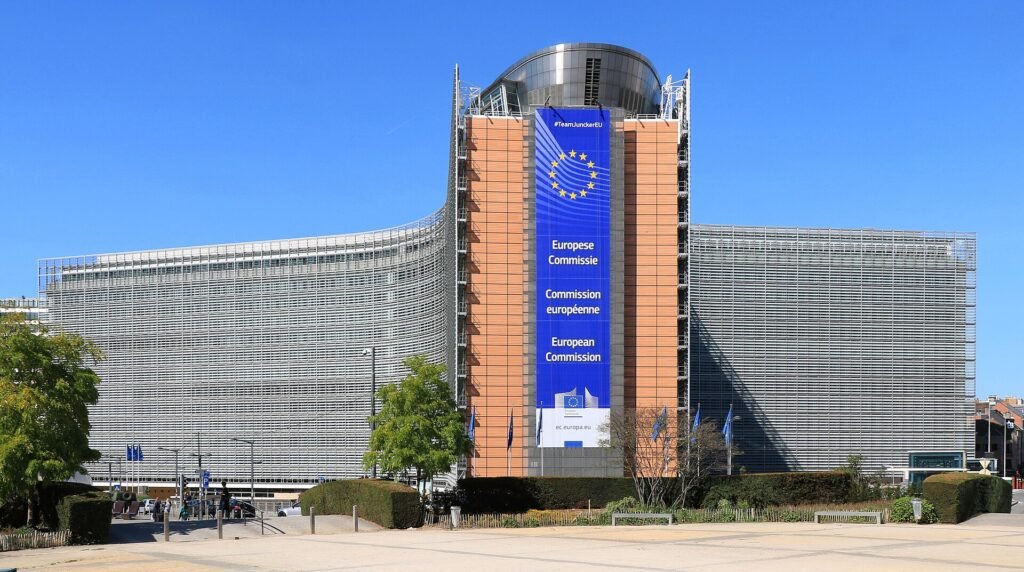
The European Union, or EU, is a political and economic union of 27 European countries that share common institutions, a single market and, for many members, a common currency. It grew out of the European Coal and Steel Community of 1951 and was formally created by the Maastricht Treaty, signed on 7 February 1992. Its stated aims include peace, the well-being of its citizens and free movement within its borders.
History of the European Union
The EU began as an effort to prevent another war in Europe after World War II. On 9 May 1950, French Foreign Minister Robert Schuman proposed placing the coal and steel industries of Western Europe under joint management, so that no single country could make the weapons to turn against the others. The treaty was signed on 18 April 1951 by Germany, France, Italy, the Netherlands, Belgium and Luxembourg, and the European Coal and Steel Community started work in 1952. The Treaties of Rome, signed on 25 March 1957, then set up the European Economic Community. The same period saw the Cold War emerge and divide the continent for more than 40 years.
Membership expanded in stages. Denmark, Ireland and the United Kingdom joined in 1973, Greece in 1981, and Austria, Finland and Sweden in 1995. Ten countries joined in 2004, ending the split between eastern and western Europe, and Bulgaria and Romania followed in 2007. Croatia joined in 2013, which briefly brought the total to 28 before the United Kingdom left in 2020.
Major treaties reshaped the system. The Maastricht Treaty entered into force on 1 November 1993 and set rules for a single currency and for foreign and security policy. The single market, with its four freedoms of movement for people, goods, services and money, launched on 1 January 1993. Euro notes and coins became legal tender in 12 countries on 1 January 2002, and the Treaty of Lisbon later modernized the institutions and working methods.
Later steps deepened the project. The agreement creating the European Economic Area took effect on 1 January 1994 and extended the single market beyond the Union’s own members. The Schengen agreement, named after a small village in Luxembourg, gradually allowed people to travel across large parts of the EU without passport checks, and the Erasmus student exchange programme began in the 1980s.
Structure and membership
The EU has seven institutions, nine bodies and more than 30 decentralized agencies. The institutions include the European Parliament, the European Council, the Council of the EU and the European Commission. Voters elect Members of the European Parliament every five years.
As of 2026, the EU has 27 member states, nine candidate countries and one potential candidate. Germany has the largest population and France is the largest by area, while Malta is the smallest on both counts. Membership of the euro area and the Schengen area, which allows travel without passport checks, differs by country. Croatia joined both in 2023, Bulgaria joined Schengen in 2024 and the euro area in 2026, while Ireland, a member since 1973, remains outside Schengen.
What the EU does
The Treaty of Lisbon sets out the EU’s aims in Article 3. Inside the Union they include promoting peace and the well-being of citizens, offering freedom, security and justice without internal borders, building an internal market, pursuing sustainable development and protecting the environment. They also include combating social exclusion and discrimination, promoting gender equality, respecting cultural and linguistic diversity and establishing an economic and monetary union whose currency is the euro. Abroad, the aims include contributing to peace, free and fair trade, the eradication of poverty and the protection of human rights.
The EU states that it is founded on values such as human dignity, freedom and democracy. In practice, the clearest everyday effects come from the single market and the freedom of movement it provides, and from policies on trade, the environment, research and regional support. The EU also responds to emergencies. In 2020 it agreed the largest stimulus package ever financed from the EU budget, with a focus on a green and digital recovery as it works toward climate neutrality by 2050. After Russia invaded Ukraine in February 2022, it adopted sanctions against Russia and provided financial, humanitarian and military help to Ukraine.
Funding and the EU budget
The European Commission describes the current long-term EU budget, known as the Multiannual Financial Framework, together with the NextGenerationEU recovery instrument, as the base for the recovery plan for Europe. The framework covers 2021 to 2027, and the Commission publishes allocations per member state and data on spending and revenue. A rule of law conditionality regulation links access to funds to respect for the rule of law, and the Commission is also working on new own resources, which are revenue sources meant to match the Union’s ambitions.
Challenges and criticism
The most visible test was the United Kingdom’s departure. After 47 years of membership, the UK left the EU on 31 January 2020, which the EU described as opening a new chapter in the relationship. The Union has also faced a global financial crisis in 2008, the Covid-19 pandemic and war on its eastern border, each of which led to changes in how it coordinates policy.
Enlargement is another continuing issue. With nine candidate countries and one potential candidate waiting, the question of how far the Union can grow while keeping its decision-making workable is still open. Debate over the balance of power between national governments and EU institutions is a recurring theme in member countries as well.
Legacy and impact
From six founding countries running coal and steel together, the EU has become a union of 27 with a single market and shared institutions. Its history is a case study in how sovereignty can be pooled in specific fields while states remain independent.
More in International Relations
Key facts
- The EU has 27 member states, nine candidate countries and one potential candidate.4
- Its roots are the European Coal and Steel Community, set up by a treaty signed on 18 April 1951.1
- The Maastricht Treaty, signed on 7 February 1992, formally created the European Union and took effect on 1 November 1993.2
- Euro notes and coins became legal tender in 12 countries on 1 January 2002.3
- The United Kingdom left the EU on 31 January 2020 after 47 years of membership.5
Related concepts
In the news
- BusinessHelium in 2025: USGS Shows the U.S. Supplies 43 Percent of World Output
- NatureSeptember 2026 Was the Second-Warmest September on Record, Copernicus Reports
- NatureMethane From Energy: What the IEA Global Methane Tracker 2026 Shows
- NatureCO2 Emissions: What the Global Carbon Budget 2025 Shows
- BusinessWhy Are Central Banks Independent From Governments?
Quick checkWhen did the single market begin?Show answer
The single market, with free movement of people, goods, services and money, was launched on 1 January 1993.
Sources
- European Union, History of the EU 1945-59, https://european-union.europa.eu/principles-countries-history/history-eu/1945-59_en
- European Union, History of the EU 1990-99, https://european-union.europa.eu/principles-countries-history/history-eu/1990-99_en
- European Union, History of the EU 2000-09, https://european-union.europa.eu/principles-countries-history/history-eu/2000-09_en
- European Union, Facts and figures on the European Union, https://european-union.europa.eu/principles-countries-history/facts-and-figures-european-union_en
- European Union, History of the EU 2020 to today, https://european-union.europa.eu/principles-countries-history/history-eu/2020-today_en
- European Union, EU countries, https://european-union.europa.eu/principles-countries-history/eu-countries_en
- European Union, Aims and values, https://european-union.europa.eu/principles-countries-history/principles-and-values/aims-and-values_en
- European Commission, 2021-2027 long-term EU budget and NextGenerationEU, https://commission.europa.eu/strategy-and-policy/eu-budget/long-term-eu-budget/2021-2027_en
Editorially reviewed by Specialty Digest Editorial TeamLast reviewed November 4, 2026Researched and drafted with AI assistanceReport an issue