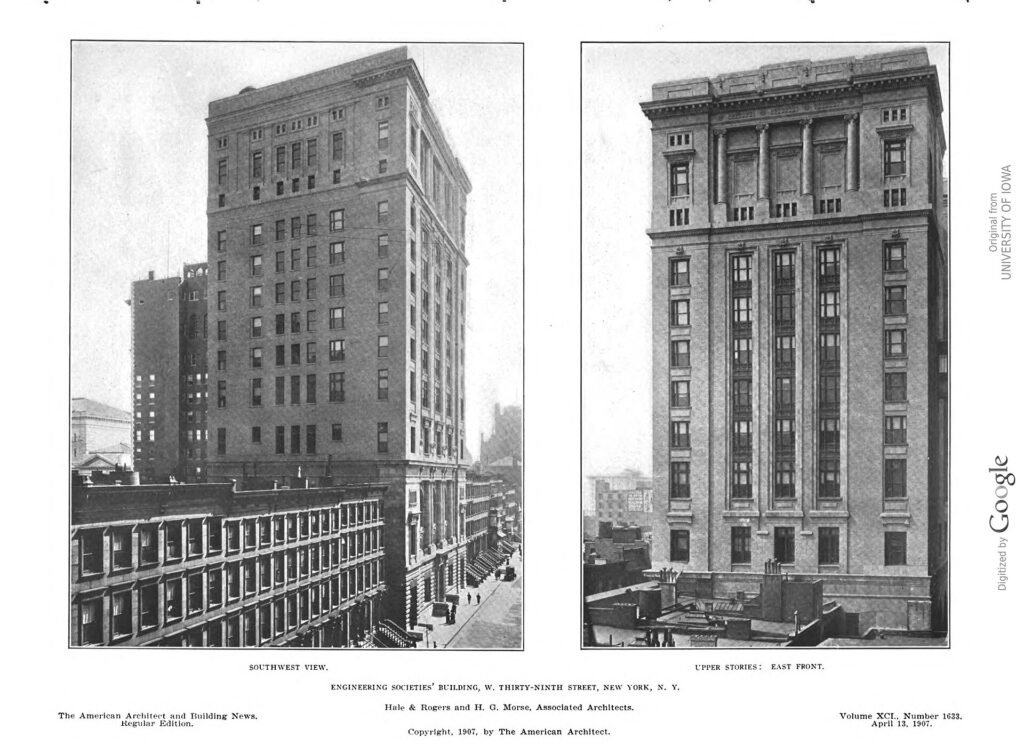
The Institute of Electrical and Electronics Engineers (IEEE) is a professional association of engineers and scientists working in electrical engineering, electronics, computing and related fields. It was formed on 1 January 1963 by the merger of the American Institute of Electrical Engineers, founded in 1884, and the Institute of Radio Engineers, founded in 1912.
History of IEEE
IEEE traces its roots to the spring of 1884, when a small group of people from the electrical professions met in New York and formed the American Institute of Electrical Engineers (AIEE). That October the AIEE held its first technical meeting in Philadelphia. Its founding president, Norvin Green of Western Union, came from the telegraph industry. Thomas Edison represented electric power, and Alexander Graham Bell represented the newer telephone industry. The AIEE gave its first Edison Medal in 1909, to Elihu Thomson.
Through technical meetings, publications and the promotion of standards, the AIEE led the growth of the electrical engineering profession, and its local sections and student branches brought those benefits to engineers in widespread places. In 1912 it also began a Fellows program to recognize outstanding members.
The Institute of Radio Engineers (IRE) arrived in 1912. It was modeled on the AIEE but devoted to wireless, which became radio, and then increasingly to electronics. The IRE grew quickly. Its membership rose from about 6,000 in 1940 to 17,000 in 1945 and 21,000 in 1950, and in 1948 it adopted a decentralized professional-group structure that let it take in new fields such as computers and information theory. By 1957 the IRE was the larger society, and both groups had more than 50,000 members.
Through the 1950s the two societies grew closer. They held joint meetings, developed a joint membership policy, merged student chapters and cooperated on standards. The IRE passed the older society in student members in 1956, and IRE members had formed sections in countries including Japan, Italy, Israel and Colombia.
A joint committee agreed on a set of Principles of Consolidation in 1962, and the boards and members of both societies approved them. On 1 January 1963 the new IEEE began with 150,000 members, 140,000 of them in the United States. Legally the AIEE was the surviving institution under a new name. The merged group was headquartered in the United Engineering Center in New York City until 1998.
Structure and membership
IEEE’s history wiki describes it as the world’s largest technical professional society. That page is undated, but it reports more than 425,000 members, including over 100,000 students, and notes that IEEE had 380,000 members in 160 countries by 2009, with 44.5 percent outside the United States.
The association is organized in two ways, by geography and by technical interest. It has 333 local sections in 10 geographic regions and about 2,200 chapters of members with similar interests. On the technical side it has 39 societies and seven technical councils grouped into 10 divisions. It also lists more than 2,350 student branches in 80 countries and about 900 employees.
Voting members elect a president each year. The president serves three years, first as president-elect, then as president and chief executive, and finally as past president. Presidents also sit on the IEEE Board of Directors and the IEEE Assembly. Six subordinate boards under the Board of Directors oversee education, the United States activities, member and geographic activities, publications, standards and technical activities.
Publications, conferences and standards
IEEE’s history wiki says that by the early twenty-first century the association served members with 38 societies, 130 journals, transactions and magazines, more than 300 conferences each year and 900 active standards. Britannica notes that it publishes journals such as the monthly Journal of Quantum Electronics.
The IEEE Standards Association is the part of IEEE that builds consensus on technical standards. It says it brings together a broad range of individuals and organizations, with collaborators in more than 160 countries, and that its Board of Governors directs policy and financial oversight for standards activities.
IEEE 802: Ethernet and Wi-Fi
The best-known standards come from the IEEE 802 LAN/MAN Standards Committee, which develops and maintains standards for local, metropolitan and other area networks. Its most widely used standards cover Ethernet, bridging, wireless local area networks, wireless personal area networks and wireless metropolitan area networks, and each area has its own working group.
The committee’s working groups include 802.1 for higher layer LAN protocols, 802.3 for Ethernet, 802.11 for wireless LANs, 802.15 for wireless specialty networks and 802.19 for wireless coexistence. The full committee meets in plenary and interim sessions several times a year, and its November 2026 plenary is scheduled for Bangkok.
The 802.11 working group produced the standard behind Wi-Fi. IEEE 802.11 was published in 1997 and allowed wireless data transmission at up to 2 megabits per second in the unlicensed 2.4 gigahertz band. Its commercial breakthrough came in 1999, when Apple introduced consumer products with Wi-Fi, helped by the 802.11b amendment, which raised theoretical speeds to 11 megabits per second.
The Wi-Fi Alliance later developed the Wi-Fi number naming convention to help the public tell versions apart, while IEEE kept the 802.11 labels. The working group is still active. In 2026 its task group for ultra high reliability, informally called Wi-Fi 8, passed a working group ballot of its second draft and received more than 8,000 comments.
Legacy and impact
By IEEE’s own account, the standards in the 802.11 family have helped bring about inexpensive internet access globally, with billions of Wi-Fi devices in use. The association has also adapted its scope over time. Its history wiki says the fields it covers now extend well beyond electrical engineering and computing into areas such as nanotechnology, robotics, bioengineering and electronic materials. The IEEE Standards Association adds that standards work behind the scenes in many areas of life, helping new technologies operate safely, securely and sustainably.
More in Electrical Engineering
Key facts
- IEEE was formed on 1 January 1963 by the merger of the AIEE (1884) and the IRE (1912).1
- At its formation IEEE had 150,000 members, 140,000 of them in the United States.2
- IEEE's history wiki reports more than 425,000 members, 333 local sections in 10 regions and 39 societies.1
- The IEEE 802.11 standard was published in 1997 and supports up to 2 Mbit/s in the 2.4 GHz band.5
- The IEEE 802 committee develops standards for Ethernet and wireless networks, among others.6
- The IEEE president serves three years in turn as president-elect, president and past president.1
- IEEE Standards Association collaborators work in more than 160 countries.4
In the news
Quick checkWhat does IEEE stand for and how did it form?Show answer
IEEE stands for the Institute of Electrical and Electronics Engineers. It was formed on 1 January 1963 by the merger of the American Institute of Electrical Engineers, founded in 1884, and the Institute of Radio Engineers, founded in 1912.
Sources
- Engineering and Technology History Wiki, IEEE History, https://ethw.org/IEEE_History
- Engineering and Technology History Wiki, Formation of IEEE by the Merger of AIEE and IRE, https://ethw.org/Formation_of_IEEE_by_the_Merger_of_AIEE_and_IRE
- Encyclopaedia Britannica, Institute of Electrical and Electronics Engineers (IEEE), https://www.britannica.com/topic/Institute-of-Electrical-and-Electronics-Engineers
- IEEE Standards Association, About Us, https://standards.ieee.org/about/
- IEEE Standards Association, The Evolution of Wi-Fi Technology and Standards (16 May 2023), https://standards.ieee.org/beyond-standards/the-evolution-of-wi-fi-technology-and-standards/
- IEEE 802 LAN/MAN Standards Committee, https://www.ieee802.org/
- IEEE 802.11 Working Group, https://www.ieee802.org/11/
Editorially reviewed by Specialty Digest Editorial TeamLast reviewed November 4, 2026Researched and drafted with AI assistanceReport an issue