The telegraph is a system for sending coded messages over long distances. The electric telegraph, which sends signals along wires, opened its first public lines in Great Britain in 1837 and the United States in 1844. It was the first technology to separate communication from transportation, and it was the only form of electrical communication until the invention of the telephone in 1876. No single person invented it.
History of the telegraph
The first long-distance systems did not use electricity. The five Chappe brothers in France developed an optical, or semaphore, telegraph and demonstrated it publicly in 1791. Wooden arms mounted on towers spelled out letters and numbers, and operators in nearby towers, about 10 kilometers apart, read the signals through telescopes.
The French government adopted the Chappe system, and the first line, connecting Paris to Lille, began operating in 1794. A message could cross about 230 kilometers in as little as 30 minutes. At its height the French network spanned nearly 5,000 kilometers, and it remained in use until the electric telegraph replaced it in 1853. Sweden, Russia and Great Britain built semaphore networks of their own.
Semaphore telegraphs were costly to run, needed two or three operators at each station and could not work at night or in bad weather. Researchers in several countries began to ask whether electricity could do the job better.
The electric telegraph grew out of electrical science between about 1800 and 1840, which included Alessandro Volta’s battery and the research on electromagnetism by Hans Christian Ørsted, André-Marie Ampère, Joseph Henry and Michael Faraday.
Inventor and origins of the telegraph
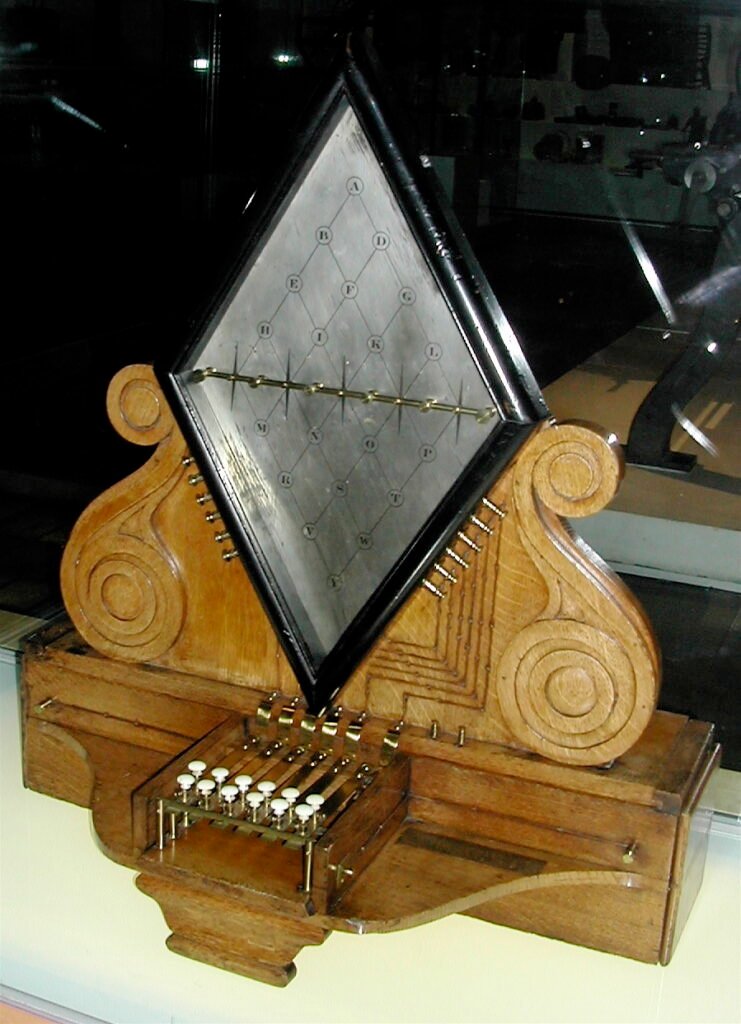
The telegraph had several independent inventors. In Britain, William Fothergill Cooke developed a telegraph in the mid-1830s that used an electric current to deflect magnetized needles to indicate letters. Charles Wheatstone had been experimenting with long-distance transmission of electricity. They joined forces in February 1837 and in June obtained a patent for a five-needle telegraph.
Their first commercial line was built in 1838 and 1839. In late 1842 Cooke patented an improved version with two needles instead of five, which halved the cost of construction and installation.
Across the Atlantic, Samuel Morse, a painter and professor of fine arts, became obsessed with the idea in 1832 during a sea voyage after a fellow passenger remarked that electricity can pass almost instantly along any length of wire. He developed a system of dots, dashes and spaces that became known as Morse code, applied for a patent in 1837 and demonstrated his recording telegraph to scientists and officials in 1837 and 1838.
The Engineering and Technology History Wiki (ETHW) describes the Cooke and Wheatstone telegraph as one of the first practical telegraphs. Morse is credited with the code and system that spread in North America. Both rest on earlier science, so the telegraph is better seen as a shared invention than the work of one person.
How the telegraph works
An electric telegraph has a sender, a wire and a receiver. The operator uses a key to break and complete an electric circuit, and the current travels along the wire to the receiving station, where it moves a needle, makes a mark or operates a clicking device.
In the Cooke and Wheatstone system the current deflected magnetized needles at the receiver to point at letters. In the Morse system the operator tapped out a code of short and long signals. Morse’s early receiver used electromagnets to emboss marks on a moving strip of paper, and operators soon learned to read messages by sound, from the clicks of the receiving magnet.
Types of telegraph
The main variants were the optical telegraph, the needle telegraph and the recording or sounding telegraph that used Morse code. Later models in Britain and elsewhere printed or recorded messages mechanically.
Submarine telegraphy carried messages under water through insulated cables. It had its own engineering problems, which, according to ETHW, stimulated major advances in physics, oceanography, marine engineering and electrical engineering.
Impact of the telegraph
In 1843 the US Congress gave Morse $30,000 to build an experimental line between Washington and Baltimore. It began operating in May 1844, and the first official message was What hath God wrought. By 1850 lines reached every important point east of the Mississippi River, and by 1861 a transcontinental line reached California.
The telegraph was one of the first technologies with a firm scientific foundation, and telegraph electricians helped establish electrical engineering as a discipline. It also changed society. ETHW says it helped create integrated national and international markets, sped the spread of news and led governments to develop telecommunications policy.
Like the printing press centuries earlier, the telegraph changed how quickly information could reach large numbers of people, but it did so across whole continents and in minutes rather than weeks.
In Britain the government bought the private telegraph lines in 1868, and the Post Office began operating them in 1870. British telegraph traffic peaked at some 90 million messages around 1900.
Decline of the telegraph and its legacy
At the turn of the twentieth century the telegraph was at its commercial peak, and it remained the mainstay of rapid long-distance communication until practical long-distance telephony developed after 1900.
Telegraphy lost ground to the telephone and the letter post. Its heyday in Britain was over by 1920, and ETHW says the overland telegraph industry in industrialized countries was dead or dying by 1970.
Submarine telegraphy lasted longer. It was the only medium for rapid overseas communication until transatlantic radiotelephony arrived in 1927, and it stayed the cheapest option until undersea telephone cables were installed in the 1950s. After 1980 facsimile and electronic mail took over the telegraph’s role in long-distance record communication.
Wireless telegraphy, which sent Morse code through the air, carried the idea forward in radio.
ETHW also observes that the older semaphore systems already contained elements that electrical telegraph networks later adopted, including an alphabetic code, a corps of trained operators and, outside the United States, control by national governments.
Key facts
- The Chappe brothers demonstrated an optical telegraph in 1791, and the first line, from Paris to Lille, began operating in 1794.1
- William Cooke and Charles Wheatstone obtained a British patent for an electromagnetic telegraph in June 1837.1
- Samuel Morse patented his telegraph in 1837, and the Washington to Baltimore line began operating in May 1844.1
- The first two telegraph lines opened in Great Britain in 1837 and the United States in 1844.1
- The telegraph was the only form of electrical communication until the telephone was invented in 1876.1
Related concepts
In the news
Quick checkWho invented the telegraph?Show answer
No single person did. The French Chappe brothers built an optical telegraph in the 1790s, William Cooke and Charles Wheatstone patented an electrical needle telegraph in Britain in 1837, and Samuel Morse developed his own electrical system and code in the United States, with a first line in 1844.
Sources
- Engineering and Technology History Wiki, Telegraph, https://ethw.org/Telegraph
- Engineering and Technology History Wiki, Samuel Morse, https://ethw.org/Samuel_Morse
- Engineering and Technology History Wiki, Charles Wheatstone, https://ethw.org/Charles_Wheatstone
Editorially reviewed by Specialty Digest Editorial TeamLast reviewed November 4, 2026Researched and drafted with AI assistanceReport an issue