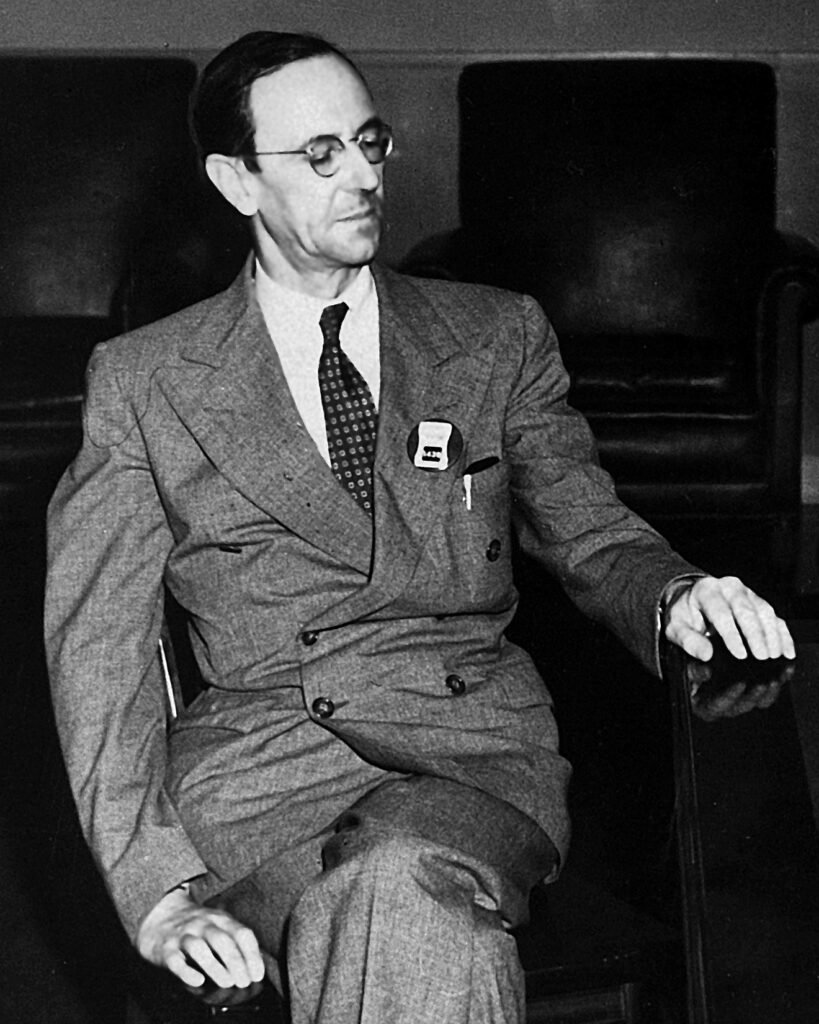
The discovery of the neutron was the demonstration, by the British physicist James Chadwick in February 1932, that the atomic nucleus contains an electrically neutral particle with about the same mass as a proton. It completed the basic picture of what nuclei are made of and gave scientists a powerful new tool for probing and splitting atoms.
Background to the discovery of the neutron
By the early 1920s physicists knew that atoms have a small, dense, positively charged core, a finding described in the entry on the discovery of the atomic nucleus. In 1919 Ernest Rutherford showed that bombarding nitrogen with alpha particles knocks out free protons, which suggested that nuclei have an internal structure.
The numbers did not add up, however. The mass of an atom was consistently greater than the mass of its protons alone, and the difference could not be due to electrons, which weigh far too little. Rutherford hypothesized that the nucleus also holds a particle with mass but no charge. At the time, the prevailing model said the nucleus contained only protons and electrons, and that model fit poorly with ideas such as nuclear spin, which physicists had proposed by 1925 to explain how atomic energy levels shift in a magnetic field.
James Chadwick, born in 1891, studied at Victoria University in Manchester and worked early on with Rutherford. He had gone to Berlin to study beta radiation under Hans Geiger, and when the First World War broke out he was caught there and interned in a German prison camp. Conditions were harsh, but he and a few other scientists were allowed to set up a crude laboratory in an abandoned barracks, trading for chemicals and building equipment from whatever was at hand. After the war he followed Rutherford to the Cavendish Laboratory in Cambridge and earned his doctorate in 1921.
The discovery
The first clue came from Germany. In 1930 Herbert Becker and Walter Bothe directed alpha particles at beryllium and found that it emitted a strong, penetrating radiation. One hypothesis was that this was high-energy electromagnetic radiation. Rutherford, for his part, had proposed years earlier that a particle of the kind Chadwick was looking for might exist inside atomic nuclei.
Chadwick repeated a German experiment in which alpha particles from polonium struck a beryllium target. The unusual radiation it produced looked like evidence for a new kind of chargeless particle, and that possibility was too important to leave unchecked. Encouraged, Chadwick devoted all of his energy to further experiments, often working through the night, and his efforts paid off within weeks.
In February 1932 he submitted a letter to the journal Nature setting out his results as evidence for the existence of a neutron. In May he followed it with a longer paper giving the technical details. According to the Nobel Foundation, he proved that the radiation consisted of a neutral particle with about the same mass as a proton, and once its existence was established the particle was called the neutron.
How the neutron was confirmed
The result was quickly championed by Niels Bohr and Werner Heisenberg. Chadwick worked with the physicist Maurice Goldhaber to measure the neutron’s mass, and the two concluded that the neutron is a genuine nuclear particle and not a tightly bound pair of a proton and an electron.
Heisenberg proposed in 1932 that the nucleus is made of protons and neutrons, which together are called nucleons. This picture replaced the older proton-electron model and resolved the puzzles over mass and spin. It also made clear why isotopes of an element, which have the same number of protons but different numbers of neutrons, differ in mass. The entry on the isotope explains the idea in more detail.
Impact and legacy of the discovery
Chadwick’s neutron became an ideal projectile for studying nuclei. Because it has no electric charge, it is not repelled by the positive charge of a nucleus and can penetrate it. The American Physical Society notes that the discovery made it possible to create elements heavier than uranium in the laboratory through the capture of slow neutrons followed by beta decay.
In 1934 Enrico Fermi bombarded uranium with neutrons, and Otto Hahn, Fritz Strassmann and Lise Meitner took up similar experiments in Berlin. The Nobel Foundation describes the neutron as a powerful new tool for investigating atoms. When Hahn and Strassmann irradiated uranium with neutrons they created barium, which is far too light to be a decay product of uranium, and Meitner and her nephew Otto Frisch showed that the uranium nucleus had been split. This line of research ended in the discovery of nuclear fission, and fission chain reactions are the basis of the nuclear reactor and of nuclear power.
Chadwick received the 1935 Nobel Prize in Physics for the discovery of the neutron and gave his Nobel lecture, titled The Neutron and Its Properties, on 12 December 1935. By then he had moved to the University of Liverpool, where he used part of his prize money to help finance a cyclotron, a particle accelerator, which was running by July 1939. He was among the scientists who witnessed the Trinity test on 16 July 1945, an event that his discovery had helped make possible.
Later developments
The neutron is no longer treated as a fundamental building block. Experiments at the Stanford Linear Accelerator Center in the late 1960s found that protons and neutrons have an inner structure of smaller point-like constituents, which were later interpreted as quarks. This is covered in the entry on the discovery of quarks.
When the Second World War began in 1939, Chadwick was on holiday in Sweden with his family. Unlike in 1914, he returned to England at once and lent his expertise to the war effort.
More in Physics
Key facts
- James Chadwick submitted a letter to Nature in February 1932 giving evidence for the neutron.1
- The neutron is a neutral particle with about the same mass as a proton.2
- Chadwick received the 1935 Nobel Prize in Physics for the discovery of the neutron.2
- Werner Heisenberg proposed in 1932 that nuclei consist of protons and neutrons, together called nucleons.3
Related concepts
Quick checkWho discovered the neutron?Show answer
James Chadwick discovered the neutron in 1932 at the Cavendish Laboratory in Cambridge by showing that the strange radiation from beryllium was a stream of neutral particles with about the mass of a proton.
Sources
- American Physical Society, This Month in Physics History: February 1932, James Chadwick's Letter to Nature on the Neutron, https://www.aps.org/apsnews/2014/02/this-month-in-physics-history
- Nobel Prize Outreach, James Chadwick: Facts (Nobel Prize in Physics 1935), https://www.nobelprize.org/prizes/physics/1935/chadwick/facts/
- Nobel Prize Outreach, The Nobel Prize in Physics 1990: Illustrated presentation (history of particles), https://www.nobelprize.org/prizes/physics/1990/9592-the-nobel-prize-in-physics-1990/
- Nobel Prize Outreach, Otto Hahn: Facts (Nobel Prize in Chemistry 1944), https://www.nobelprize.org/prizes/chemistry/1944/hahn/facts/
Editorially reviewed by Specialty Digest Editorial TeamLast reviewed November 5, 2026Researched and drafted with AI assistanceReport an issue