The discovery of germ theory was the 19th-century recognition that specific microorganisms cause specific infectious diseases. It grew from the work of Ignaz Semmelweis, John Snow, Louis Pasteur and Robert Koch, and it replaced the older belief that disease arose from bad air.
Background
For most of history the dominant explanation was miasma theory, the belief that diseases were caused by “bad air” rising from decaying matter. The theory was widely accepted among physicians in the mid-1800s.
A few thinkers proposed alternatives. In 1840 the anatomist Jacob Henle published the view that infectious diseases are caused by living, parasitic organisms. Another obstacle was the idea of spontaneous generation, the belief that life could arise from non-living matter through a vital force. Pasteur’s experiments later helped to disprove it.
The discovery
Semmelweis and hand hygiene
Semmelweis graduated in 1844 from the University of Pest and turned to obstetrics. He became an assistant at the Vienna General Hospital on 1 July 1846, at the age of 28. Two obstetric clinics there there had very different death rates from childbed fever. Before he acted, about 11.4 percent of mothers in the first clinic died, compared with 2.7 percent in the second.
In mid-May 1847 he introduced hand washing with chlorine. The death rate in the first clinic fell to around 5 percent that year and to 1.3 percent in 1848. A 2025 review describes this as an early trial-like comparison of hand hygiene.
Snow and cholera
John Snow investigated the 1854 Broad Street cholera outbreak in London. He proposed that cholera was waterborne, at a time when miasma theory prevailed, and he mapped the locations of cases to show a pattern centered on one source. The idea was met with skepticism at first, because miasma theory was so widely accepted among physicians. His method is a founding example of epidemiology.
Pasteur and fermentation
Pasteur showed in the 1850s that microorganisms drive fermentation and spoilage. His 1857 paper on lactic fermentation was an early landmark. His results undermined spontaneous generation and led to pasteurization, a heating process that kills harmful microbes in food and drink.
Koch and anthrax
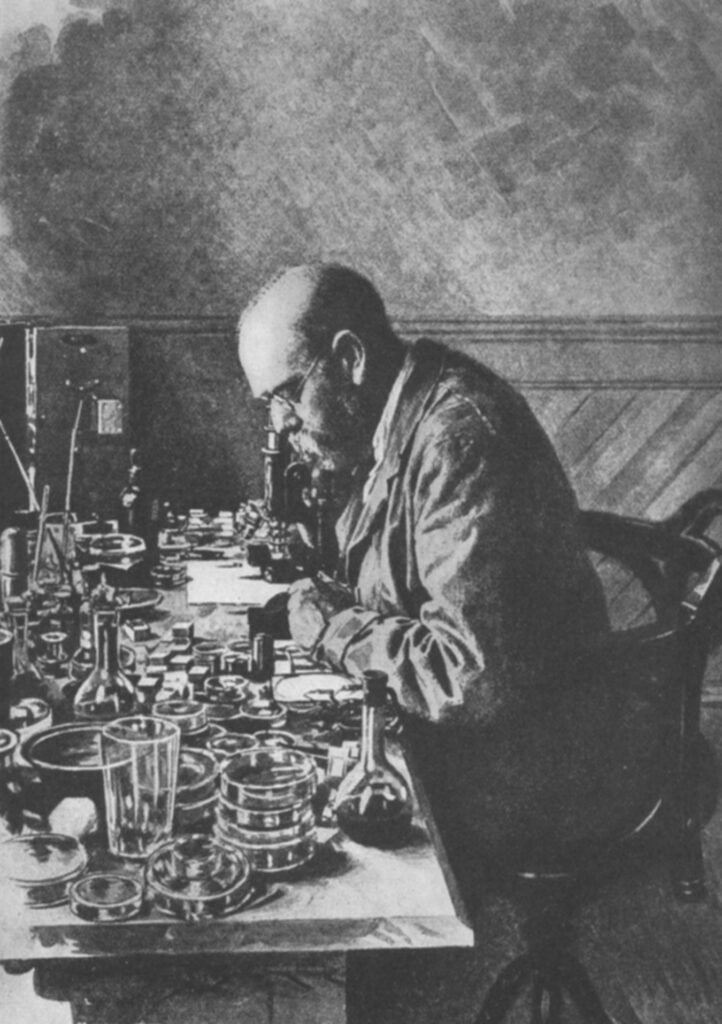
Koch worked as a district medical officer at Wollstein, now in Poland, in the 1870s, where anthrax was common among farm animals. He had no scientific equipment and no library nearby, and his laboratory was the four-room flat that was his home, with a microscope that his wife had given him. There he injected mice with anthrax bacilli from the spleens of dead animals, and the mice died, while mice given blood from healthy animals did not.
He then grew the bacilli in pure culture in the aqueous humor of an ox’s eye. He observed that they formed spores that survive harsh conditions and later grow back into bacilli. After several generations in culture, the bacilli still caused anthrax. The botanist Ferdinand Cohn published the work in 1876, and Koch became famous.
How it was confirmed
After joining the Imperial Health Bureau in Berlin in 1880, Koch refined his methods. His group grew bacteria on solid media such as potato and on agar in the flat dish invented by his colleague Petri, and they developed staining techniques that made bacteria visible.
Koch also set out the conditions, known as Koch’s postulates, that must be met before a particular microbe is accepted as the cause of a particular disease. Researchers have since reviewed and revised the postulates as knowledge advanced.
In 1882 he published his work on the tubercle bacillus, the cause of tuberculosis. In 1883 he led a German commission to Egypt, where he found the vibrio that causes cholera. He received the 1905 Nobel Prize in Physiology or Medicine for his work on tuberculosis.
Disputes over credit
Germ theory had no single discoverer. Koch did not discover the anthrax bacillus, which had been seen earlier by Pollender, Rayer and Davaine. His contribution was to prove, through pure culture and animal tests, that the bacillus really causes the disease.
The pioneers also disagreed. Koch criticized Pasteur’s vaccination methods as ambiguous, although historians note that many myths about Pasteur have since been clarified.
Impact and legacy
Germ theory made modern infection control possible. Pasteur’s work contributed to the antiseptic surgical techniques of Joseph Lister. Pasteur and others went on to develop vaccines against chicken cholera, anthrax and rabies.
Koch’s study of cholera led to control rules that the Great Powers approved at Dresden in 1893, and it influenced plans to protect water supplies. Both ideas remain core public health practice.
Germ theory also prepared the way for antibiotics. Once microbes were known to cause infection, the search for substances that kill them led to the discovery of penicillin in the 20th century.
Koch’s pure-culture methods mattered as much as his findings. They allowed the bacteria that cause a disease to be obtained free from other organisms, then detected and identified, and they became the foundation of diagnostic bacteriology.
In Berlin, Koch worked with assistants including Loeffler and Gaffky, who helped him refine the techniques that later laboratories adopted.
FAQs
Who discovered germ theory? No single person did. Semmelweis, Snow, Pasteur and Koch each contributed evidence in the 19th century, and Koch’s methods gave the most direct proof.
What did germ theory replace? It replaced miasma theory, the belief that disease was caused by bad air.
What are Koch’s postulates? They are conditions that must be satisfied before a particular microbe is accepted as the cause of a particular disease.
Did Pasteur or Koch come first? Pasteur’s fermentation work dates from the 1850s, and Koch’s anthrax work was published in 1876.
More in Medicine
Key facts
- Semmelweis introduced chlorine hand washing in Vienna in mid-May 1847, and first-clinic mortality fell to 1.3 percent in 1848.3
- John Snow investigated the 1854 Broad Street cholera outbreak and argued cholera was waterborne.4
- Pasteur's 1857 work on lactic fermentation showed living organisms drive fermentation.2
- Koch showed in the 1870s that the anthrax bacillus causes anthrax, and Cohn published the work in 1876.1
- Koch announced the tubercle bacillus in 1882 and received the 1905 Nobel Prize for his tuberculosis work.15
- Koch's postulates set conditions for accepting a microbe as the cause of a disease.16
This entry explains a medical term. It is not medical advice. If you are concerned about your health, speak with a qualified health professional.
Related concepts
Quick checkWho discovered germ theory?Show answer
No single person did. Semmelweis, Snow, Pasteur and Koch contributed evidence in the 19th century, and Koch proved in the 1870s that a specific bacterium causes anthrax.
Sources
- Nobel Prize, Robert Koch, Biographical, https://www.nobelprize.org/prizes/medicine/1905/koch/biographical/
- PubMed Central (2024), Louis Pasteur: A Legacy Unmasked, https://pmc.ncbi.nlm.nih.gov/articles/PMC11438523/
- PubMed Central (2025), Ignaz Philipp Semmelweis (1818-1865), a public health visionary and champion of hand hygiene, https://pmc.ncbi.nlm.nih.gov/articles/PMC12720402/
- PubMed Central (2024), John Snow: The Pioneer of Modern Epidemiology and Anesthesia, https://pmc.ncbi.nlm.nih.gov/articles/PMC11416802/
- Nobel Prize, The Nobel Prize in Physiology or Medicine 1905, https://www.nobelprize.org/prizes/medicine/1905/summary/
- Yale Journal of Biology and Medicine (1976), Causation and Disease: The Henle-Koch Postulates Revisited (abstract), https://pmc.ncbi.nlm.nih.gov/articles/PMC2595276/
Editorially reviewed by Specialty Digest Editorial TeamLast reviewed November 5, 2026Researched and drafted with AI assistanceReport an issue