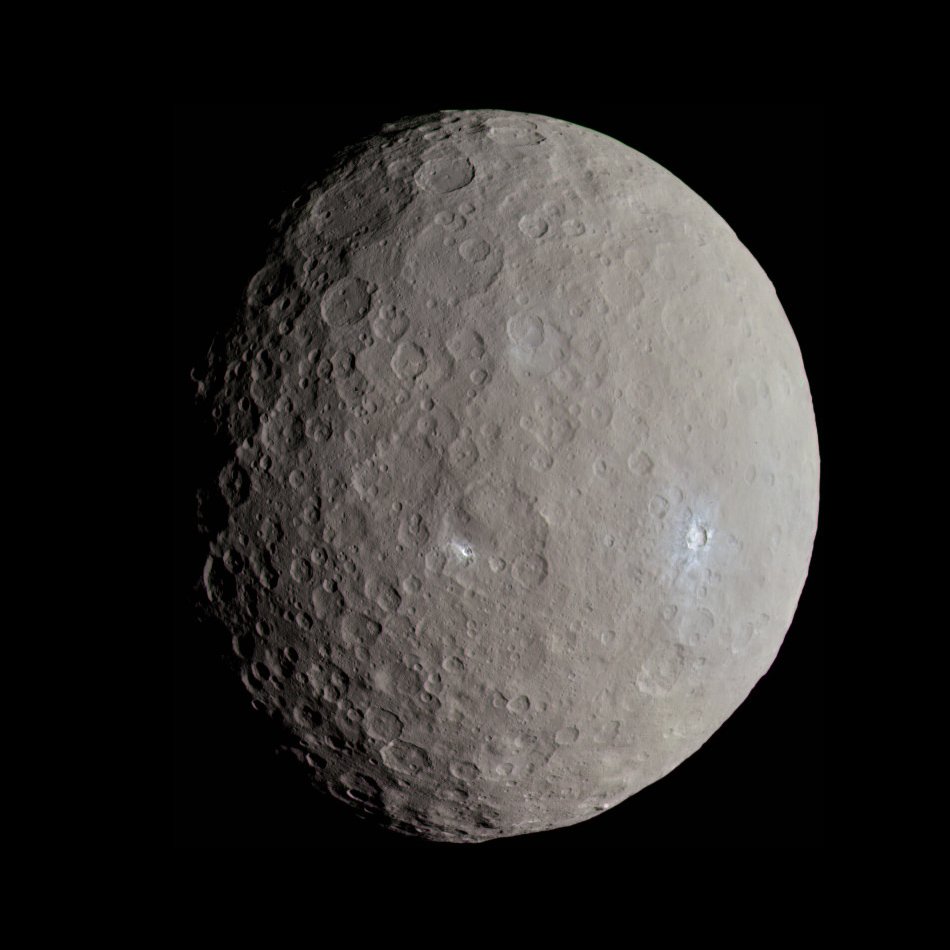
The discovery of Ceres was the first sighting of a body in what is now called the asteroid belt. The Italian astronomer Giuseppe Piazzi found it from the Palermo Observatory in Sicily on 1 January 1801. It was first counted as a planet, later grouped with the asteroids, and reclassified as a dwarf planet in 2006.
Background to the discovery of Ceres
By the end of the eighteenth century, astronomers had good reason to wonder whether a planet was missing between Mars and Jupiter. A numerical formula popular at the time, which Johann Elert Bode favored and which was later discredited, left a gap at that distance from the Sun. The 1781 discovery of Uranus had raised expectations that further planets might turn up.
In 1800, a group of German astronomers organized a society they called the Celestial Police, with Franz Xaver von Zach as its secretary. According to NASA‘s Jet Propulsion Laboratory, 24 astronomers each agreed to scour a 15-degree strip of the zodiac for the missing planet. Piazzi did not receive his invitation until after he had spotted Ceres.
The discovery of Ceres
Piazzi directed the observatory at Palermo. He was compiling a catalog of star positions with his assistant, Niccolo Cacciatore, using a precision instrument known as a Ramsden Circle. On 1 January 1801 he noticed an object whose light, according to the observatory’s records, was a little faint and colored like Jupiter.
On the following nights he looked again and saw that its position had changed, so it was not a fixed star. As spring came, the object slipped toward the Sun’s glare and out of reach of observers. For some months the discovery was at risk of becoming a lost comet, a faint wanderer recorded once and never seen again.
Piazzi was 54 years old at the time. MacTutor, the University of St Andrews biographical archive, records that he was born on 16 July 1746 in Ponte in Valtellina, in what is now Italy, and he died in Naples on 22 July 1826. His assistant Cacciatore later became director of the Palermo Observatory and was the source of the best-known account of that first night.
How the discovery was confirmed
Several astronomers calculated orbits from Piazzi’s short series of positions. Bode believed the object was the missing planet that fit his formula, and the Italian astronomer Barnaba Oriani asked von Zach on 7 April 1801 to publish news that such a planet might have been found. Meanwhile, cloudy skies and the object’s position near the Sun meant that no one besides Piazzi could observe it that spring.
Piazzi also held back his observations while he refined them, which upset several colleagues. In July 1801 he made his data public and announced the name Ceres Ferdinandea, after the Roman goddess of agriculture and King Ferdinand of Sicily. Other astronomers had suggested Juno, Hera and Piazzi. By the end of July many believed it was a planet, but they still needed fresh observations.
The decisive step came from mathematics. Piazzi published his complete data in von Zach’s journal in September 1801, and the 24-year-old Carl Friedrich Gauss applied new methods to calculate the orbit. His predictions differed from the others, and some astronomers doubted him. Von Zach was the first to see Ceres again, on 7 December 1801, and other astronomers followed, with Piazzi himself recovering it on 23 February 1802.
Is Ceres a planet, an asteroid or a dwarf planet?
In March 1802, Heinrich Olbers discovered a second, similar body, later named Pallas. William Herschel then argued that Ceres and Pallas belonged to an entirely new class of objects, which he called asteroids because they looked like stars in a telescope. Juno followed in 1804 and Vesta in 1807, and the number of known asteroids grew steadily from there.
In 2006, the International Astronomical Union reclassified Ceres as a dwarf planet, the same category as Pluto. NASA says Ceres is the largest object in the asteroid belt and the only dwarf planet in the inner solar system. It holds about a quarter of the belt’s total mass, though Pluto is still about 14 times more massive.
Scientific significance of Ceres
The discovery opened a new part of the solar system. Ceres showed that the space between Mars and Jupiter held many small bodies instead of a single large planet, and the term asteroid entered scientific language. The recovery of the object in 1801 and 1802 also demonstrated that orbit calculations from a small number of observations could keep track of a faint moving body.
In 1806 the French astronomer Jean Baptiste Delambre noted that Uranus, Ceres, Pallas and Juno had all been found while their discoverers were searching for something else. He argued that the best way to meet such accidents was to carry out a large, useful project, as Piazzi had done by repeatedly observing stars for his catalog.
Ceres has a radius of 296 miles, or 476 kilometers, about one thirteenth of Earth’s. NASA reports that it orbits at an average distance of 2.8 astronomical units, completing a circuit of the Sun every 4.6 Earth years, and that it rotates once in about nine hours. The dwarf planet may contain as much as 25 percent water, according to NASA, which would give it more water than Earth has.
Later developments and exploration
NASA’s Dawn mission launched in 2007 and arrived at Ceres on 6 March 2015, making it the first dwarf planet visited by a spacecraft. Dawn showed a heavily cratered body with a tall cone-shaped mountain and more than 130 reflective patches that are likely salt. NASA notes that no crater is wider than 175 miles, or 280 kilometers, which is surprising for a body that has existed for roughly 4.5 billion years.
The Herschel Space Observatory found water vapor around Ceres in 2013, and scientists have suggested ice volcanoes or sublimating ice near the surface as possible sources. The craters and other features that Piazzi could never have seen are being named after agricultural deities and festivals, extending the theme he began with the name Ceres.
Dawn also observed from a very low orbit in January 2016, only 240 miles, or 385 kilometers, above the surface. Piazzi, who died in 1826, could not have imagined that his faint point of light would one day be mapped in this detail.
More in Astronomy & Space
Key facts
- Giuseppe Piazzi first saw Ceres on 1 January 1801 at the Palermo Observatory in Sicily.1
- Franz Xaver von Zach was the first to see Ceres again, on 7 December 1801, using the orbit Carl Friedrich Gauss calculated; Piazzi recovered it on 23 February 1802.1
- Piazzi named the object Ceres Ferdinandea; Ceres is the Roman goddess of agriculture.12
- William Herschel coined the term asteroid; Juno followed in 1804 and Vesta in 1807.1
- The International Astronomical Union classified Ceres as a dwarf planet in 2006.2
- NASA's Dawn arrived at Ceres on 6 March 2015, the first visit to a dwarf planet.12
- Ceres has a radius of 476 kilometers and orbits the Sun every 4.6 Earth years.2
Related concepts
Quick checkWho discovered Ceres, and when?Show answer
Giuseppe Piazzi saw it on 1 January 1801 from Palermo, Sicily. Gauss's orbit calculations allowed astronomers to find it again that December.
Sources
- NASA Jet Propulsion Laboratory, Ceres: Keeping Well-Guarded Secrets for 215 Years, https://www.jpl.nasa.gov/news/ceres-keeping-well-guarded-secrets-for-215-years/
- NASA Science, Ceres Facts, https://science.nasa.gov/dwarf-planets/ceres/facts/
- University of St Andrews MacTutor History of Mathematics, Giuseppe Piazzi, https://mathshistory.st-andrews.ac.uk/Biographies/Piazzi/
Editorially reviewed by Specialty Digest Editorial TeamLast reviewed November 5, 2026Researched and drafted with AI assistanceReport an issue