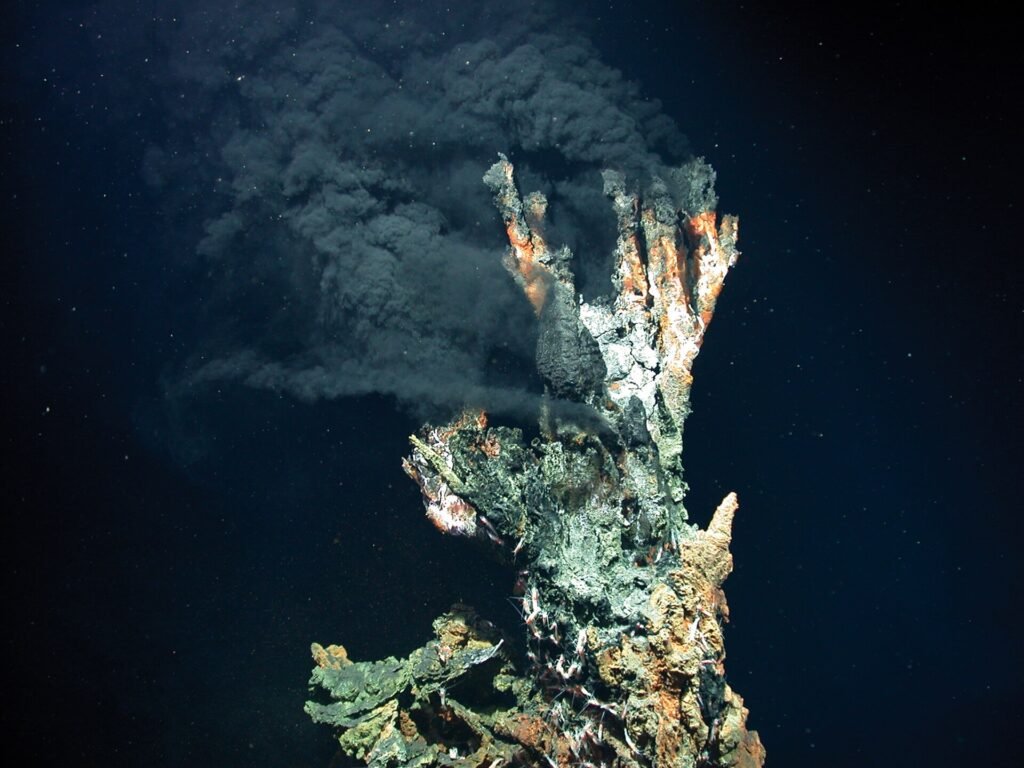
Hydrothermal vents on the deep seafloor were discovered in February 1977 by scientists exploring the Galápagos Rift in the eastern Pacific Ocean. The finding revealed hot springs on the seabed and, around them, thriving animal communities that live on chemical energy rather than sunlight.
Background
Scientists had suspected for some time that hot water must escape from the seafloor along mid-ocean ridges, where new crust forms, in places where the planet’s heat reaches the ocean. Several expeditions in the 1970s hunted for evidence, among them the Southtow and Pleiades expeditions and Project FAMOUS, which proved that submersibles could explore a mid-ocean ridge.
The Pleiades expedition marked the Galápagos Rift as a promising place, partly because it found piles of empty clamshells there. In February 1977 the Galápagos Hydrothermal Expedition, funded by the National Science Foundation, went to look for active vents. It left the Panama Canal on 8 February aboard the research vessel Knorr.
The target was about 640 kilometers west of Ecuador and 330 kilometers northeast of the Galápagos Islands. The team of geologists, geochemists and geophysicists included Robert Ballard and Richard Von Herzen of Woods Hole, Jack Corliss, Jack Dymond and Louis Gordon of Oregon State University, John Edmond and Tanya Atwater of the Massachusetts Institute of Technology, Tjeerd van Andel of Stanford and Dave Williams of the U.S. Geological Survey. According to Woods Hole, no one thought a biologist was needed on board.
The discovery
The Knorr reached the general area on 12 February and lowered three sound beacons to the seafloor to track its equipment. On 15 February the team lowered ANGUS, a two-ton steel cage fitted with cameras, strobe lights and a temperature sensor that could detect changes as small as 0.005 degrees Celsius. It was towed about 4.5 meters above the bottom, at a depth of 2,500 meters, and took a photograph every ten seconds.
The Navy had mapped the region in detail with its powerful and then top-secret SASS sonar, which helped the team choose where to search. Because the Knorr had to fight a current of about one and a half knots to stay over the site, the crew had to adjust course constantly while watching the temperature readings for a spike.
At about midnight the sensor registered a three-minute spike in the temperature of the near-freezing water, which was 2 degrees Celsius. ANGUS took about 3,000 color photographs along 16 kilometers of seafloor before it ran out of film. When the film was developed, the frames from the time of the spike showed something never seen before in the deep sea. For thirteen frames the bare lava was covered with hundreds of white clams and brown mussel shells, and then the bottom was barren again.
The clams were alive, which separated this find from the empty clamshells of the earlier expedition. Within hours the Alvin team was preparing the dive. The lava terrain around the vents was young and fresh, and the photographs showed a skate swimming above it, a reminder that the surrounding deep sea holds life as well.
The clams were alive. Within hours the submersible Alvin arrived, and on 17 February 1977 it made dive 713 with pilot Jack Donnelly and scientific observers Jack Corliss and Tjeerd van Andel. They found shimmering warm water and a community of animals. The scientists named the place the Garden of Eden, according to Oregon State University.
How it was confirmed
Alvin’s manipulator arm collected clams, mussels, worms and anemones. Some of the samples are still held at the Smithsonian Institution. Photographs showed tubeworms, white crabs and a pink fish gathered around the vents, and a purple octopus moving across a clam bed. NASA notes that Alvin saw plumes of dark “smoke” rising from the vents.
Vent sites were given informal names. Alvin picked up a large clam at a site called Clambake 1, while at Clambake 2 the clams were dead because that vent was no longer active, which showed that vents can switch off. The three sound beacons that guided the work were nicknamed Sleepy, Dopey and Bashful, and ANGUS carried the motto Takes a Lickin but Keeps on Clickin. Numerous vents have since been found in places from Hawaii to Japan to the Mediterranean Sea, wherever volcanic activity warms water that circulates through the seafloor.
The vent sites also sit on the moving plates of the planet’s crust, so the discovery connects to the wider story of plate tectonics. For a deeper look at another extreme ocean environment, see the discovery of the Mariana Trench.
Impact and legacy
The discovery overturned a basic assumption. Until 1977 scientists believed that all life on Earth depended in some way on the Sun, because photosynthesis supports the food chains at the surface. Hot water at a vent is rich in chemicals that microorganisms can use as a source of energy, a process called chemosynthesis, and those organisms power the whole community.
The finding therefore showed that an ecosystem could thrive independently of sunlight. It changed oceanography, marine biology and chemistry, and led to new thinking on how life began on Earth. Robert Collier, who took part in the 1977 expedition, said it spawned new fields of study. The entry on hydrothermal vents explains how these structures form and what lives around them.
NASA also notes that vents changed ideas about habitability in the Solar System. Moons such as Jupiter’s Europa and Saturn’s Enceladus are thought to have oceans of liquid water beneath their ice, and if vents exist there, those oceans could support life as we know it.
Who led the expedition
Accounts credit different people because it was a large team effort. Oregon State University describes the group as led by its oceanographer Jack Corliss, who was designated leader of the Alvin exploration by the National Science Foundation. The Woods Hole account stresses the role of ANGUS and the photographs analyzed by the team including Robert Ballard. Both institutions describe the work as a team effort rather than the achievement of a single person.
Key facts
- The Galápagos Hydrothermal Expedition began on 8 February 1977.1
- ANGUS recorded a temperature spike near midnight on 15 February 1977 and photographed dense clams.1
- Alvin dive 713 on 17 February 1977 observed the vent community.1
- The expedition scientists called the vent community the Garden of Eden.2
- Before 1977 scientists believed all life depended on the Sun for energy.3
- Chemosynthetic microorganisms power vent ecosystems.3
Related concepts
Quick checkWhen were hydrothermal vents discovered?Show answer
In February 1977, on the Galápagos Rift in the eastern Pacific. The submersible Alvin made the first dive to a vent community on 17 February 1977.
Sources
- 1. Woods Hole Oceanographic Institution, The Discovery of Hydrothermal Vents: 1977 - Astounding Discoveries, https://www.whoi.edu/feature/history-hydrothermal-vents/discovery/1977.html
- 2. Oregon State University, Corliss, OSU to commemorate 40th anniversary of hydrothermal vents discovery, https://news.oregonstate.edu/news/corliss-osu-commemorate-40th-anniversary-hydrothermal-vents-discovery
- 3. NASA Astrobiology, Life in the Extreme: Hydrothermal Vents, https://astrobiology.nasa.gov/news/life-in-the-extreme-hydrothermal-vents/
Editorially reviewed by Specialty Digest Editorial TeamLast reviewed November 5, 2026Researched and drafted with AI assistanceReport an issue