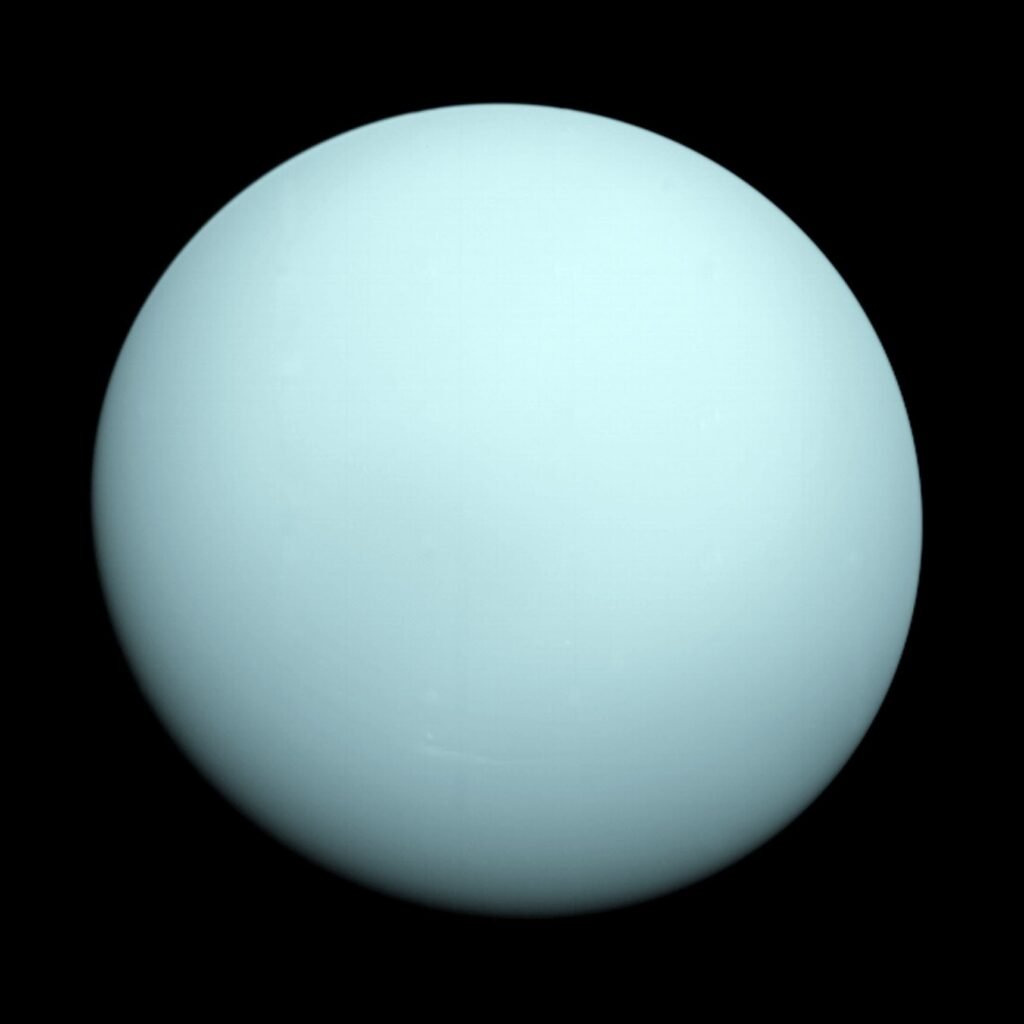
The discovery of Uranus was the first identification of a planet with the help of a telescope. The astronomer William Herschel noticed the object on the evening of 13 March 1781 and at first took it for a comet or a star. Within about two years astronomers accepted it as a seventh planet, the first one unknown to the ancient world.
Background to the discovery of Uranus
Before 1781, people knew five planets besides Earth: Mercury, Venus, Mars, Jupiter and Saturn. All five are bright enough to see with the naked eye, and observers had followed their slow movement against the fixed stars for thousands of years. Nobody expected another, and no organized search for one existed.
Herschel built his own reflecting telescopes and was working through the night sky methodically, examining stars region by region. He was not hunting for a planet. The find came out of routine survey work, which is why the report that followed treated the object as a comet rather than as something far more important.
The discovery of Uranus
Herschel described the moment in a paper titled Account of a Comet, which was read to the Royal Society on 26 April 1781. He reported that on the night of Tuesday 13 March, between ten and eleven o’clock, he was looking at small stars near H Geminorum in the constellation Gemini when one of them appeared noticeably larger than its neighbors. That odd size made him look again.
The object did not behave like a star. Stars hold fixed positions relative to one another from night to night, while this one slowly shifted against the background. Comets and planets move in that way, and comets were the only new wanderers anyone had found in recorded history, so Herschel announced a comet. According to NASA, he considered it either a comet or a star.
The distinction mattered. A comet is a small body of ice and dust that usually follows a stretched-out orbit and develops a tail near the Sun. A planet follows a stable, roughly circular path. Which one the object was could only be settled by following its path for a longer time.
How the discovery was confirmed
As positions were gathered over the following months, the object showed no tail and did not follow the orbit expected of a comet. Its motion fitted a path around the Sun far beyond Saturn, at an average distance that NASA gives as about 19 times the distance between Earth and the Sun. Planets follow nearly circular orbits, and the term orbital eccentricity describes how stretched an orbit is.
NASA reports that the object was universally accepted as a new planet about two years after Herschel’s sighting. The German astronomer Johann Elert Bode helped settle the question, in part through his own observations of it. Once astronomers agreed on the result, the seventh planet became the first to be found with a telescope rather than by eye.
Naming Uranus
Herschel tried to name his discovery Georgium Sidus, meaning George’s star, in honor of King George III. The name found little support outside Britain. Bode proposed Uranus instead, after the Greek god of the sky, and that name prevailed. Giving a planet a classical name also kept it in line with the other planets, which carry the names of Roman deities.
Herschel went on to find more in the same system. On 11 January 1787 he discovered two of the planet’s moons, Titania and Oberon, and records show he spotted Oberon first. Uranus now has 28 known moons, according to NASA, including five major ones named Miranda, Ariel, Umbriel, Titania and Oberon. Their names come from characters in the works of William Shakespeare and Alexander Pope.
Scientific significance of Uranus
The discovery changed how people pictured the solar system. For the first time, the known family of planets had grown, and the planet sat roughly twice as far from the Sun as Saturn. The result also showed that a careful survey with a good instrument could uncover large objects that had escaped notice for all of human history.
Uranus turned out to be unlike the planets known earlier. It is an ice giant, meaning most of its mass is a hot, dense fluid of water, methane and ammonia ices above a small rocky core. The methane in its atmosphere absorbs red light and reflects blue, which gives the planet its pale blue-green color. NASA measures its equatorial diameter at 31,763 miles, or 51,118 kilometers, about four times the width of Earth.
The planet’s orbit is also unusual. A Uranian year lasts about 84 Earth years, and the planet’s axis is tilted by 97.77 degrees, so it appears to roll around the Sun on its side. NASA notes this may be the result of a collision with an Earth-sized object long ago. The tilt produces the most extreme seasons in the solar system.
Later developments and legacy
Uranus played a part in a second discovery. Astronomers found that its orbit did not match predictions based on the known planets, and some concluded that an unseen world was pulling on it. The French mathematician Urbain Le Verrier calculated where such a planet should be, and in 1846 astronomers found Neptune close to his predicted position. In that sense, the first planet found by telescope led directly to the second one found by calculation.
Only one spacecraft has visited Uranus. NASA’s Voyager 2 made its closest approach in January 1986 and sent back images of the planet and several of its moons. It saw only a few discrete clouds, though later observations revealed dynamic clouds as Uranus approached its equinox. NASA counts 13 faint rings around the planet, in two sets, and lists wind speeds of up to 560 miles per hour, or 900 kilometers per hour.
Herschel’s discovery also showed the value of careful, repeated survey work, and the same kind of patient observation led to the discovery of Ceres twenty years later.
More in Astronomy & Space
Key facts
- William Herschel found Uranus on 13 March 1781 and first reported it as a comet.2
- His paper Account of a Comet was read to the Royal Society on 26 April 1781.2
- Astronomers universally accepted it as a planet about two years later, helped by observations from Johann Bode.1
- Herschel proposed the name Georgium Sidus; Bode suggested Uranus, the name that was adopted.1
- Herschel discovered the moons Titania and Oberon on 11 January 1787.2
- Uranus has an equatorial diameter of 51,118 kilometers, a year of about 84 Earth years and an axial tilt of 97.77 degrees.1
- Voyager 2 flew past Uranus in January 1986, the only spacecraft visit so far.1
Related concepts
Quick checkWho discovered Uranus, and when?Show answer
William Herschel discovered it on 13 March 1781. He first reported it as a comet, and astronomers accepted it as a planet about two years later.
Sources
- NASA Science, Uranus Facts, https://science.nasa.gov/uranus/facts/
- University of St Andrews MacTutor History of Mathematics, William Herschel's astronomical discoveries, https://mathshistory.st-andrews.ac.uk/Extras/Herschel_William_discoveries/
- NASA Science, Neptune Facts, https://science.nasa.gov/neptune/facts/
Editorially reviewed by Specialty Digest Editorial TeamLast reviewed November 5, 2026Researched and drafted with AI assistanceReport an issue