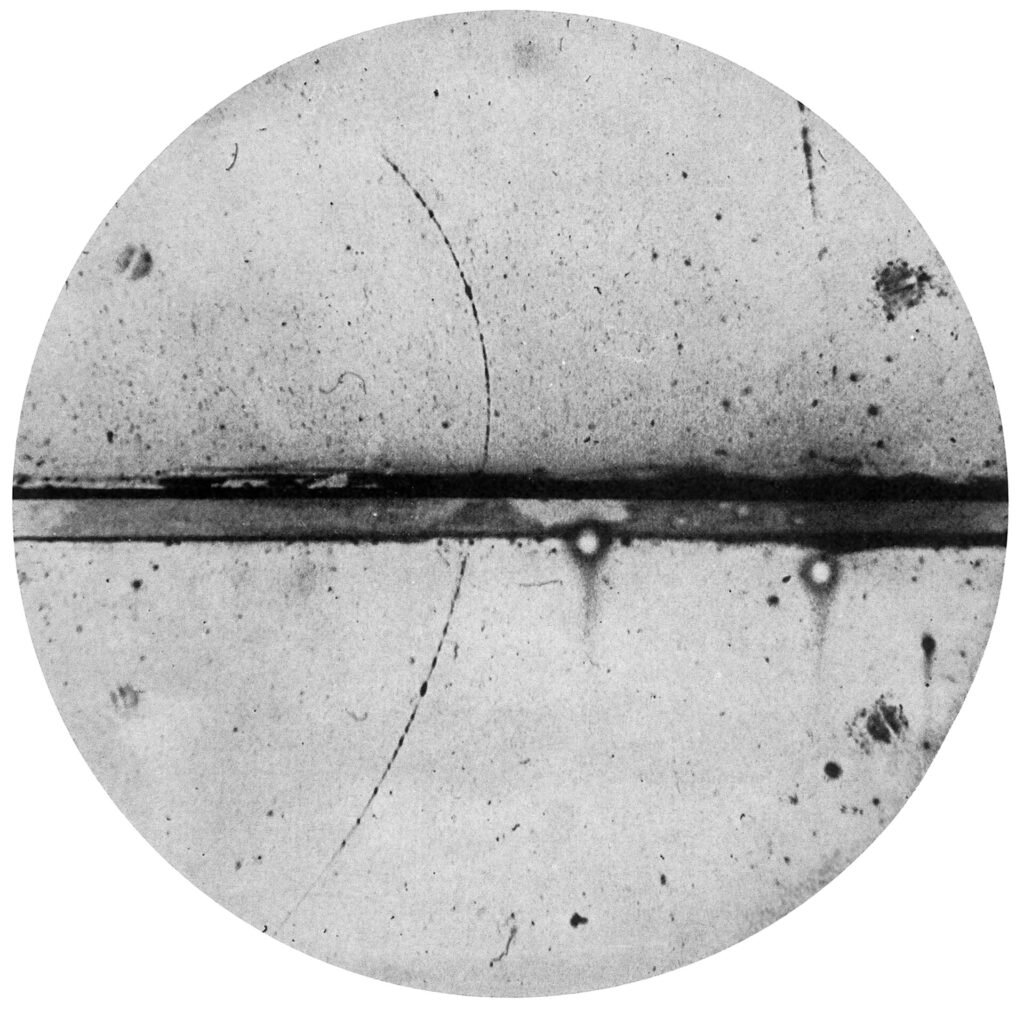
The discovery of the positron was the observation, in 1932 by the American physicist Carl D. Anderson at the California Institute of Technology, of a particle with the mass of an electron but a positive electric charge. It was the first antiparticle shown to exist by experiment, and it confirmed a prediction that had been made from quantum theory.
Background to the discovery of the positron
In 1928 the British physicist Paul Dirac showed that combining quantum mechanics with Einstein’s relativity implied that every particle has a counterpart, called an antiparticle, with the same mass and the opposite electric charge. The Nobel Foundation describes this as a kind of mirror image of matter, which is now called antimatter. If the idea was right, the familiar electron should have a positively charged twin.
The hunt for experimental proof was on. A Caltech postdoctoral researcher would win the race.
Experimenters set out to look for it. Carl Anderson was born in New York in 1905 and studied at Caltech, where he completed a doctorate in 1930. His early work was on X-rays, but in 1930 he began studying cosmic rays, high-energy particles that reach Earth from space, together with the Caltech physicist Robert Millikan.
Most researchers studied cosmic rays with cloud chambers, and Anderson built a better one than his colleagues.
How the cloud chamber worked
A cloud chamber is a short cylinder with glass end plates, filled with a gas that is saturated with water vapor. When an ionizing particle passes through, it leaves a trail of tiny water droplets that can be photographed. The density of the droplets tells researchers how strongly the particle ionizes the gas, which depends on the kind of particle.
Anderson added a piston so that he could drop the pressure in the chamber very rapidly, and he used a mixture of water and alcohol. He also surrounded the chamber with a large electromagnet. The magnetic field bent the paths of charged particles into curves, and the amount of curvature revealed a particle’s momentum and the sign of its charge. The result was much clearer photographs than other groups could obtain.
The discovery
Anderson’s photographs showed cosmic rays producing showers of both positively and negatively charged particles. The positive tracks could not be protons, because a proton with that curvature would stop in a much shorter distance than the track length. Anderson and Millikan wondered whether the positive tracks might be electrons moving in the opposite direction.
To settle the direction of travel, Anderson placed a lead plate across the middle of the chamber. A particle loses energy passing through the plate, so its track is more sharply curved on the far side. In August 1932 he recorded the historic photograph of a positively charged particle that passed upward through the plate. It was clearly positive, and its mass appeared to be equal to that of an electron.
The particle was named the positron. Anderson published the result in the journal Physical Review in 1933. In the published photograph, the particle enters from the bottom, strikes the lead plate in the middle and loses energy, which shows up as the greater curvature of the upper part of the track.
How the positron was confirmed
Some of the scientific community was skeptical at first, but the result was confirmed within a year. In 1933 Anderson and his colleague Seth Neddermeyer obtained the first direct proof that gamma rays from a radioactive source generate positrons as they pass through matter, according to the Nobel Foundation.
Scientists concluded that the positron is one of a pair of particles, one positive and one negative, produced when a gamma ray is converted into matter. This pair production is a direct illustration of the relationship between mass and energy described by Albert Einstein.
Impact and legacy of the discovery
Anderson graduated from Caltech in 1927 with a degree in physics and engineering, was a research fellow there from 1930 to 1933, and became an assistant professor in 1933 and a full professor in 1939. During the Second World War he also worked on projects for the National Defense Research Committee and the Office of Scientific Research and Development.
Anderson shared the 1936 Nobel Prize in Physics, receiving one half for the discovery of the positron while the other half went to Victor Hess for his discovery of cosmic radiation. The American Physical Society notes that Anderson was 31, the youngest person to win the physics prize up to that time.
The positron opened the field of antimatter research. Researchers at the University of California, Berkeley, discovered the antiproton in 1955, and the antineutron followed in 1956. In 1995 a team at CERN combined positrons with antiprotons to make nine atoms of antihydrogen, each lasting only about 40 billionths of a second. Within three years the same group was producing as many as 2,000 antihydrogen atoms an hour.
Making whole anti-atoms took another three decades after the antiproton. In 1995 CERN researchers used the Low Energy Antiproton Ring to slow antiprotons down rather than speed them up, which let them pair the antiprotons with positrons.
Antimatter propulsion remains impractical. The American Physical Society reports that CERN’s facility makes enough antiprotons in a year to light a 100-watt bulb for only three seconds, and that the energy needed to make them is enormous.
The year 1932 was a remarkable one for the structure of matter. The same twelve months saw the discovery of the neutron by James Chadwick, and the positron joined the electron and proton as a particle that physicists could now detect and measure. A later discovery in this series, the discovery of the neutrino, relied on detecting positrons produced in a nuclear reactor.
More in Physics
Key facts
- Paul Dirac showed in 1928 that relativity and quantum theory imply a matching antiparticle for every particle.1
- Carl Anderson recorded the positron in a cloud chamber photograph in August 1932.1
- Anderson received half of the 1936 Nobel Prize in Physics for the discovery of the positron.2
- Antihydrogen atoms were first made at CERN in 1995, nine atoms each lasting about 40 nanoseconds.1
Related concepts
Quick checkWhat is the positron?Show answer
The positron is the antiparticle of the electron, with the same mass but a positive charge. Carl Anderson discovered it in 1932 while photographing cosmic rays in a cloud chamber at Caltech.
Sources
- American Physical Society, This Month in Physics History: August 1932, Discovery of the Positron, https://www.aps.org/apsnews/2004/08/discovery-positron-1932
- Nobel Prize Outreach, Carl D. Anderson: Facts (Nobel Prize in Physics 1936), https://www.nobelprize.org/prizes/physics/1936/anderson/facts/
- Nobel Prize Outreach, Carl D. Anderson: Biographical, https://www.nobelprize.org/prizes/physics/1936/anderson/biographical/
Editorially reviewed by Specialty Digest Editorial TeamLast reviewed November 5, 2026Researched and drafted with AI assistanceReport an issue