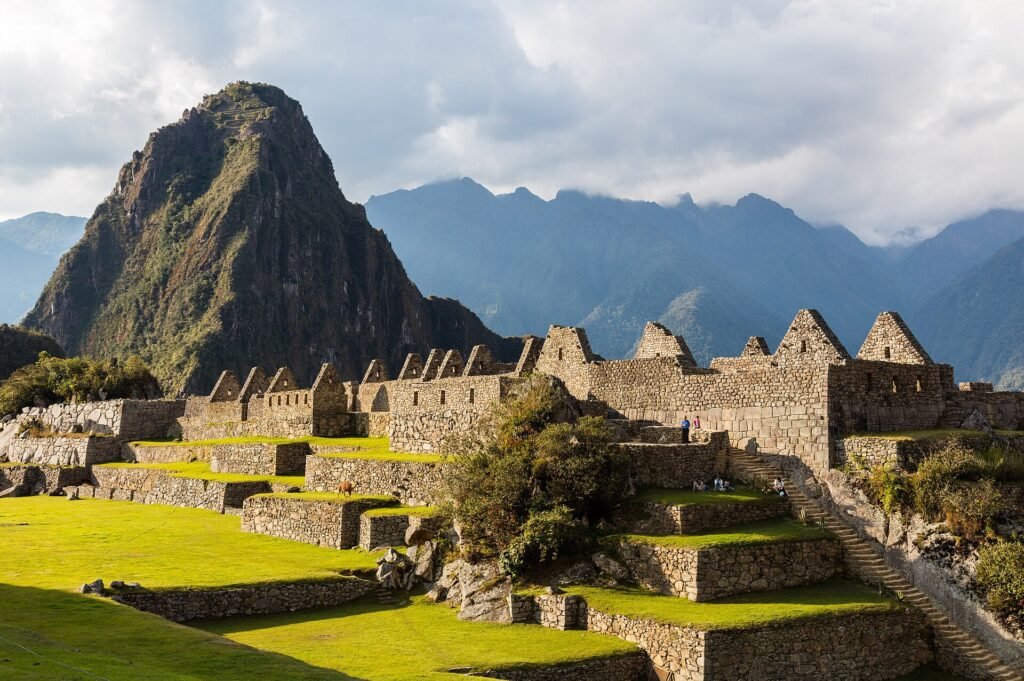
The discovery of Machu Picchu was the 1911 expedition by Hiram Bingham, a Yale lecturer, to a ruined Inca citadel high in the Peruvian Andes. He reached the site on 24 July 1911, guided by local people, and his reports brought it to worldwide attention.
Bingham was not the first person to know the ruins, and he misjudged what they were. Modern research treats the site as a royal retreat built around the year 1450.
Background to the discovery of Machu Picchu
Machu Picchu stands 2,430 meters above sea level on the eastern slopes of the Andes, in a tropical mountain forest above the upper Amazon basin. UNESCO calls it probably the most amazing urban creation of the Inca Empire at its height, with walls, terraces and ramps that seem cut from the rock itself.
The Spanish invaders of the sixteenth century never found it. No account of Machu Picchu appears in the much-studied chronicles of the conquest, so outsiders had no written record of the place.
Bingham came to Peru searching for the last refuge of the Inca. After the Spanish conquest, the final independent Inca rulers had held out for years in a remote region called Vilcabamba, and its exact location was unknown.
The discovery
On the morning of 24 July 1911, Bingham set out in a cold drizzle to investigate rumors of Inca ruins. He crossed a narrow bridge of logs tied with vines, hiked for about two hours, and reached a grass-covered hut.
Local farmers walked the party a short way, then a small boy led them the rest of the distance. Bingham saw a citadel of stone cut from escarpments, with blocks fitted so tightly that a knife blade could not slip between them.
Bingham returned for further expeditions, and the National Geographic Society helped fund the trips in 1912 and 1915. His account appeared in the April 1913 issue of National Geographic magazine, which introduced the site to a global audience.
During his years of work he removed thousands of artifacts to Yale for study, and he found human remains there. Those finds shaped early ideas about the place, some of which later research overturned.
How the discovery was confirmed
Confirmation meant working out what the site actually was. Bingham believed he had found Vilcabamba, and he defended that view for almost 50 years.
The identification failed in 1964, when the explorer Gene Savoy located ruins at Espiritu Pampa, in the Vilcabamba region west of Machu Picchu, and showed that they were the lost city Bingham had been seeking. Bingham had in fact seen walls and bridges at Espiritu Pampa during his 1911 trek, but he dismissed them and focused on Machu Picchu.
Later scholars corrected other conclusions as well. Bingham proposed that Machu Picchu was a convent where chosen women served the Inca ruler, and he found more than a hundred skeletons that he thought were about 75 percent female. Modern studies show a roughly even split between male and female remains.
Archaeologists John Rowe, Richard Burger and Lucy Salazar-Burger concluded that the site was a retreat built by and for the Inca ruler Pachacuti, not a defensive stronghold. Brian Bauer of the University of Illinois at Chicago dates its construction to around 1450 and estimates it housed only about 500 to 750 people.
Bauer also notes that people from many parts of the empire lived there. Ceramics from regions as far away as Lake Titicaca and head-shaping practices linked with coastal peoples point to a mixed population.
Impact and legacy of the discovery
The find changed how the world understands the Inca. Machu Picchu showed what imperial architecture looked like in the mountains, with palaces, temples, dwellings and storehouses. Its buildings, plazas and platforms are joined by narrow lanes and paths, and one sector is cut off by walls, ditches and perhaps a moat. The Peruvian scholar Luis Lumbreras describes one walled sector as a place of restricted ceremonial isolation rather than a military fortification.
Researcher Johan Reinhard argues that the site sits at the center of a sacred landscape. The Urubamba River nearly surrounds it, and the surrounding mountains were sacred landforms, so Reinhard describes it as a cosmological, hydrological and sacred geographical center for a wide region.
Farming at Machu Picchu probably used the grand terraces. Experts say those terraces alone could not feed the population, so cultivation likely spread to the nearby hills.
The site is now a symbol of Peruvian heritage. In 2007 it was named one of the new seven wonders of the world in a worldwide poll, an honor that brought both pride and pressure to the nearby city of Cusco as visitor numbers, pollution and demand for hotels grew.
The setting adds to its value. The surrounding natural area on the eastern Andes takes in the upper Amazon basin, which UNESCO describes as rich in plant and animal life, and you can read more about the country in the entry on Peru.
Disputes over credit and the return of artifacts
Calling Bingham the discoverer is contested. Local farmers in the area guided him to the ruins, so people of the valley clearly knew the way, and his role is better described as bringing the site to international attention.
The artifacts he took to Yale were also disputed. In September 2007 Yale agreed to return some of them to Peru, and a museum for the study of Machu Picchu and Inca culture, run jointly by the University of Cusco and Yale, opened in Cusco in 2011.
Researchers expect that no single discovery will settle the site’s original purpose. Advances such as the re-identification of the sex of the skeletons may help clarify why it was built, how it was used and why it was later abandoned.
More in Archaeology
Key facts
- Machu Picchu stands 2,430 meters above sea level on the eastern slopes of the Andes in Peru.1
- Hiram Bingham of Yale reached the ruins on 24 July 1911, guided by local farmers and a boy.2
- The site was built around the year 1450 and probably housed about 500 to 750 people.2
- Bingham believed Machu Picchu was Vilcabamba, but Gene Savoy identified Espiritu Pampa as that lost city in 1964.2
- Yale agreed in September 2007 to return some of Bingham's artifacts, and a joint museum opened in Cusco in 2011.2
Related concepts
Quick checkWho discovered Machu Picchu?Show answer
Hiram Bingham of Yale brought it to international attention on 24 July 1911, but local farmers already lived near the ruins and guided him there.
Sources
- UNESCO World Heritage Centre, Historic Sanctuary of Machu Picchu, https://whc.unesco.org/en/list/274/
- National Geographic, Machu Picchu, https://www.nationalgeographic.com/history/article/machu-picchu
Editorially reviewed by Specialty Digest Editorial TeamLast reviewed November 5, 2026Researched and drafted with AI assistanceReport an issue