The discovery of quarks happened in stages. In 1964 the theorists Murray Gell-Mann and George Zweig independently proposed quarks as the building blocks of protons, neutrons and related particles, and in 1968 and 1969 electron-scattering experiments at the Stanford Linear Accelerator Center (SLAC) showed that the proton contains small, point-like constituents that were later identified as quarks. The sixth and last quark, the top quark, was found in 1995.
Background to the discovery of quarks
By 1940 physicists knew that atomic nuclei are made of protons and neutrons, as the entries on the discovery of the atomic nucleus and the discovery of the neutron describe. During the 1950s new particle accelerators turned up a large number of further particles, called hadrons, whose properties resembled those of the proton and neutron. They behaved like members of different families, and physicists wanted a theory that explained the pattern.
Experiments also hinted that protons and neutrons are not simple points. At Stanford in the 1950s, Robert Hofstadter and his co-workers fired electrons with energies up to 1 billion electron volts at nucleons to measure how charge and magnetism are distributed inside them. They found a picture of soft spheres, which suggested size and structure but showed no distinct parts.
In 1964 Murray Gell-Mann, then at the California Institute of Technology, and George Zweig, then at CERN, independently proposed a classification system for the hadrons. Each hadron, they suggested, is built from a different combination of simpler particles. Gell-Mann called these particles quarks, and they had the odd property of carrying fractions of an electric charge.
The idea needed three kinds of quark, and at first it was far from clear that they were real particles rather than theoretical tools. The Nobel Foundation notes that the theory predicted particles not yet seen, and that when these were later found in experiments, the theory was accepted. Gell-Mann received the 1969 Nobel Prize in Physics for his classification of elementary particles and their interactions.
For some years the quark was in doubt. Researchers searched for free quarks in seawater, in meteorites, in cosmic radiation and in accelerator experiments, and none turned up. The most popular explanation became that quarks were only mathematical quantities in the equations of physics. Collision experiments with protons had also failed to shake any such particles loose. The results fit a proton that was a featureless blob of charge.
The discovery
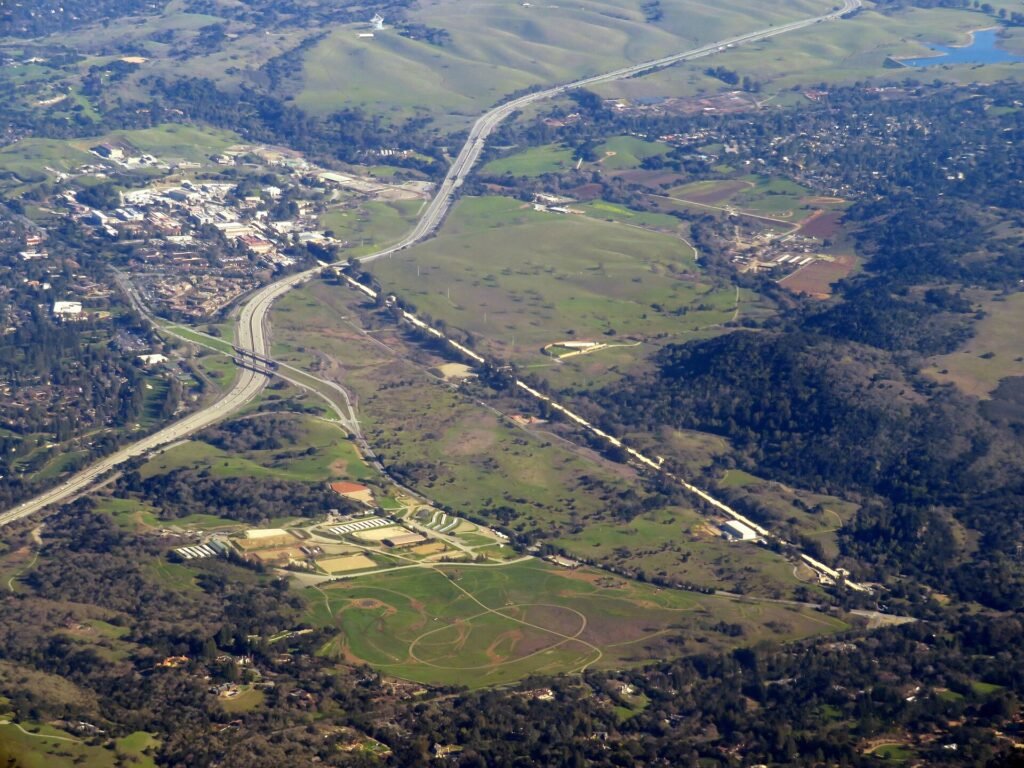
The test came at SLAC, whose two-mile-long accelerator began operating in 1967 and was used to fire electrons at protons, rather like a giant electron microscope. The team included Jerome Friedman and Henry Kendall of the Massachusetts Institute of Technology (MIT) and Richard Taylor of SLAC. It is known as the SLAC-MIT experiment.
First they studied elastic collisions, in which an electron bounces off a proton like a billiard ball. The results were consistent with a smooth proton and were, as Friedman put it, not very exciting. The team then studied inelastic collisions, in which the proton absorbs some of the electron’s energy and breaks apart.
Here something unexpected appeared. For electrons with energies between 7 and 17 billion electron volts, the scattering rate was 10 to 100 times greater than predicted for a featureless proton. The Nobel Foundation describes the finding as a sign that there was something small and hard inside the proton, and it dates the first traces of quarks to the SLAC-MIT experiment of 1968.
How quarks were confirmed
The SLAC theorist James Bjorken had predicted a simple scaling law for such collisions, and the data matched it. Richard Feynman then showed that the same law follows if the proton contains small, non-interacting constituents that he called partons. Two reports in Physical Review Letters in 1969 described the results. After 1968, according to the Nobel Foundation, intensive research into the inner structure of the nucleons started all over the world.
Further deep inelastic scattering experiments eventually showed that the proton contains three particles with fractional charges, and over time the partons were identified with the quarks of the theory. The experiments also gave the first hints of gluons, the neutral particles that bind quarks together.
Other quarks were found in turn. In 1974 Burton Richter and Samuel Ting independently discovered a heavy new particle, the J/psi, which proved the existence of a fourth quark, now called charm. They shared the 1976 Nobel Prize in Physics. The bottom quark was found at Fermilab in 1977, and the Nobel Foundation notes that the work of Martin Perl on the tau lepton showed that a third family of particles existed.
The top quark was announced at Fermilab on 2 March 1995 by two teams, CDF and DZero, each with about 450 members. It was the last of the six quarks predicted by the theory. The CDF group had reported evidence in April 1994 but had stopped short of claiming a discovery, and the later analysis of about three times as much data established it.
Impact and legacy of the discovery
Quarks are among the basic ingredients of the standard model of particle physics. Protons and neutrons are each made of two kinds of quark, called up and down, and the Nobel Foundation estimates that more than 99 percent of all the matter on Earth, including human bodies, consists of quarks and the gluons that bind them. The small remainder is electrons.
The existence of a third family of quarks and leptons matters to the standard model. The Nobel Foundation explains that without it, the model would be incomplete and could not accommodate CP violation, a breaking of a fundamental symmetry that, among other things, regulates particle decay.
The discovery earned Friedman, Kendall and Taylor the 1990 Nobel Prize in Physics for their investigations of deep inelastic scattering, which the Nobel committee called essential for developing the quark model. Accelerator experiments that followed include the discovery of the Higgs boson, whose associated field gives mass to quarks and other elementary particles.
Key facts
- Murray Gell-Mann and George Zweig independently proposed quarks in 1964.2
- The SLAC-MIT experiment of 1968 gave the first experimental signs of quarks inside the proton.1
- Richter and Ting discovered the J/psi particle in 1974, proving the charm quark.4
- Fermilab announced the top quark, the last of six, on 2 March 1995.5
Related concepts
Quick checkWhen were quarks discovered?Show answer
Quarks were proposed in 1964 and first seen indirectly in electron-scattering experiments at SLAC in 1968. The sixth and last quark, the top quark, was announced at Fermilab on 2 March 1995.
Sources
- Nobel Prize Outreach, The Nobel Prize in Physics 1990: Illustrated presentation, https://www.nobelprize.org/prizes/physics/1990/9592-the-nobel-prize-in-physics-1990/
- American Physical Society, Physics 7, 81: Landmarks, Discovery of Particles inside the Proton, https://physics.aps.org/articles/v7/81
- Nobel Prize Outreach, Murray Gell-Mann: Facts (Nobel Prize in Physics 1969), https://www.nobelprize.org/prizes/physics/1969/gell-mann/facts/
- Nobel Prize Outreach, Samuel C.C. Ting: Facts (Nobel Prize in Physics 1976), https://nobelprize.org/prizes/physics/1976/ting/facts
- Fermilab, Physicists discover top quark (press release, 2 March 1995), https://news.fnal.gov/1995/03/physicists-discover-top-quark/
- Nobel Prize Outreach, Press release: The 1995 Nobel Prize in Physics, https://www.nobelprize.org/prizes/physics/1995/press-release/
Editorially reviewed by Specialty Digest Editorial TeamLast reviewed November 5, 2026Researched and drafted with AI assistanceReport an issue