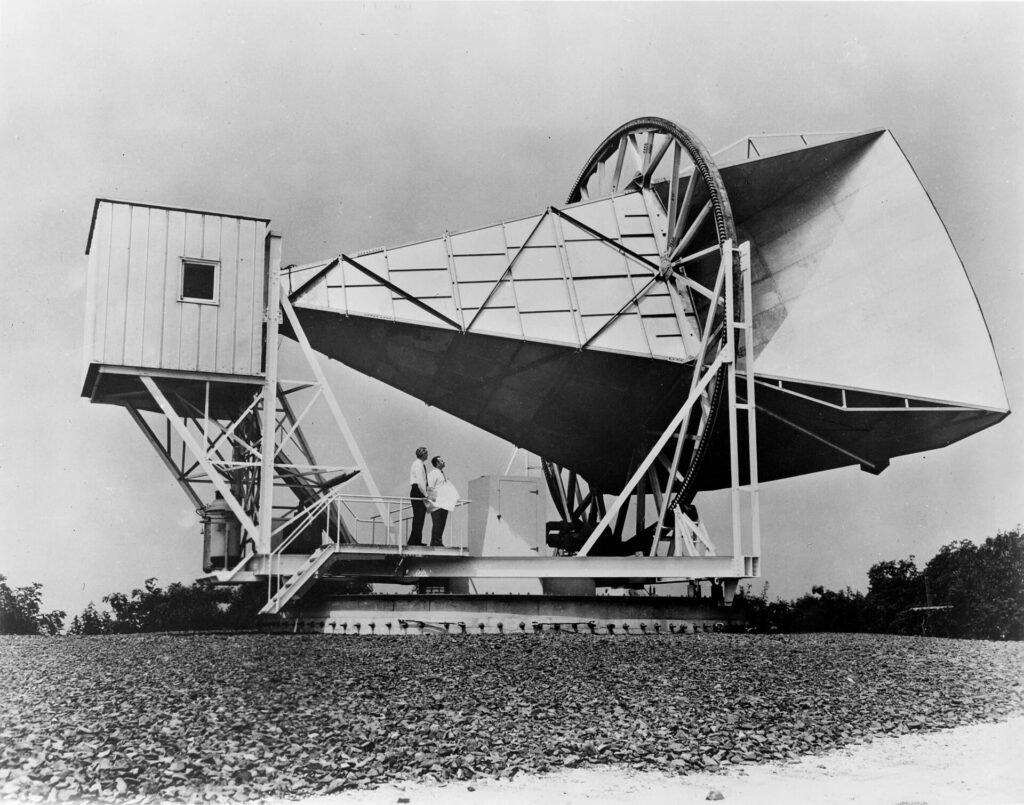
The discovery of the cosmic microwave background was the 1960s detection of a faint, uniform glow of microwave radiation coming from every direction in the sky. Arno Penzias and Robert Wilson found it at Bell Telephone Laboratories in New Jersey, and it is now understood as leftover light from the early, hot universe. They shared the 1978 Nobel Prize in Physics for the finding.
Background to the discovery of the cosmic microwave background
The idea of a relic glow came from theory before observation. In 1948, according to the American Institute of Physics, George Gamow argued that a big-bang universe would begin dominated by radiation. Ralph Alpher and Robert Herman predicted that a remnant of that radiation would still pervade all of space.
The Nobel Foundation adds that Gamow and his colleagues were trying to explain how chemical elements formed at the start of the universe. The radiation that should survive, they reasoned, would resemble that from a body only a few degrees above absolute zero. It would fall entirely in the microwave range, far outside what the eye can see. Because such a weak signal looked impossible to pick out of cosmic noise, the early predictions were largely forgotten.
The discovery of the cosmic microwave background
In the early 1960s, Bell Telephone Laboratories built a very sensitive receiver for communicating with the Echo and Telstar satellites. When it became free for research, Penzias and Wilson, two radio astronomers, decided to use it to study microwaves from the sky. The instrument produced very little noise of its own and was tuned to a wavelength of 7 centimeters, which suited the work.
They found microwaves at that wavelength that were stronger than expected. The Nobel Foundation says the two began studying cosmic radiation in 1964, while the American Institute of Physics dates the work to 1963, so sources differ by a year on when the observations started. At first they believed the excess was caused by distortions or faults in their equipment, but it was not.
The American Institute of Physics describes the realization: Penzias and Wilson had detected microwaves arriving from all around the sky, a universal background radiation. A signal that came evenly from every direction could not be tied to any single star, galaxy or nearby object.
How the discovery was confirmed and interpreted
Robert Dicke, a physicist at nearby Princeton University, learned of the measurement. According to the American Institute of Physics, he correctly interpreted it in 1965 as radiation at about 3 kelvins left over from the big bang. Dicke had not known of the earlier prediction by Alpher and Herman, and he had independently thought of the idea. Even before hearing about Penzias and Wilson, he had set his former student James Peebles to work on calculating what such radiation would be like.
One measurement at a single wavelength was not enough to settle the matter. The Nobel Foundation explains that support came from studies of the shape of the radiation spectrum, which soon showed it matched that of a body at about 3 degrees. Some astronomers who preferred the steady-state theory did not accept the interpretation at first. The American Institute of Physics notes that Fred Hoyle proposed it might come from starlight interacting with needle-shaped iron grains between the stars.
Only measurements at several wavelengths could separate the explanations. The needed techniques were not available until the early 1970s, according to the same source. Until then the question of whether the radiation was truly a relic of the big bang stayed open for the minority of scientists who preferred other theories.
Scientific significance of the cosmic microwave background
The background gave direct evidence that the universe was once hot and dense. The 1978 Nobel announcement described the discovery as fundamental, because it opened a way to learn about cosmic processes that took place a very long time ago, at the time the universe was created. It also supported the picture of an expanding cosmos, as laid out in the discovery of the expansion of the universe.
The Nobel Foundation’s 2006 prize announcement explains that when the radiation was released, the temperature of the universe was almost 3,000 degrees Celsius. As the universe expanded, the radiation cooled. The glow measured today corresponds to a temperature barely 2.7 degrees above absolute zero.
Later developments and legacy
NASA‘s Cosmic Background Explorer, known as COBE, launched on 18 November 1989. The Nobel Foundation reports that its first results arrived after nine minutes of observations and showed a perfect blackbody spectrum, a result that drew a standing ovation when it was shown at an astronomy conference. More than 1,000 researchers, engineers and others contributed to the mission.
COBE was also designed to look for tiny differences in temperature between directions. The Nobel Foundation says these variations are about one hundred-thousandth of a degree, and without them matter would have been spread evenly throughout the universe instead of gathering into stars and galaxies. John Mather and George Smoot shared the 2006 Nobel Prize in Physics for these measurements. The Nobel Foundation’s 2019 summary adds that COBE presented its first image of the early universe’s light in April 1992, and that later satellites, the American WMAP and the European Planck, sharpened the picture.
The Royal Swedish Academy of Sciences announced the 1978 physics prize on 17 October 1978. One half went to Pyotr Kapitsa for work in low-temperature physics, and Penzias and Wilson received a quarter each for their discovery of cosmic microwave background radiation. In 2019, James Peebles, whose theoretical work in cosmology followed from the idea of a hot early universe, received half of that year’s physics prize.
The discovery has a notable human side. Penzias and Wilson were engineers working on telecommunications who found a clue to the universe by trying to eliminate noise. Arno Penzias was born on 26 April 1933 and died on 22 January 2024, according to the Nobel Foundation.
More in Astronomy & Space
Key facts
- Arno Penzias and Robert Wilson found microwaves at about 7 centimeters wavelength that were stronger than expected, at Bell Telephone Laboratories in Holmdel, New Jersey.5
- The Nobel Foundation dates their cosmic radiation study to 1964; the American Institute of Physics dates it to 1963.52
- Robert Dicke correctly interpreted the signal in 1965 as radiation of about 3 kelvins left over from the big bang.2
- Alpher and Herman had predicted such a remnant radiation after Gamow's 1948 paper.2
- Penzias and Wilson shared the 1978 Nobel Prize in Physics, a quarter share each.15
- NASA's COBE satellite launched on 18 November 1989 and registered a perfect blackbody spectrum.3
- The radiation corresponds to a temperature barely 2.7 degrees above absolute zero.3
Related concepts
Quick checkWho discovered the cosmic microwave background?Show answer
Arno Penzias and Robert Wilson detected it at Bell Telephone Laboratories in the mid-1960s. Robert Dicke's group at Princeton interpreted it in 1965 as leftover radiation from the big bang.
Sources
- Nobel Foundation, Press release: The 1978 Nobel Prize in Physics, https://www.nobelprize.org/prizes/physics/1978/press-release/
- American Institute of Physics, Discovery of the Universe: The Big Bang, https://history.aip.org/exhibits/cosmology/ideas/bigbang.htm
- Nobel Foundation, Press release: The 2006 Nobel Prize in Physics, https://www.nobelprize.org/prizes/physics/2006/press-release/
- Nobel Foundation, Popular information: The Nobel Prize in Physics 2019, https://www.nobelprize.org/prizes/physics/2019/popular-information/
- Nobel Foundation, Arno Penzias: Facts, https://www.nobelprize.org/prizes/physics/1978/penzias/facts/
Editorially reviewed by Specialty Digest Editorial TeamLast reviewed November 5, 2026Researched and drafted with AI assistanceReport an issue