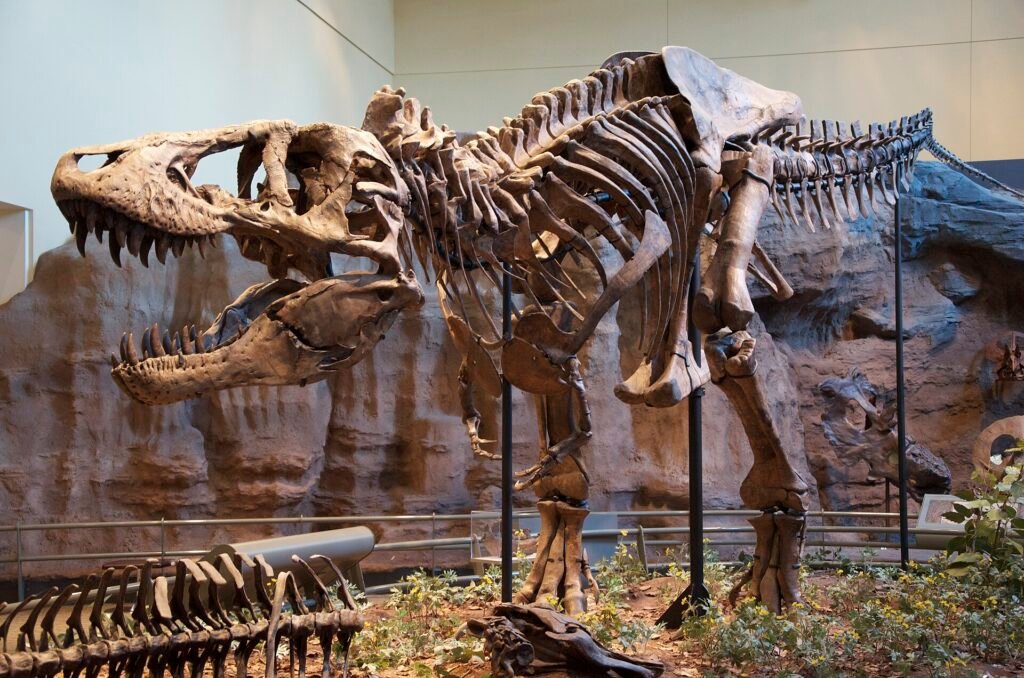
Tyrannosaurus rex, a name meaning tyrant lizard king, is a large meat-eating dinosaur that lived in western North America about 68 to 66 million years ago. The first skeletons were found by the fossil collector Barnum Brown in 1900 and 1902, and Henry Fairfield Osborn named the species in 1905.
Background
The story of the name begins earlier than the famous skeletons. In 1892 the paleontologist Edward Drinker Cope named some of the first known bones of the animal Manospondylus gigas, which means giant porous vertebra. Cope thought that they belonged to a Triceratops-like dinosaur. Nobody then realized that they were from the same animal that would later become famous.
T. rex is long extinct, and the Natural History Museum classes it as a large theropod. Barnum Brown, who worked for the American Museum of Natural History in New York, was the collector behind the early finds. The animal ranged across western North America, and fossils have been found in both the United States and Canada. The Carnegie Museum says it lived in the western United States and southwestern Canada during the late Cretaceous, about 66 to 68 million years ago.
The discovery
According to the Natural History Museum in London, the first known skeleton of a Tyrannosaurus rex was discovered in 1900 in Wyoming, followed by another in 1902. Brown found both. The Carnegie Museum of Natural History dates its specimen to 1902: Brown discovered it and sent it to the American Museum of Natural History, and the Carnegie Museum bought it in 1941.
The Burke Museum in Seattle explains that Osborn introduced the name Tyrannosaurus rex in 1905 in his original description of the animal. The first specimen, now displayed at the Carnegie Museum in Pittsburgh, was found in Montana. It was incomplete, but enough bones were preserved to show that this was a two-legged meat-eater larger than any known at the time. A second, more complete skeleton was found soon after and is displayed at the American Museum of Natural History in New York.
The Carnegie Museum points out that its specimen is the holotype, the specimen on which the species is based. Every other fossil of the animal must be compared with it. A few specimens now known to belong to the species were found before the holotype, but the holotype was the first to be recognized by science.
How it was confirmed
Scientists later realized that Manospondylus gigas and Tyrannosaurus rex belonged to the same species. The usual rules of scientific naming say that the first name given to a species takes priority. Because many scientists preferred Tyrannosaurus rex, the older name stopped being used, the Natural History Museum explains.
For decades only two museums displayed a standing T. rex skeleton. Then more specimens came to light. The Burke Museum notes that several nearly whole skeletons were added in the 1980s and 1990s, among them the famous and controversial specimen Sue, now at the Field Museum in Chicago. Further finds during the past two decades have given scientists the data to study how individuals changed as they grew and how the species is related to other dinosaurs.
The Natural History Museum describes T. rex as a large two-legged predator about 12 meters long, with a weight of about 7,000 kilograms. It had 60 saw-edged teeth, some up to 20 centimeters long. Its bite is three to five times as strong as a lion’s and is the strongest of any known land animal. The largest known specimens, called Sue and Scotty, jointly hold a Guinness World Record.
Fossils show how it lived. Tyrannosaurus tooth marks have been found on bones of Triceratops and Edmontosaurus, and pieces of swallowed bone turn up in fossilized dung. A large part of the brain handled smell, which suggests it could find food from a distance. Scientists do not know whether T. rex hunted in packs, and some bones show bite marks from other tyrannosaurs.
Disputes over taxonomy
Sources differ slightly on which skeleton counts as the first. The Natural History Museum in London dates the first known skeleton to 1900 in Wyoming and a second to 1902. The Carnegie and Burke museums focus on the specimen found in 1902 in Montana, because it became the holotype on which the species was described. Both accounts agree that Brown collected the skeletons and that Osborn named the animal.
The naming of the species was also a matter of choice. Manospondylus gigas was the older name, and under the normal rules it would have taken priority. The Natural History Museum notes that because many scientists preferred Tyrannosaurus rex, the older name fell out of use.
A more recent debate concerns how many species exist. In 2022 a study in the journal Evolutionary Biology, led by the independent scientist Gregory S. Paul, proposed splitting the fossils into three species: T. rex, T. regina and T. imperator. The authors based this on differences in the leg bones and teeth, and suggested that T. rex and T. regina evolved from T. imperator and may have lived side by side. Paul said the changes in the thigh bone are likely not related to the sex or age of the specimen.
Paul Barrett, a dinosaur expert at the Natural History Museum who was not involved in the study, said he was very skeptical. He suggested the proposed forms could all have been able to mate with each other, with the differences between them due to other reasons. The museum currently describes T. rex as the only member of its genus, and other named members are not widely accepted.
Impact and legacy
Few animals of the past are as familiar. The Burke Museum observes that putting two impressive skeletons on display in two of the largest natural history museums in the United States, just as public interest in paleontology was growing, got T. rex off to a good start. Its huge size, large teeth and tiny arms fueled the imagination, and it soon appeared in art, comics, film, television and popular music.
Its fame has also helped museums show how fossils are studied. Each new specimen adds to what scientists know about growth and relationships, which feeds into wider work on evolution, and the holotype remains the reference to which they are compared. For another well-known case of a fossil that reshaped ideas about the past, see the entry on the discovery of Archaeopteryx.
More in Earth Sciences
Key facts
- Edward Drinker Cope named bones of the animal Manospondylus gigas in 1892.3
- Barnum Brown discovered the holotype specimen in 1902.1
- Henry Fairfield Osborn described and named Tyrannosaurus rex in 1905.2
- The holotype was bought by the Carnegie Museum in 1941.1
- T. rex lived about 68 to 66 million years ago.3
- A 2022 proposal to split T. rex into three species met with skepticism.4
Related concepts
Quick checkWho discovered Tyrannosaurus rex?Show answer
Barnum Brown found the first skeletons, in 1900 and 1902, and Henry Fairfield Osborn named Tyrannosaurus rex in 1905.
Sources
- 1. Carnegie Museum of Natural History, Tyrannosaurus rex, https://carnegiemnh.org/tyrannosaurs-rex/
- 2. Burke Museum, Tyrannosaurus rex: A gigantic beast, https://www.burkemuseum.org/news/tyrannosaurus-rex-gigantic-beast
- 3. Natural History Museum, London, Dino Directory: Tyrannosaurus, https://www.nhm.ac.uk/discover/dino-directory/tyrannosaurus.html
- 4. Natural History Museum, London, Controversial paper suggests there are three Tyrannosaurus species, https://www.nhm.ac.uk/discover/news/2022/march/controversial-paper-suggests-there-are-three-tyrannosaurus-species.html
Editorially reviewed by Specialty Digest Editorial TeamLast reviewed November 5, 2026Researched and drafted with AI assistanceReport an issue