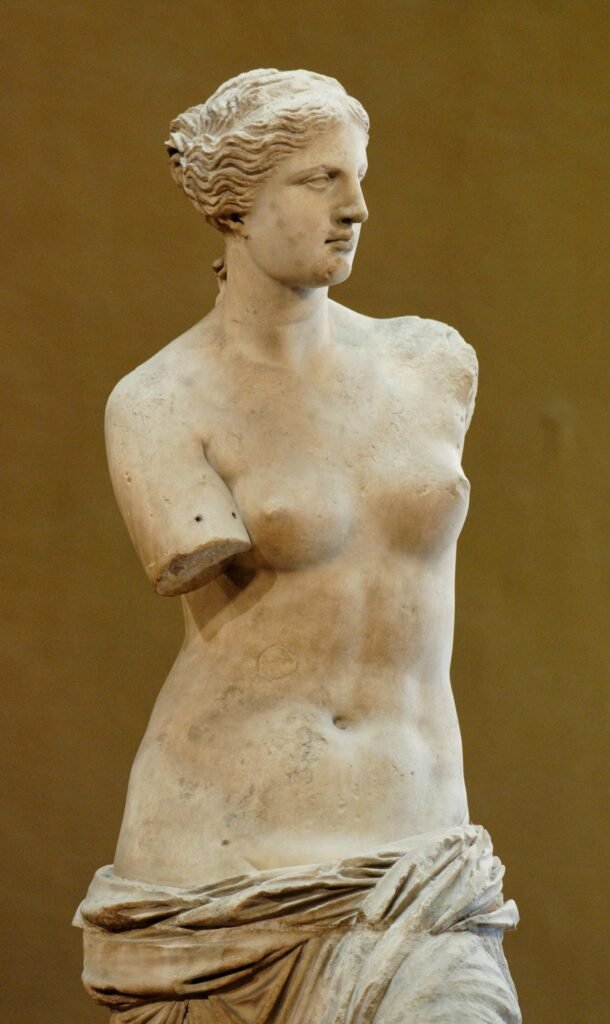
The Venus de Milo is an ancient Greek marble statue of a goddess, usually identified as Aphrodite, carved in the Hellenistic period and found on the island of Milos in 1820. It stands 204 centimeters (about 6 feet 8 inches) tall and has been in the Louvre in Paris since 1821. Its missing arms and its debated identity have made it one of the best-known works of ancient sculpture.
Background and creation of the Venus de Milo
The Louvre dates the statue to the third quarter of the second century BC, roughly 150 to 125 BC. That places it in the Hellenistic period, the stretch of Greek history that followed the conquests of Alexander the Great. The museum’s online record for the statue names no sculptor.
The figure is carved from marble from the island of Paros. It consists of two main pieces joined at the hips, and the left arm was a separate piece fitted into a socket. Small holes show that bronze elements were once attached, including a diadem and a bracelet on the right arm. The plinth was recut in antiquity.
The statue came to light in 1820 on Milos, an island of Greece that is also called Melos, and it was found in fragments. The French ambassador to Greece, the Marquis de Rivière, acquired it almost at once. He presented it to King Louis XVIII, who gave it to the Louvre in March 1821. In the museum’s words, the statue went from obscurity to the spotlight in barely two years.
The timing helped its fame. After the defeat of Napoleon Bonaparte at Waterloo, the Treaty of Vienna of 1815 required France to return some 5,000 works seized during its conquests, and the Louvre’s rooms of antiquities emptied. The museum says the newcomer was therefore welcomed and promoted as a masterpiece. A 2020 Vox video by Phil Edwards makes a similar argument, saying the political situation, more than the statue alone, turned a notable find into an icon.
Description of the Venus de Milo
The statue shows a standing woman, bare to the hips, with a cloak, called a himation, wrapped around her lower body. Her hair is gathered in a bun and held by a band. The Louvre points to her gentle gaze and her swaying, hip-shifted stance as the features that set her apart from other sculpted goddesses.
The work is incomplete. The left arm, most of the right arm and the left foot are lost. The nose is chipped, the bun has been glued back on, and the tip of the nose was rebuilt in plaster. The back of the figure shows many small chips.
Objects found near the statue add to the puzzle. One was a hand holding an apple, carved from the same Parian marble. The museum also notes that the position of the left leg could suggest the figure once held a shield, in which Aphrodite, the partner of the war god Ares, was often shown admiring her reflection. Nobody can say for certain which pose the arms took.
Who does the Venus de Milo represent?
Without its arms, the statue lacks the held objects that usually identify a Greek deity. At the time of the find, two identifications were weighed. One was Amphitrite, a sea goddess especially honored on Milos. The other was Aphrodite, the goddess of beauty, whom the Romans called Venus.
The half-nude body and the jewelry the figure once wore tipped the balance toward Aphrodite. The hand with the apple, an attribute of Aphrodite, pointed the same way, although the Louvre presents it as a possible clue and not as proof. The popular name combines a Roman goddess with a Greek island, and it comes from the place of discovery.
When the statue entered the Louvre, restorers discussed adding new arms. The plan was dropped for fear of altering the work, and because no one knew what position the arms had held. Today the museum presents the figure as an ideal of Greek beauty, and her incompleteness remains part of how visitors meet her.
Reception and legacy of the Venus de Milo
The Louvre counts the statue among the three most famous female figures in its collection, alongside the Mona Lisa and the Winged Victory of Samothrace. It says the statue earned a reputation as soon as it entered the museum in 1821, and that artists have copied it and reworked it in countless ways in art and popular culture ever since. Vox adds that French officials went to considerable lengths to protect the statue’s standing, and it points readers to a book by Gregory Curtis and a paper by Philippe Jockey for the detailed story.
Where to show her has been a recurring question. Antiquities arrived at the Louvre in stages. Louis XIV placed part of his collection in the Salle des Cariatides in 1692, new pieces came after the Italian campaigns of 1798, and Napoleon bought the Borghese collection in 1807. The Galerie des Antiques was then enlarged by the architects Charles Percier and Pierre Fontaine, who used gray and red marble to set off the white statues. It was inaugurated in 1811, ten years before the Venus arrived.
She was first placed in that gallery, then moved several times as curators asked whether she should stand alone, on what base and against what background, and even whether she belonged among the paintings of the Grande Galerie. Since 2010 she has stood by herself in the room where she was first shown.
Where to see the Venus de Milo
The statue is on display in Room 345 of the Sully Wing, ground level, in the Louvre’s Department of Greek, Etruscan and Roman Antiquities. Its catalog number is Ma 399. The museum cautions that room details in its online catalog may lag behind recent redesigns of its collection management tools, so visitors should check the current floor plan.
More in Visual Arts
Key facts
- The Louvre dates the statue to about 150 to 125 BC, in the Hellenistic period.1
- It is carved from Parian marble, stands 204 centimeters tall and is catalogued as Ma 399.1
- It was found in 1820 on the Greek island of Milos and given to the Louvre by King Louis XVIII in 1821.12
- The arms are lost, and a hand holding an apple was found near the statue.2
- In 1815 the Treaty of Vienna required France to return about 5,000 seized works, which left the Louvre's antiquities rooms emptied before the Venus arrived.3
Related concepts
Quick checkWhen was the Venus de Milo found?Show answer
It was found in 1820 on the Greek island of Milos and reached the Louvre in 1821.
Sources
- Louvre Museum, Collections database: Venus de Milo (Ma 399), https://collections.louvre.fr/en/ark:/53355/cl010277627
- Louvre Museum, Ideal Greek Beauty: Venus de Milo and the Galerie des Antiques, https://www.louvre.fr/en/explore/the-palace/ideal-greek-beauty
- Louvre Museum, Une arrivée providentielle au Louvre (Chefs-d'oeuvre du Louvre), https://www.louvre.fr/decouvrir/les-parcours-de-visite/chefs-d-oeuvre-du-louvre/une-arrivee-providentielle-au-louvre
- Vox, How the Venus de Milo got so famous (Phil Edwards, 26 February 2020), https://www.vox.com/2020/2/26/21153125/venus-de-milo-history
Editorially reviewed by Specialty Digest Editorial TeamLast reviewed November 5, 2026Researched and drafted with AI assistanceReport an issue