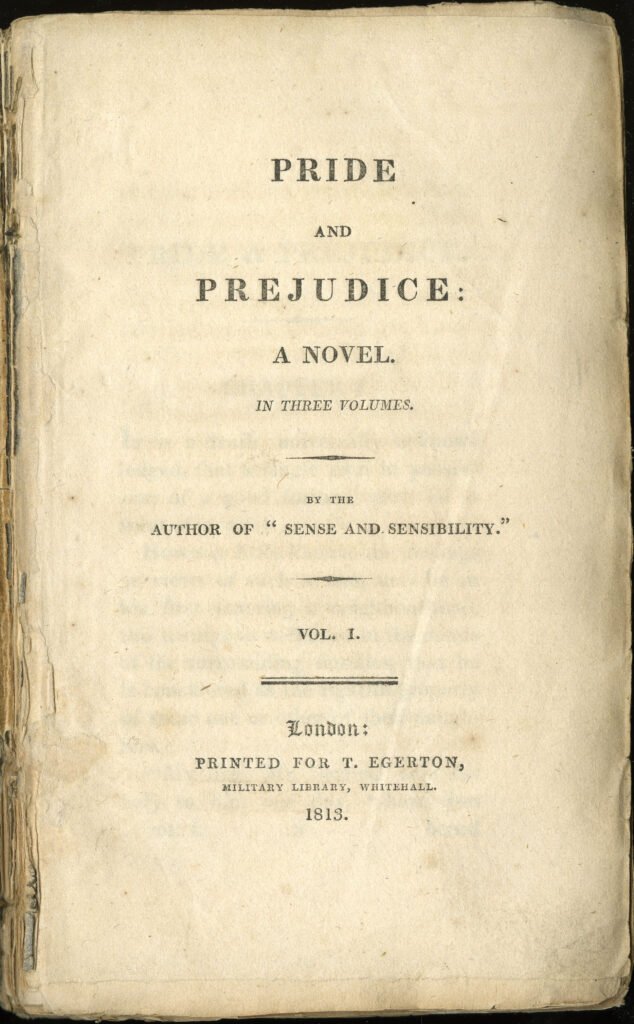
Pride and Prejudice is a novel by the English writer Jane Austen, published anonymously in three volumes in January 1813. It follows Elizabeth Bennet, the second of five sisters in a country family, as she and the wealthy Fitzwilliam Darcy misjudge each other and then revise their opinions. It is among the best-known English novels.
Background and writing of Pride and Prejudice
Austen first drafted the story in 1796 at Steventon, in Hampshire, under the title First Impressions. She revised the manuscript extensively between 1811 and 1812 at Chawton, and it was during this revision that she gave it the title Pride and Prejudice.
By then she had published one novel. Her first publisher, Thomas Egerton, ran a lending library for military readers in Whitehall, and he had issued Sense and Sensibility in 1811 on commission, which meant Austen carried the financial risk herself.
When that book sold well, Egerton agreed to publish the next at his own risk and bought the copyright. Austen wrote that he paid 110 pounds for it and that she would have preferred 150.
Austen probably found this publisher through her brother Henry, who was a militia officer and army agent with connections in the military world.
Publication and first edition
The first edition appeared in January 1813. It is thought to have run to around 1,500 copies and was priced at 18 shillings for the three-volume set. It sold out quickly, a second edition followed later in 1813 and a third in 1817.
Because Egerton owned the copyright, he took the profit from these sales and Austen did not. The title page described the work only as being by the author of Sense and Sensibility. No one knows why she stayed anonymous, though her authorship was an open secret among family and friends.
In a letter of 29 January 1813 she told her sister Cassandra that she had received her copy from London and called the book her own darling child. Jane Austen’s House in Chawton, Hampshire, now holds a first edition from the set that belonged to her brother Edward Knight at Godmersham Park. Such sets were usually sold in paper boards, and owners often had them rebound in leather to match their libraries.
Plot summary of Pride and Prejudice
The Bennet family lives at Longbourn in Hertfordshire. Mr. and Mrs. Bennet have five daughters and no son, and the estate is set to pass to a male cousin, the clergyman Mr. Collins, so the daughters need to marry well.
The arrival of the wealthy Charles Bingley at nearby Netherfield raises the family’s hopes, and he soon admires the eldest daughter, Jane. His friend Darcy seems proud and cold at a local ball, and Elizabeth takes a strong dislike to him. She also believes a charming officer, George Wickham, when he tells her that Darcy treated him unjustly.
Elizabeth refuses a proposal from Mr. Collins, who then marries her friend Charlotte Lucas. At Hunsford in Kent, Darcy surprises Elizabeth with a proposal of his own, mixed with remarks about her family’s low standing, and she rejects it. In a long letter he answers her charges and reveals the truth about Wickham.
Elizabeth’s view of Darcy changes during a visit to his estate at Pemberley. Her youngest sister Lydia then runs away with Wickham, which threatens the whole family’s reputation. Darcy quietly helps bring about a marriage, Bingley returns to Jane, and Elizabeth finally accepts Darcy.
Characters in Pride and Prejudice
Elizabeth Bennet is intelligent, quick and fond of testing other people’s opinions, which also makes her slow to doubt her own. Fitzwilliam Darcy is a rich landowner whose reserve is mistaken for arrogance, and part of his arc is learning to act with courtesy toward people of lower rank.
Jane Bennet is gentle and reluctant to think ill of anyone, and Bingley is open and easily led by his friends. Mr. Bennet meets his household with dry wit and little action, while Mrs. Bennet is anxious to see her daughters married. Wickham is charming but unreliable, Mr. Collins is pompous and servile, and Lady Catherine de Bourgh is Darcy’s overbearing aunt.
Themes in Pride and Prejudice
Marriage and money run through the book. Women of Austen’s class had few ways to earn a living, so marriage was also a question of security, and the novel sets love against prudence through characters such as Charlotte Lucas.
The title points to the two flaws the central pair must overcome. Darcy’s pride in rank makes him dismissive at first, and Elizabeth’s prejudice leads her to trust Wickham and distrust Darcy. The earlier title, First Impressions, shows how central the idea of snap judgment was to the plan.
Class and family reputation also matter. Lydia’s elopement shows how one sister’s conduct could damage the prospects of the others, while the proud Lady Catherine de Bourgh shows rank used as a weapon.
Austen tells the story in a clear, ironic voice. The narrator often moves close to a character’s thoughts without quoting them, so readers see Elizabeth’s errors from the inside and can also judge them.
Reception and legacy of Pride and Prejudice
The novel sold well from the start, and the sale of the first edition and the quick appearance of a second edition show the demand. A scholar writing in the journal of the Jane Austen Society of North America calls it arguably Austen’s most famous and influential work. Nearly ten percent of the books and objects at Jane Austen’s House relate directly or indirectly to its writing, publication and legacy.
It has since been translated widely and adapted many times for stage, film and television. Its characters, especially Elizabeth Bennet and Mr. Darcy, are familiar even to people who have not read the book, and it is a common set text in schools and universities.
More in Literature
Key facts
- Pride and Prejudice was published in January 1813 by Thomas Egerton in London, in three volumes.1
- Austen first drafted it in 1796 as First Impressions and revised it extensively in 1811 and 1812.2
- Egerton bought the copyright, and Austen wrote that he paid 110 pounds.1
- The first edition is thought to have run to about 1,500 copies at 18 shillings, with a second edition in 1813 and a third in 1817.1
- The title page named the author only as the author of Sense and Sensibility.1
Related concepts
Quick checkWhat was Pride and Prejudice originally called?Show answer
Austen drafted it in 1796 as First Impressions and gave it the title Pride and Prejudice when she revised it in 1811 and 1812.
Sources
- Jane Austen's House, Publication (Pride and Prejudice), https://janeaustens.house/?p=13477
- Jane Austen's House, First edition: Pride and Prejudice (object record), https://janeaustens.house/object/pride-and-prejudice-first-edition/
- Lizzie Dunford, Darling Children: The Presence of Pride and Prejudice at Jane Austen's House, Persuasions On-Line, vol. 44 no. 1, Jane Austen Society of North America, https://jasna.org/publications-2/persuasions-online/volume-44-no-1/dunford/
Editorially reviewed by Specialty Digest Editorial TeamLast reviewed November 5, 2026Researched and drafted with AI assistanceReport an issue