The Canterbury Tales is a collection of stories, mostly in verse, by the English poet Geoffrey Chaucer, written in Middle English between about 1375 and 1400. It presents a group of pilgrims who travel from London to the shrine of Saint Thomas Becket at Canterbury and pass the time by telling tales. Chaucer never finished the work, yet it remains one of the best-known works of medieval English literature.
Background and creation of The Canterbury Tales
Geoffrey Chaucer was born between 1340 and 1345 into a family of wealthy London wine merchants. He served in noble households, visited Italy in the 1370s, and held the post of controller of customs on wool, hides and skins from 1374. Before the Tales he had written dream-vision poems such as The Parliament of Birds, as well as the love story Troilus and Criseyde.
His choice of language was significant. At the time, much of the English upper class spoke French, and Latin was treated as the proper language of learning and lasting literature. Chaucer wrote in English, and in doing so he helped turn it into a flexible literary language.
The idea of linking separate stories inside a frame was not new. Giovanni Boccaccio’s Decameron (1349 to 1351) has ten young nobles who leave plague-stricken Florence and entertain one another with tales. It is unclear whether Chaucer knew that book in full, but his unfinished poem uses a similar frame technique, with a pilgrimage in place of a retreat from disease. Scholars date the Tales to roughly 1375 to 1400.
Structure and content of The Canterbury Tales
In the General Prologue, the narrator, who is named Chaucer, meets roughly thirty travelers at an inn in Southwark near London. The host proposes a storytelling contest, with each pilgrim to tell stories on the road to Canterbury and on the way back, and the best storyteller to win a free supper. The plan would have produced about 120 tales, but far fewer were written, and several of those are unfinished.
The pilgrims come from many walks of life and include a knight, a miller, a prioress, a pardoner, a lawyer, a merchant and the well-known Wife of Bath. Their tales match a wide range of types, from courtly romance in the Knight’s Tale to bawdy comic stories in the Miller’s and Reeve’s Tales and moral prose in the Tale of Melibee. Linking passages between the tales show the pilgrims interrupting, insulting and answering one another, so the frame develops its own drama.
Manuscripts disagree about the order of the tales. Modern editions usually group tales that clearly belong together into ten sections called fragments, because the links between some of the groups are uncertain.
Most of the verse is written in rhyming couplets of ten-syllable lines, a form that later English poets would use heavily. Two tales, the Tale of Melibee and the Parson’s Tale, are in prose, and the Tale of Sir Thopas deliberately imitates the sing-song style of popular romances, a joke on the pilgrim who tells it.
Manuscripts and early printing of The Canterbury Tales
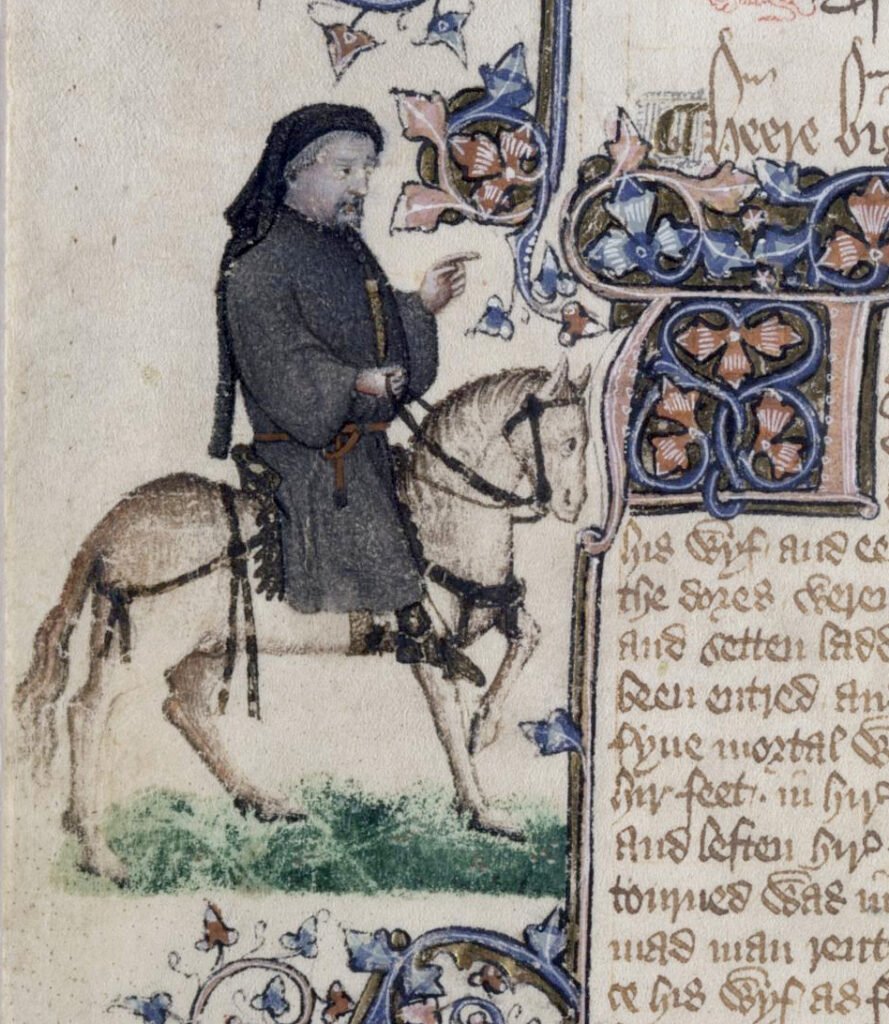
No copy in Chaucer’s own hand survives. The two earliest and most authoritative manuscripts, known as the Hengwrt and the Ellesmere, were copied by the same scribe. The Ellesmere manuscript is now held by the Huntington Library in San Marino, California, and it is noted for its illustrations of the pilgrims and its portrait of Chaucer.
The first printer of the work was William Caxton, who worked at Westminster. He issued an edition around 1476 and a second edition around 1483. In the prologue to the second edition he calls Chaucer the first author and maker of the book and asks readers to remember his soul. Printing made the text far easier to circulate than hand copying, and it fixed one version of the tale order for many readers.
Themes in The Canterbury Tales
A central theme is society itself. The pilgrims represent clergy, workers, merchants and aristocrats, and their tales and portraits reveal how each group sees the others. Chaucer is often gently ironic, and he is sharpest about church officials who profit from their positions, such as the Pardoner, who preaches against greed while admitting that he sells false relics.
Love, marriage and authority recur throughout. The Wife of Bath argues from her own experience that women should have mastery in marriage, and several later tales answer her. The Knight’s Tale treats love as a force tied to fate and honor, while the Miller’s Tale mocks that high ideal with a farce about a carpenter and his young wife.
The collection is also about storytelling. The pilgrims often reveal as much about themselves as about their subjects, and Chaucer plays with the question of who can be trusted to tell the truth. The narrator named Chaucer presents himself as a naive listener, an irony that readers have enjoyed for centuries. Even the ending, in which the Parson’s long prose treatise gives way to a retraction asking forgiveness for Chaucer’s worldly writing, leaves a debate over how seriously to take it.
Reception and legacy of The Canterbury Tales
Dozens of surviving manuscripts and early printings show that the Tales were copied and read widely in the generations after Chaucer’s death. Later writers came to treat Chaucer as a founder of English literature, and he is often called the first great English poet.
The work’s influence reaches beyond the page. It is a standard text in English courses, has been translated into modern English many times, and has been adapted for the stage, radio, film and television. The device of a mixed company of travelers swapping stories has been borrowed by countless later writers, and the idea of a pilgrimage to Christian shrines in the Middle Ages is closely tied in the public imagination to Chaucer’s travelers.
More in Literature
Key facts
- The Poetry Foundation dates The Canterbury Tales to about 1375 to 1400 and notes that Chaucer never finished it.1
- Chaucer was born between 1340 and 1345 and wrote in English at a time when Latin and French dominated learned writing.1
- Its frame technique resembles Boccaccio's Decameron (1349 to 1351), though it is unclear that Chaucer knew that work in full.1
- The Ellesmere manuscript, held by the Huntington Library, contains illustrations of the pilgrims and a portrait of Chaucer.2
- William Caxton issued a second edition of the Tales at Westminster around 1483.3
- The Hengwrt and Ellesmere manuscripts, the two earliest and most authoritative, were written by the same scribe.4
Related concepts
Quick checkWho wrote The Canterbury Tales, and what frames its stories?Show answer
Geoffrey Chaucer wrote it, and its stories are told by pilgrims traveling from London to the shrine of Thomas Becket at Canterbury.
Sources
- Poetry Foundation, Geoffrey Chaucer (biography), https://www.poetryfoundation.org/poets/geoffrey-chaucer
- Chaucer Bibliography (University of Texas at San Antonio), record for Herbert C. Schulz, The Ellesmere Manuscript of Chaucer's Canterbury Tales (Huntington Library, 1966), https://chaucer.lib.utsa.edu/items/show/274398
- Caxton and Beyond (De Montfort University), Canterbury Tales (2nd edition) edition description, https://caxtonandbeyond.dmu.ac.uk/editions/59_Cha_Can.html
- History of Information, Both of the Earliest and Most Authoritative Manuscripts of Chaucer's Canterbury Tales Were Written by the Same Scribe, https://historyofinformation.com/detail.php?id=1919
Editorially reviewed by Specialty Digest Editorial TeamLast reviewed November 5, 2026Researched and drafted with AI assistanceReport an issue