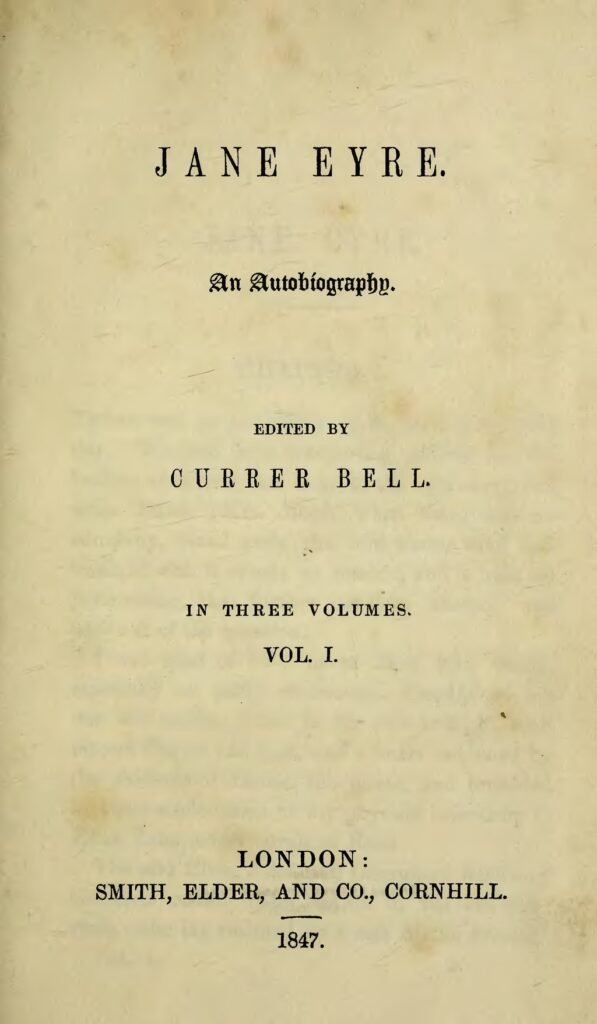
Jane Eyre is a novel by the English writer Charlotte Brontë (1816 to 1855), published in 1847 under the pseudonym Currer Bell. It follows an orphaned girl who grows into a governess and who insists on her own moral independence, even when she falls in love with her employer, Mr. Rochester. It was the first novel Brontë had published, and it remains her best-known work.
Background and writing of Jane Eyre
Brontë grew up in Yorkshire as the daughter of a clergyman, and she began as a poet. In 1846 she and her sisters Emily and Anne paid for a volume of verse, Poems by Currer, Ellis, and Acton Bell, using male-sounding pseudonyms.
She also tried to place her first novel, The Professor, which was rejected repeatedly. The London firm of Smith, Elder declined it but asked to see any other novel she had in hand. That request led her to complete Jane Eyre, which the firm published in 1847.
She wrote at the family home in Haworth, now the Brontë Parsonage Museum, where all three sisters produced their novels. After the book’s success, she wrote almost no more poetry, except for three unfinished poems prompted by the deaths of her siblings in 1848 and 1849.
Her private life was marked by loss. Her brother Branwell died on 24 September 1848, Emily on 19 December 1848 and Anne on 28 May 1849. Through these years she kept up letters with George Henry Lewes and with William Smith Williams, a reader at Smith, Elder.
Plot summary of Jane Eyre
Jane is a poor orphan raised by an unkind aunt, Mrs. Reed, at Gateshead. She is sent to Lowood, a harsh charity school, where she makes a close friend, Helen Burns, and later stays on as a teacher.
At eighteen she takes a post as governess at Thornfield Hall, where she teaches Adèle, the ward of the brooding owner, Edward Rochester. Strange laughter and a night-time fire hint at a secret in the house, and as Jane and Rochester grow close, he proposes marriage.
The wedding is stopped when a stranger declares that Rochester is already married. His first wife, Bertha Mason, is kept hidden in the upper floor of the hall. Jane refuses to stay as his companion on any lesser terms and leaves Thornfield with almost nothing.
She is taken in by a clergyman, St. John Rivers, and his sisters, and she finds work as a teacher. When St. John asks her to marry him and join a mission abroad, she refuses, and she returns to Thornfield to find it burned. Rochester is blinded and maimed, and Bertha has died in the fire, so the two are able to marry on more equal terms.
Style and structure of Jane Eyre
The book is narrated by Jane herself, looking back on her life, and the title page presented it as an autobiography. This direct first-person voice gives readers close access to her thoughts and her moral reasoning, and it often addresses the reader openly.
The Brontë Parsonage Museum describes the novel as a mix of moral dilemmas, supernatural scenes and evocative landscapes. Weather, fire, and the contrast between cold institutions and warm rooms all reinforce the emotional pattern of the plot.
Characters in Jane Eyre
Jane is the narrator and central figure, plain-spoken, observant and determined to be judged on her character. Edward Rochester is the wealthy, moody master of Thornfield, whose secrecy clashes with the honesty Jane demands. Bertha Mason is his first wife.
Mrs. Reed and Mr. Brocklehurst stand for cruelty and hypocrisy in Jane’s childhood, while Helen Burns offers patience and faith. St. John Rivers is dutiful, cool and driven by a sense of mission, and his sisters Diana and Mary give Jane her first real family. Adèle Varens, Rochester’s young ward, and the housekeeper Mrs. Fairfax complete the household at Thornfield.
Themes in Jane Eyre
The most prominent theme is independence. Jane keeps asking for respect as an equal, whether she is addressing her aunt, her employer or a suitor, and she will not exchange her self-respect for comfort or love.
Class and gender are closely linked to it. As a governess, Jane belongs to a group that was neither servant nor family, and her wages depend on goodwill. Her small inheritance later gives her a measure of security and the freedom to choose.
Religion also shapes the book, in contrasting forms. The hypocritical head of Lowood, the saintly Helen Burns and the ambitious missionary St. John Rivers each show a different way of living a Christian life, and Jane tests them against her own conscience.
Readers have also debated the role of Bertha Mason, a woman from the West Indies who is confined and silenced. Later critics have read her as a symbol of the limits placed on women and of the colonial wealth in the background of the English household, and the novelist Jean Rhys explored her story in Wide Sargasso Sea in 1966.
Reception and legacy of Jane Eyre
The novel was popular at once. According to the Poetry Foundation, Currer Bell quickly became known to readers as the author of Jane Eyre, and Brontë let her identity become known after her success. She went on to publish Shirley in 1849 and Villette in 1853. Her sister Emily’s Wuthering Heights had appeared in December 1847, only weeks after Jane Eyre.
Some Victorian critics thought the Brontë sisters’ writing coarse or brutal, but their directness and emotional force proved lasting. Today the Museum notes that the novels continue to inspire artwork, music, television, film and theatre around the world.
Jane Eyre is widely taught as a central text of nineteenth-century English fiction, and it is often cited in discussions of the governess figure, the Gothic tradition and women’s voices in literature. Responses such as Rhys’s novel show how readers keep returning to its characters and questions.
More in Literature
Key facts
- Jane Eyre was published in 1847 under the pseudonym Currer Bell.1
- Charlotte Brontë lived from 1816 to 1855, and Jane Eyre was her first published novel.12
- The London firm of Smith, Elder published it after declining her earlier novel, The Professor.1
- The Brontë Parsonage Museum describes it as mixing moral dilemmas, supernatural scenes and evocative landscapes.2
- Brontë later published Shirley in 1849 and Villette in 1853.1
Related concepts
Quick checkUnder what name was Jane Eyre first published?Show answer
It appeared in 1847 under the pseudonym Currer Bell, and Charlotte Brontë later let her identity become known.
Sources
- Poetry Foundation, Charlotte Brontë (biography), https://www.poetryfoundation.org/poets/charlotte-bronte
- Brontë Parsonage Museum, The Brontë novels, https://bronte.org.uk/the-brontes-and-haworth/jane-eyre
Editorially reviewed by Specialty Digest Editorial TeamLast reviewed November 5, 2026Researched and drafted with AI assistanceReport an issue