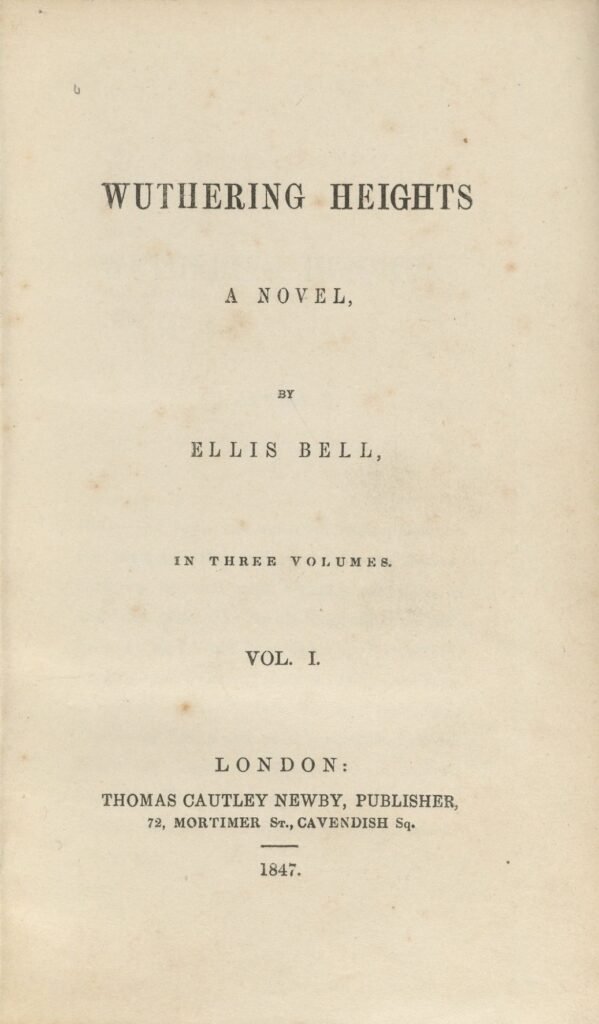
Wuthering Heights is a novel by the English writer Emily Brontë (1818 to 1848), published in December 1847 under the pseudonym Ellis Bell. Set on the Yorkshire moors, it tells of the destructive bond between Catherine Earnshaw and the foundling Heathcliff and of the two households their quarrel affects across two generations. It was Brontë’s only novel.
Background and writing of Wuthering Heights
Emily Brontë grew up in the Haworth parsonage in West Yorkshire with her sisters Charlotte and Anne and her brother Branwell. The family home is now the Brontë Parsonage Museum, which says the sisters wrote their novels there and that the story evokes the turbulent moorland around Haworth.
In 1846 the three sisters paid for a joint volume, Poems by Currer, Ellis, and Acton Bell, which sold only two copies. In April 1846 Charlotte told a publisher that the Bells were preparing a work of fiction in three separate tales, which became Charlotte’s The Professor, Emily’s Wuthering Heights and Anne’s Agnes Grey.
Critics have also linked the novel to Emily’s poems about Gondal, an imaginary land she and Anne invented. The isolated scenery and passionate, grieving characters of that verse seem to have given her practice for the setting of Wuthering Heights and for the figures of Cathy and Heathcliff.
Publication and early reception
After the sisters had difficulty finding a publisher, Thomas Newby agreed to publish Emily’s and Anne’s novels, and they appeared in December 1847. The Professor was published only in 1857, after Charlotte’s death. Charlotte’s own novel Jane Eyre had appeared a few weeks earlier in 1847.
The first reviewers were puzzled by the strangeness and savagery of the book, yet almost all recognized its power and originality. The Brontë Parsonage Museum quotes one reviewer who wrote that readers were shocked and nearly sickened by cruelty and vengeance, yet also met passages that showed the force of love.
Emily died on 19 December 1848, a year after publication. In 1850 Charlotte edited a new edition, added a Biographical Notice to counter charges of coarseness, and revised some of Emily’s unpublished poems for the volume, in some cases adding lines of her own.
Plot summary of Wuthering Heights
The story is framed by Mr. Lockwood, a tenant at Thrushcross Grange who visits his landlord at the nearby farmhouse of Wuthering Heights. Curious about the household, he asks the housekeeper, Nelly Dean, to tell him its history, and most of the novel is her account.
Years earlier, Mr. Earnshaw brought home an orphan boy from Liverpool and named him Heathcliff. He grew close to Earnshaw’s daughter Catherine, but her brother Hindley resented him and treated him as a servant after their father died.
Catherine chose to marry the refined Edgar Linton of Thrushcross Grange, partly for social position. Heathcliff left, returned years later with money, and set about taking revenge on Hindley, on the Lintons and on their children.
Catherine died after giving birth to a daughter. In the second half of the book, the next generation, Cathy Linton and Hareton Earnshaw, grow up in the shadow of Heathcliff’s schemes, and their growing affection offers a gentler ending after his death.
Characters in Wuthering Heights
Catherine Earnshaw is wild, proud and torn between her attachment to Heathcliff and her wish for comfort and standing. Heathcliff is the orphan who becomes a hard, vengeful master, and the book leaves open how far readers should pity him or fear him.
Edgar Linton is gentle and conventional, and his sister Isabella marries Heathcliff with painful results. Hindley Earnshaw turns from jealousy to drink and ruin, and the servant Joseph speaks in a thick Yorkshire dialect that adds local color. In the next generation, Cathy Linton is spirited like her mother, and Hareton Earnshaw is a rough young man who is denied education but shows loyalty and warmth.
Style and structure of Wuthering Heights
The novel uses nested narrators, so that Lockwood relays Nelly’s version of events, and Nelly sometimes relays what others told her. This layering makes readers weigh each account and ask how reliable the storyteller is.
The two houses stand for contrasting worlds. Wuthering Heights is rough, exposed and weathered, while Thrushcross Grange is sheltered and polished, and the movement of characters between them marks changes in power and class.
Themes in Wuthering Heights
Love and obsession are central, and the book treats them as forces that can consume and destroy as well as inspire. Catherine’s well-known claim of identity with Heathcliff is a statement of passion, but her choice of marriage shows the pressures of status.
Revenge and cruelty form a second strand. Heathcliff passes the harm he suffered as a child on to others, and the novel asks whether that cycle can be broken, a question the second generation partly answers.
Class and property also matter. Heathcliff’s origin is never explained, and his rise from servant to owner of both houses shows how inheritance and marriage could be used to gain control of land.
Nature is closely tied to character. The Gothic elements, such as ghostly sightings at the window and bleak weather, have helped the book remain a genre-defining classic, in the words of the Museum.
Reception and legacy of Wuthering Heights
Opinion shifted over time from bewilderment to admiration. Critics of the twentieth century paid close attention to its poetic imagery and to the ways it drew on Emily’s earlier verse, and it is now ranked among the central works of Victorian fiction.
The Museum notes that the Brontë novels continue to inspire artwork, music, television, film and theatre worldwide, and Wuthering Heights remains one of the most adapted of them. It is widely taught, and its two main characters are familiar even to people who have not read it.
More in Literature
Key facts
- Wuthering Heights was published in December 1847 by Thomas Newby under the pseudonym Ellis Bell.1
- Emily Brontë lived from 1818 to 1848 and died on 19 December 1848.12
- It appeared in the same month as Anne Brontë's Agnes Grey, while Charlotte's The Professor was published in 1857.1
- Charlotte Brontë edited a new edition in 1850 and wrote a Biographical Notice to answer charges of coarseness.1
- The Brontë Parsonage Museum calls it a genre-defining Gothic classic set on the moorland around Haworth.3
Related concepts
Quick checkWho wrote Wuthering Heights, and under what name?Show answer
Emily Brontë wrote it, and it appeared in December 1847 under the pseudonym Ellis Bell.
Sources
- Poetry Foundation, Emily Brontë (biography), https://www.poetryfoundation.org/poets/emily-bronte
- Poetry Foundation, Charlotte Brontë (biography), https://www.poetryfoundation.org/poets/charlotte-bronte
- Brontë Parsonage Museum, The Brontë novels, https://bronte.org.uk/the-brontes-and-haworth/jane-eyre
Editorially reviewed by Specialty Digest Editorial TeamLast reviewed November 5, 2026Researched and drafted with AI assistanceReport an issue