Romeo and Juliet is a tragedy by William Shakespeare about two teenagers from feuding families in Verona who fall in love and die. Scholars generally date its writing to 1595 or 1596, and it was first printed in 1597. The Folger Shakespeare Library describes it as one of Shakespeare’s most popular plays, both in his lifetime and ours.
Background and creation of Romeo and Juliet
No record says exactly when Shakespeare wrote the play. Scholars place it in 1595 or 1596 because its lyrical style resembles Love’s Labour’s Lost, Richard II, A Midsummer Night’s Dream and The Merchant of Venice, all written in the mid-1590s. The Royal Shakespeare Company and the Folger give the same reasoning.
The story was not new. Arthur Brooke published The Tragicall Historye of Romeus and Juliet in 1562, the first English version, and his long poem was popular and reprinted several times. Brooke in turn drew on a tale told in French and Italian literature. Italian versions by Luigi da Porta in the 1530s and Matteo Bandello in the 1550s already had the feuding families, called Montecchi and Capelletti, the secret wooing and marriage, the helpful Nurse, the friar’s potion, the lost message and the deaths in the tomb.
Shakespeare kept those elements and reshaped them as a play. He also set the action in a Verona that the Folger editors suggest may reflect Elizabethan ideas about hot-blooded Italians.
Summary of Romeo and Juliet
The prologue calls the title characters star-crossed lovers. Romeo is a Montague and Juliet is a Capulet, and their families are locked in a blood feud that plays out on the streets of Verona. Each time a member of one family dies, relatives demand the blood of the killer.
Romeo and his friends go in disguise to a party at Juliet’s house. The two fall in love at once and decide to marry. A friar, Laurence, marries them in secret, hoping the match will end the feud.
Street violence soon follows, and Romeo is banished from Verona. If he were found with Juliet, her relatives would kill him. Her family then arranges for her to marry Count Paris. To avoid that marriage, Juliet takes a potion from the friar that makes her seem dead, and she is placed in the family tomb. The friar sends word to Romeo, but the plan goes wrong and Romeo hears instead that she has died.
In the tomb, Romeo takes his own life. Juliet wakes, sees his body and does the same. Their deaths appear at last to end the feud between the families.
Themes and interpretation of Romeo and Juliet
The Folger editors Barbara Mowat and Paul Werstine stress the contrast between love and a violent, death-filled world. The usual troubles of young lovers are magnified here, because the families are not merely disapproving, they are trying to kill each other. In that setting, the movement from love at first sight to union in death seems almost inevitable.
Another theme is how love and fate interact. The prologue announces the ending before the first scene, so the audience watches events unfold with a sense that the stars conspire against the couple. At the same time the plot turns on human choices, secrecy and a delayed message.
The editors also note that the play has become the quintessential story of young love, partly because its language is so beautiful and lets the lovers say what anyone would wish to say. Because most young people feel they must overcome large obstacles to be together, readers often respond as if the play were about all lovers and not about one couple in an unusual world.
Adaptations show how flexible the setting is. A seventeenth-century rewrite called The History and Fall of Caius Marius moved the story to ancient Rome. In the twentieth century, Leonard Bernstein, Arthur Laurents and Stephen Sondheim placed it among New York street gangs in West Side Story.
Early printings of Romeo and Juliet
The play reached print in several forms before the First Folio of 1623. In 1597 appeared a small quarto titled An Excellent conceited Tragedie of Romeo and Iuliet. It is only about two-thirds as long as later versions. It follows them closely until near the end of Act 2, then offers a very different wedding scene, and in the last three acts its language varies widely from later texts.
The Folger calls this the First Quarto a so-called bad quarto. The Royal Shakespeare Company describes it as an unauthorized edition, printed at a time when no copyright law protected authors, and notes that the title page boasts of performances in public with great applause.
A second quarto followed in 1599, advertised as newly corrected, augmented and amended. It seems to have been printed mostly from a manuscript with the fuller text, although its printer also consulted the first quarto. A third quarto reprinted the second in 1609, and an undated fourth quarto has been dated by the scholar Carter Hailey to 1623. The First Folio of 1623 reprinted the third quarto, with changes that seem too skilled to be the work of typesetters alone.
Modern editors almost all use the Second Quarto as their base text. The Folger editors add that older stories about the first quarto, such as the claim that it was assembled from actors’ memories, rest on questionable evidence or sometimes none, and that scholars now treat them more skeptically.
Reception and legacy of Romeo and Juliet
The rapid appearance of an unauthorized edition in 1597 suggests the play was a hit with early audiences. Since then it has been staged, adapted and illustrated continually. The Folger collection includes a painting by James Northcote from about 1790 of the final tomb scene, and costume designs for a 1936 film.
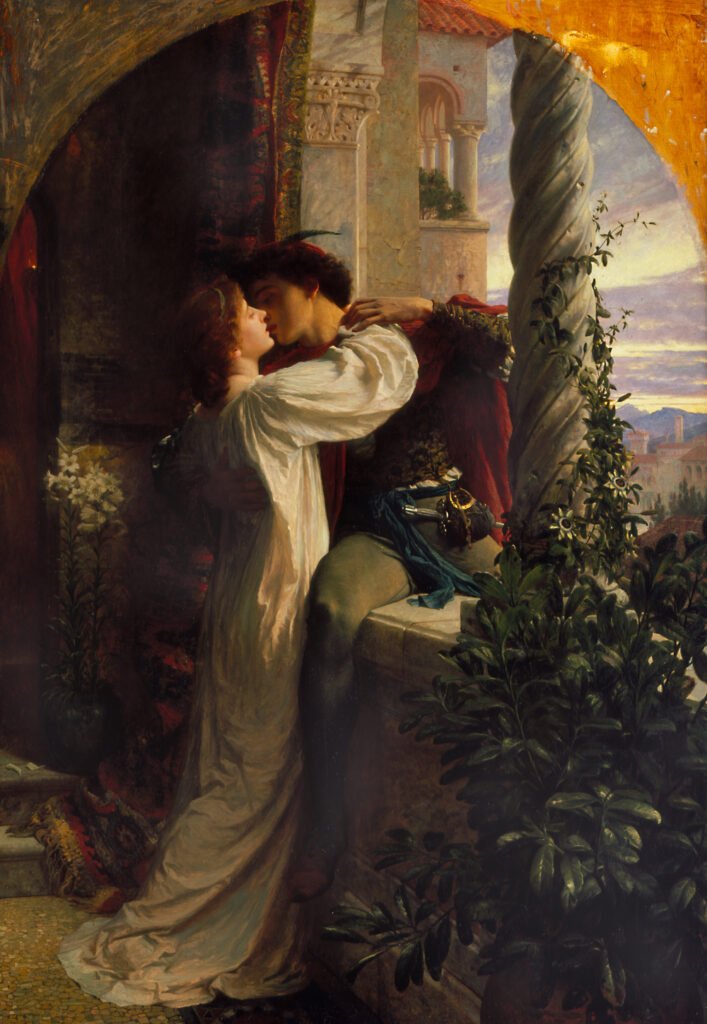
The balcony scene is the subject of an 1884 canvas by Frank Dicksee, shown above. The Folger’s own page for the play singles out two passages: Romeo’s remark about the light at Juliet’s window and Juliet’s parting wish of good night until morning.
As a tragedy, the play ties its ending to a family feud and not to a flaw in one hero, which is one reason adaptors can move it to other times and places. Its sources lie in Italy, but its fame belongs to English theater and to world literature.
More in Literature
Key facts
- Scholars generally date the writing of Romeo and Juliet to 1595 or 1596.12
- Shakespeare's main source was Arthur Brooke's 1562 poem The Tragicall Historye of Romeus and Juliet, which drew on earlier Italian tales.12
- The first printing, in 1597, was a short quarto often called a bad quarto, and the fuller Second Quarto followed in 1599.3
- Modern editors almost all base their editions on the 1599 Second Quarto.3
- The play was rewritten in the seventeenth century as The History and Fall of Caius Marius and in the twentieth as the musical West Side Story.4
Related concepts
Quick checkWhen did Shakespeare write Romeo and Juliet?Show answer
Scholars generally date it to 1595 or 1596, and it was first printed in 1597.
Sources
- Folgerpedia, Romeo and Juliet (Folger Shakespeare Library), https://folgerpedia.folger.edu/Romeo_and_Juliet
- Royal Shakespeare Company, Dates and Sources: Romeo and Juliet, https://www.rsc.org.uk/romeo-and-juliet/past-productions/dates-and-sources
- Folger Shakespeare Library, An Introduction to This Text: Romeo and Juliet (Barbara Mowat and Paul Werstine), https://www.folger.edu/explore/shakespeares-works/romeo-and-juliet/an-introduction-to-this-text/
- Folger Shakespeare Library, About Shakespeare's Romeo and Juliet (Barbara Mowat and Paul Werstine), https://www.folger.edu/explore/shakespeares-works/romeo-and-juliet/about-shakespeares-romeo-and-juliet/
Editorially reviewed by Specialty Digest Editorial TeamLast reviewed November 5, 2026Researched and drafted with AI assistanceReport an issue