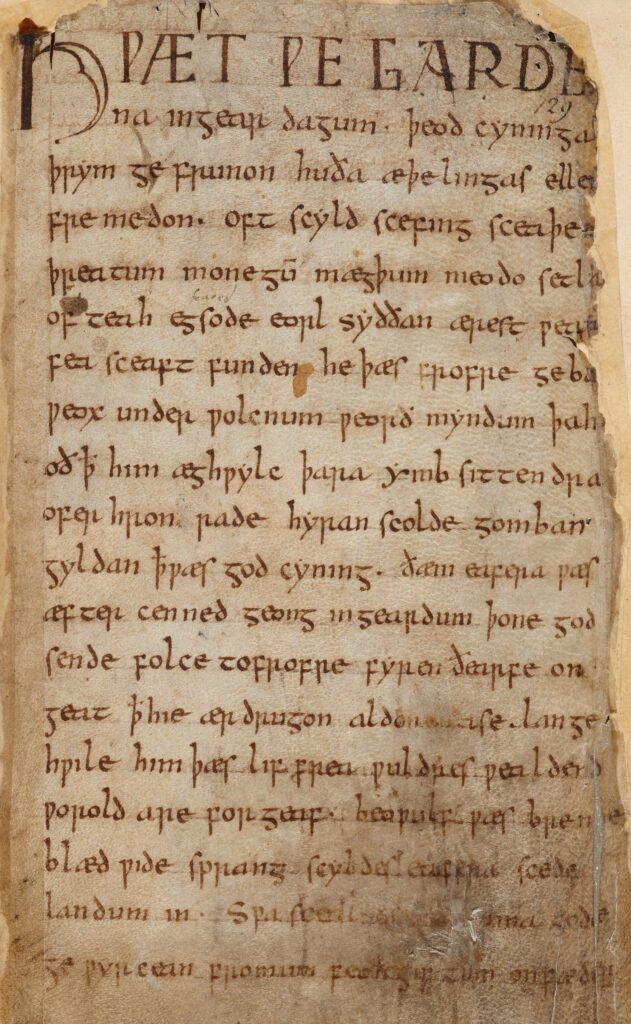
Beowulf is an anonymous Old English heroic poem of more than 3,000 lines about the Geatish warrior Beowulf, who defeats the monster Grendel and Grendel’s mother and, as an old king, fights a dragon. It survives in a single manuscript made around the year 1000 and is one of the oldest long poems in the English language.
Background and creation of Beowulf
The poet is unknown and is usually called the Beowulf poet. The date of composition is debated. Arguments have been made for an origin as early as the seventh century and as late as the eleventh, and the surviving manuscript probably dates from the late tenth or early eleventh century. The poem was composed in England, though where is uncertain. It is written in alliterative verse, a style shared by Old English, Old High German, Old Saxon and Old Norse poetry.
The story takes place in Scandinavia in the sixth century. Beowulf belongs to the Geats, a North Germanic people who lived in what is now southern Sweden, and he helps the Danish king Hrothgar. Although the hero and his deeds are legendary, some characters and events also appear in other sources. The Geatish king Hygelac, for example, is recorded raiding Frisia by the sixth-century chronicler Gregory of Tours, who calls him Chlochilaicus. Excavations of burial mounds in Scandinavia have produced rich sixth-century finds that match descriptions given in later texts.
The Beowulf manuscript
The only surviving copy is part of the Cotton MS Vitellius A XV, a composite volume of two codices that holds nine works. The part containing Beowulf is called the Nowell Codex, after the sixteenth-century owner Laurence Nowell. In it Beowulf follows three prose works and comes before the poem Judith.
The volume entered the library of Sir Robert Cotton, who shelved it beneath the bust of the Roman emperor Vitellius, and that shelf position gave it its name. Cotton’s collection was left to the nation in the early 1700s and became a foundation collection of the British Museum in 1753. A fire at Ashburnham House in 1731 burned the edges of the manuscript, which was saved by being thrown from a window. Much text crumbled away from the edges in the years that followed.
In 1787 the Icelandic scholar G. J. Thorkelin and a hired scribe made two transcripts of the poem. By 1845 the manuscript had been rebound on paper frames to slow the loss of its edges. Julius Zupitza published a facsimile in 1882, and the Electronic Beowulf project, begun in 1990, produced high-quality digital images. The British Library put the manuscript online in 2013.
Summary of Beowulf
The poem divides roughly into three parts. In the first, Beowulf and his warriors sail to Denmark to help Hrothgar, whose great hall Heorot has been attacked for twelve years by Grendel, a monster described as a descendant of Cain. Beowulf tears off Grendel’s arm in a wrestling match, and the wounded monster flees to die.
In the second part, Grendel’s mother avenges her son by killing one of Hrothgar’s closest warriors. Beowulf follows her to a lair beneath a lake, using a sword lent to him by Unferth, and kills her there.
In the third part, Beowulf has ruled the Geats for about fifty years. A dragon guarding a hoard threatens his people, and in his final contest he faces it, a battle that costs him his life.
Themes and interpretation of Beowulf
A central theme is heroic reputation. Beowulf tells Hrothgar that it is better to avenge friends than to mourn them, and that a warrior should earn fame because every person comes to the end of life. The poem’s values include loyalty to a lord, generosity from kings to retainers and the duty of vengeance, along with a strong sense that life is short.
Monsters mark a boundary between the human community and what lies outside it. Grendel is an outsider who is tormented by the sounds of celebration from the hall. Linking him to Cain places the story in a Christian frame, even though the events belong to a pre-Christian Germanic world. Many readers see the poem as a meeting point of those two traditions.
A further theme is the passage of time. The hero’s youthful strength wins glory in the first two fights, while the last fight shows an aged king who protects his people at a high cost. Interpreters differ about whether the ending is a triumph, a tragedy or a warning, and this openness is one reason scholars keep returning to the text. The same ideas are explored in the entry on narrative structure.
Reception and legacy of Beowulf
Thorkelin’s transcripts of 1787 and Zupitza’s facsimile of 1882 laid the groundwork for modern editions. In 1936 J. R. R. Tolkien gave an influential lecture that argued the poem should be appreciated as a work of art and not only as a source of historical facts.
Since then the poem has become a standard text in the study of English literature, and it has been translated into modern English many times, including a widely read verse translation by Seamus Heaney in 1999. It has also inspired novels, films and music. The British Library describes it as the greatest poem in the Old English language.
Beowulf remains important to historians as well as literary scholars, because it preserves legends of early medieval Scandinavia and shows how a Christian author in England viewed the pagan past. It belongs to the early history of English poetry, and its setting in Denmark and Sweden reflects shared traditions among the peoples of northern Europe.
More in Literature
Key facts
- Beowulf survives in one manuscript, Cotton MS Vitellius A XV, made around the year 1000.1
- The poem has more than 3,000 lines in three parts: Grendel, Grendel's mother and a dragon.1
- The author is unknown, and proposed dates of composition range from the seventh to the eleventh century.2
- A fire at Ashburnham House in 1731 damaged the edges of the manuscript.13
- The Cotton collection was left to the nation in the early 1700s and became a foundation collection of the British Museum in 1753.1
- The manuscript is now in the British Library and has been viewable online since 2013.1
Related concepts
Quick checkWhere does the only surviving manuscript of Beowulf come from?Show answer
It is Cotton MS Vitellius A XV, made around 1000, damaged in an 1731 fire and now held by the British Library.
Sources
- 1. British Library, Hwaet! Beowulf online, https://www.bl.uk/stories/blogs/posts/beowulf-online
- 2. World History Encyclopedia, Beowulf, https://www.worldhistory.org/Beowulf/
- 3. McMaster University, The Beowulf Project: The Manuscript, https://humanities.mcmaster.ca/~beowulf/manuscript.html
Editorially reviewed by Specialty Digest Editorial TeamLast reviewed November 5, 2026Researched and drafted with AI assistanceReport an issue