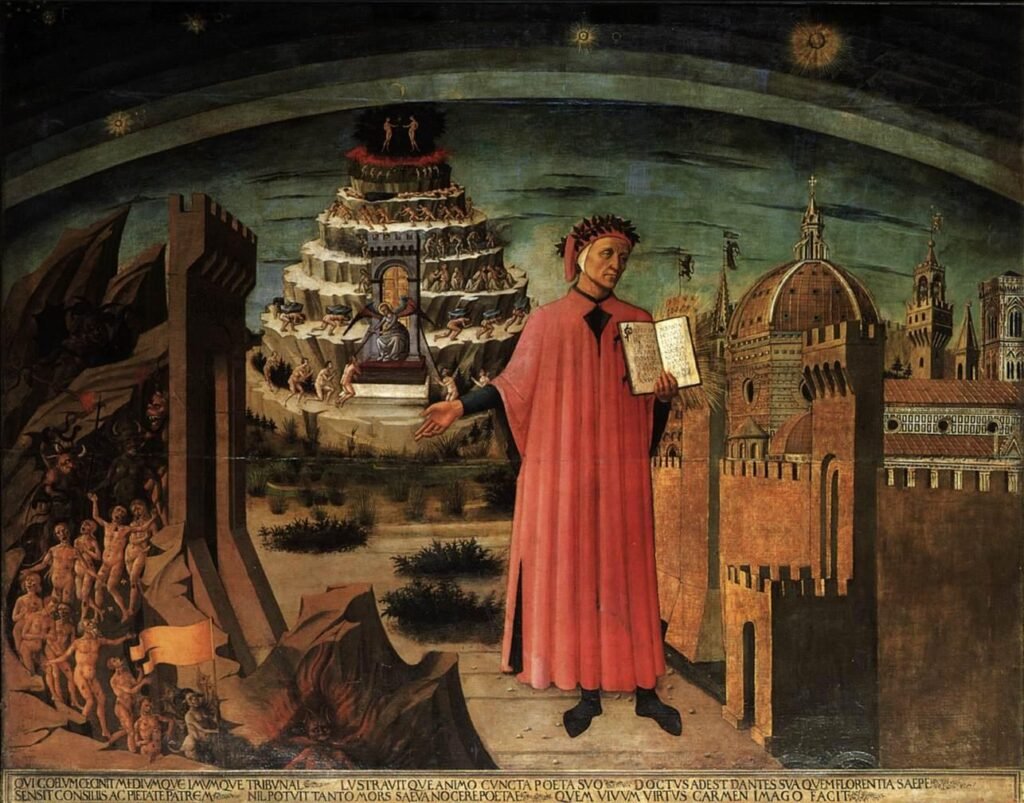
The Divine Comedy is an epic poem by the Italian poet Dante Alighieri that describes an imagined trip through Hell, Purgatory and Heaven. Dante called it La Commedia, and it is divided into three parts: Inferno, Purgatorio and Paradiso. The Poetry Foundation dates its composition to about 1307 to 1321, the year Dante died, and it is widely counted among the greatest poems in world literature.
Background and creation of The Divine Comedy
Dante was born in Florence in 1265 into a family of minor nobility. He wrote his first major work, the Vita Nuova, around 1292 in memory of Beatrice Portinari, who had died in 1290. He then studied philosophy and wrote the Convivio, a collection of lyrics with prose commentary.
Around 1300 Dante became active in Florentine politics and sided with the White Guelphs, a faction opposed to the papacy. In 1301 the rival Black Guelphs, backed by papal forces, seized power. Prominent White Guelphs, including Dante, were stripped of their property and banished. He never returned to Florence, and he wrote the Commedia in exile, along with other works such as De Vulgari Eloquentia and De Monarchia.
Dante also wrote in Latin. The Poetry Foundation describes De Vulgari Eloquentia as an unfinished tract on the origin of the Italian dialects and the literary language, and De Monarchia as a treatise presenting his Christian political philosophy. The Commedia, by contrast, is written in Italian.
In his last years Dante settled in Ravenna under the patronage of Guido da Polenta. The Poetry Foundation and the Italian encyclopedia Treccani agree that he died there in the night of 13 to 14 September 1321.
Treccani adds a point about language. In De Vulgari Eloquentia, Dante argued that the highest poetry needs an illustrious language set apart from everyday speech. The Commedia largely departs from that ideal. It is, in Treccani’s words, the one great Italian poem that tackles the largest questions while staying firmly rooted in contemporary reality, and it dares to draw the sublime out of the ugly and the common.
Structure and summary of The Divine Comedy
The poem has three parts, called canticles. Inferno has 34 cantos, and Purgatorio and Paradiso have 33 each, for a total of 100, as the canto menu of the Princeton Dante Project shows. A canto is a section of a long poem, much like a chapter in a book.
In the story, Dante imagines himself traveling through the afterlife. In Inferno, his guide is the Roman poet Virgil, whom the Poetry Foundation describes as his mentor and protector. Hell is a huge funnel with nine descending circular ledges, and sinners are sorted by the nature of their sins and suffer fitting punishments. Those who recognize and reject their sins can reach Paradise through purification, which is the subject of Purgatorio.
In Purgatory the poem shifts from human reason to divine revelation. Virgil, a symbol of reason, can help Dante understand sin, but on the mountain the poet needs a more powerful guide who represents faith. That guide is Beatrice. In Paradiso, the process of spiritual renewal reaches its end, and God rewards the poet with perfect knowledge.
Themes and interpretation of The Divine Comedy
The Poetry Foundation calls the poem an encyclopedic overview of the customs, beliefs, philosophies, aspirations and material life of the medieval world. It is as rich in science, astronomy and philosophy as it is rooted in fourteenth-century Catholicism and Italian politics. Readers therefore meet theology and current events side by side. People from Dante’s own time appear in it.
Interpretation has long centered on allegory, the use of characters and events to stand for ideas. The translator Mark Musa, quoted by the Poetry Foundation, argues that Dante invites readers to approach the poem as he expects them to read the Bible: to accept the literal level as historically true and to see figurative meaning in the main characters. Musa adds that this is not a simple or consistent allegory but a much more sophisticated one.
Treccani stresses a different quality. In its view, the poem’s mixture of the highest subjects with ordinary, contemporary and even harsh material sets it apart from other Italian poetry of the period. The Poetry Foundation notes that the work’s philological and philosophical layers have drawn scrutiny from critics, literary theorists, linguists and philosophers, and that scholars continue to debate its structural unity.
The poem’s Christian setting is explicit. Its moral order depends on the Christian belief that souls are judged and that repentance can lead to salvation, which the three-part structure makes visible.
Reception and legacy of The Divine Comedy
The Poetry Foundation says the poem caused an immediate sensation during Dante’s life. His fame then waned during the Italian Renaissance and was revived in the nineteenth and twentieth centuries. Treccani offers another view of influence. It says the Commedia stands isolated near the beginning of Italian literature, a constant point of reference but not a model that others followed. Even Petrarch and Boccaccio, who were closest in time, imitated it only here and there and on the surface, and Treccani adds that Petrarch’s lyric poetry cannot be understood without a first reference to Dante.
The poem has been translated many times. Project Gutenberg offers a free edition in the American poet Henry Wadsworth Longfellow’s translation, and the Poetry Foundation notes that Inferno, the first part, is the most popular and widely studied section.
Modern readers also have scholarly tools. The Princeton Dante Project, which opened for local use on 18 May 1999, places the Italian text, a new verse translation, notes, images and audio recitations in one resource, along with Dante’s minor works.
Visual art has returned to the poem as well. The painting above, by Domenico di Michelino in the mid-fifteenth century, shows Dante holding his poem with Hell, Mount Purgatory and Florence arranged around him, and it gives a visual summary of the poem’s three-part world.
Key facts
- Dante wrote La Commedia between about 1307 and his death in 1321, after being banished from Florence in 1301.1
- The poem has three parts: Inferno, Purgatorio and Paradiso.1
- Inferno has 34 cantos and Purgatorio and Paradiso have 33 each, making 100 in all.2
- Virgil guides Dante through Hell, and Beatrice guides him later in the poem.1
- Dante died in Ravenna on the night of 13 to 14 September 1321.13
Related concepts
Quick checkWhat are the three parts of the Divine Comedy?Show answer
Inferno (Hell), Purgatorio (Purgatory) and Paradiso (Heaven).
Sources
- Poetry Foundation, Dante Alighieri, https://www.poetryfoundation.org/poets/dante-alighieri
- Princeton Dante Project (2.0), Dante's Divine Comedy, https://dante.princeton.edu/pdp/
- Treccani, Enciclopedia on line: Dante Alighieri, https://www.treccani.it/enciclopedia/dante-alighieri/
- Project Gutenberg, Divine Comedy, Longfellow's Translation, Complete (ebook 1004), https://www.gutenberg.org/ebooks/1004
Editorially reviewed by Specialty Digest Editorial TeamLast reviewed November 5, 2026Researched and drafted with AI assistanceReport an issue