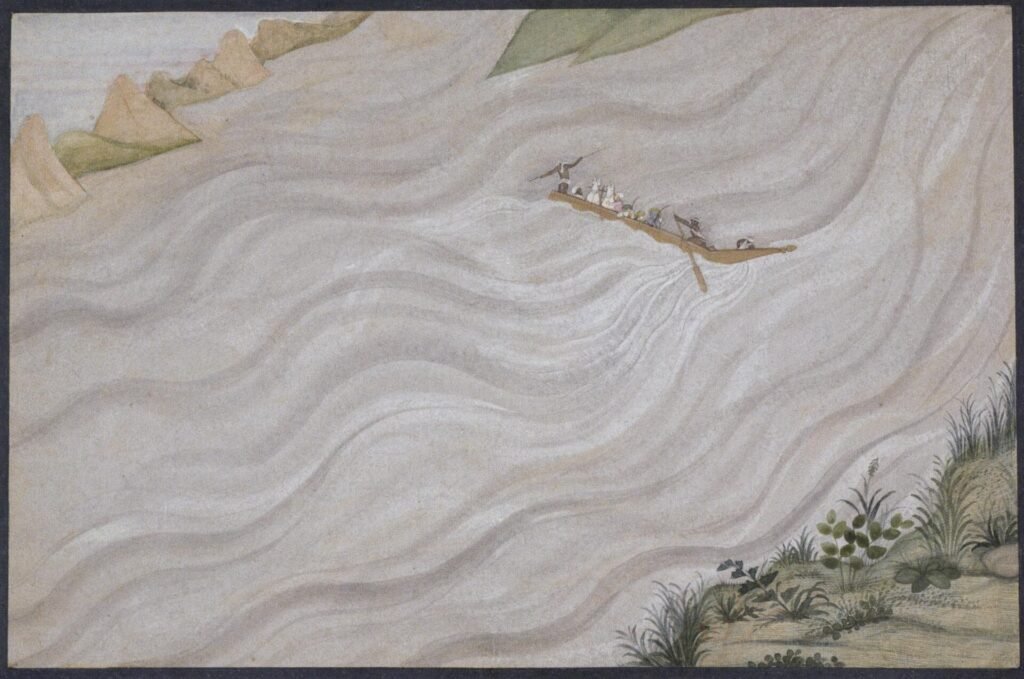
The Ramayana is an ancient Sanskrit epic attributed to the sage Valmiki. It tells how Prince Rama of Ayodhya is sent into exile, loses his wife Sita to the demon king Ravana, and wins her back with the help of an army of monkeys. About 24,000 verses long, it is one of the two great Sanskrit epics of India, alongside the Mahabharata, and it is retold across South and Southeast Asia.
Background and composition of the Ramayana
Tradition names Valmiki as the poet and says he taught the work to Rama’s twin sons, Lava and Kusha. For that reason it is known as the Adi Kavya, the first poem. Sources differ on its date. One places the composition in the fifth century BCE, while another dates Valmiki’s epic to about 200 BCE.
The epic is also a family of stories. Many other versions exist in the regional languages of South Asia, and most of them share the same core narrative but differ in details, especially in how the story ends.
There is also a question about the poem’s length. A tradition counts seven books. One account says the Ramayana as Valmiki composed it is thought to have had six, ending with Rama crowned at Ayodhya, and that the seventh, the Uttara Ramayana, continues the story. Another describes Valmiki’s own ending as the questioning of Sita’s loyalty. The sources therefore describe the ending differently.
Summary of the Ramayana
Dasharatha, king of Ayodhya, has no children, so he arranges a sacrifice to obtain sons. His three queens bear four sons: Rama, Bharata and the twins Lakshmana and Shatrughna. The sage Vishwamitra later takes Rama and Lakshmana to defend his hermitage against demons and then brings them to the court of Mithila, where a contest for the princess Sita’s hand is held.
Rama is the eldest son of Dasharatha, king of Ayodhya. The gods have declared that he is born to defeat Ravana, and tradition regards him as the seventh incarnation of the god Vishnu. He wins the hand of Sita, who was born from a furrow in the earth, by stringing a bow that once belonged to Shiva.
When Dasharatha prepares to name Rama his heir, Queen Kaikeyi claims two favors the king had once promised her. She asks that her own son Bharata be crowned and that Rama be exiled for fourteen years. Bound by his father’s word, Rama accepts, and Sita and his brother Lakshmana go with him. Dasharatha dies of grief. Bharata, away at his maternal grandfather’s court when this happens, returns in fury and refuses the throne. He goes to the forest to bring Rama back, but Rama declines to break his father’s word. Bharata places Rama’s sandals on the throne and rules in Rama’s name.
In the forest, Ravana’s sister is rebuffed by Rama and wounded by Lakshmana, and she appeals to Ravana. He sends a demon disguised as a golden deer to lure the brothers away, then abducts Sita and carries her to his island kingdom of Lanka.
Rama allies with the monkey king Sugriva. Sugriva’s general Hanuman finds Sita in Lanka, and the army builds a bridge across the sea. After a great war Rama kills Ravana and recovers Sita. She undergoes a trial by fire to prove her purity. Rama returns to Ayodhya, ends his exile and is crowned. The later book relates that rumors about Sita’s time in Ravana’s palace lead to her banishment.
Themes and interpretation of the Ramayana
The central theme is dharma, a Sanskrit word for duty and right conduct. Rama keeps his father’s promise even at great personal cost, and the epic uses the story to teach Hindu life lessons. The work leans toward an ideal picture of the world. Rama is the ideal son and king, Sita the ideal wife, Hanuman the ideal devotee, and Lakshmana and Bharata the ideal brothers. Even Ravana is not presented as entirely despicable.
The epic also shows duties in tension. Dasharatha is bound by a promise to his queen, Rama by obedience to his father, Bharata by loyalty to his brother, and each choice has a cost for someone else.
The comparison with the other great epic is often made. In the Mahabharata, whose best-known section is the Bhagavad Gita, the characters are shown with all their human failings, whereas the Ramayana presents models of conduct.
The most debated part of the epic is the treatment of Sita after her rescue. Her trial by fire and her later banishment raise questions about duty, trust and justice, and retellings across regions answer them in different ways.
Reception and legacy of the Ramayana
The Ramayana has been told and retold orally, in literature, in plays, in films and even in comic books, and it remains a living part of popular culture in South and Southeast Asia. Its characters feature in religious practice within Hinduism, and its stories are performed in dance, theater and festival traditions across the region.
For many people the story is first met through performance, oral retelling or film and not through a written text.
Because so many versions exist, readers meet the epic differently depending on language and place. The Sanskrit text attributed to Valmiki serves as a reference point, but regional poets reshaped the plot to express local values. This history of retelling is a large part of the epic’s importance.
For English readers, Ralph T. H. Griffith’s verse translation is freely available through Project Gutenberg. The epic remains a key text for studying the religion, literature and social ideals of India and the cultures that share its stories.
More in Religious Texts and Scripture
Key facts
- The Ramayana is a Sanskrit epic attributed to the sage Valmiki, about 24,000 verses long.2
- Sources date its composition from about the fifth century BCE to about 200 BCE.12
- By tradition it is the Adi Kavya, the first poem, and Valmiki taught it to Rama's sons Lava and Kusha.2
- Rama is traditionally considered the seventh incarnation of the god Vishnu.1
- Rama's exile lasts fourteen years.12
- Many regional-language versions exist, and they differ most in how the story ends.1
Related concepts
Quick checkWho composed the Ramayana, according to tradition?Show answer
The sage Valmiki, who is also said to have taught it to Rama's twin sons.
Sources
- 1. Asia Society, Ramayana: An Introduction to the Great Indian Epic, https://asiasociety.org/education/ramayana
- 2. World History Encyclopedia, Ramayana, https://www.worldhistory.org/The_Ramayana/
- 3. Project Gutenberg, The Ramayan of Valmiki, translated into English verse by Ralph T. H. Griffith (ebook 24869), https://www.gutenberg.org/ebooks/24869
Editorially reviewed by Specialty Digest Editorial TeamLast reviewed November 5, 2026Researched and drafted with AI assistanceReport an issue