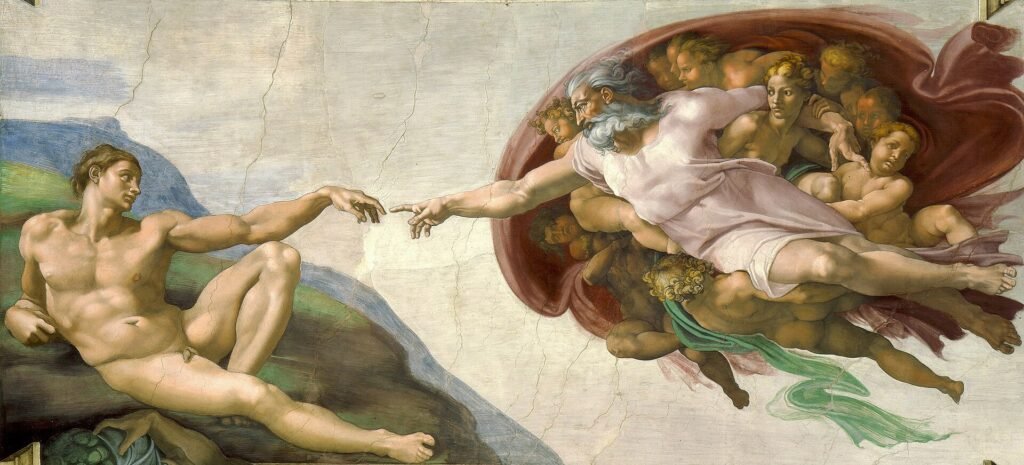
The Creation of Adam is a fresco panel by Michelangelo on the ceiling of the Sistine Chapel in Vatican City, painted around 1511. It shows God reaching out to give life to Adam, the first man in the Book of Genesis. It is one of the nine central scenes from Genesis that run along the length of the ceiling.
Background and creation of The Creation of Adam
The panel belongs to the ceiling that Pope Julius II commissioned from Michelangelo. The British Museum says Michelangelo had been summoned to Rome by the pope in 1505, three years before the work began. According to the Vatican Museums, the artist signed a contract on 8 May 1508. Michelangelo did not like the first plan, which called for twelve apostles and ornament, so the pope let him design the program himself.
He painted the ceiling in two stages. The first half, from the entrance wall to the Creation of Eve, was finished in August 1510. The figure of Adam belongs to the second half, which the British Museum dates to around 1511, and the whole ceiling was finished by 31 October 1512.
The scene is a fresco, painted on wet plaster. The British Museum says Michelangelo would have used a full-size cartoon to transfer the final design to the surface.
Description of The Creation of Adam
The composition has two main figures set against an open, almost empty background. On the left the nude Adam reclines on the ground, propped on one arm, with his other arm stretched out toward God. On the right God, an elderly bearded figure, is carried through the air within a billowing cloak, surrounded by a group of younger figures.
The scene is built around the space between the two outstretched hands. God’s hand extends firmly toward Adam, while Adam’s hand hangs loosely, as though he is still waiting to receive life. The small gap between the fingers is the center of the picture, and everything else leads the eye to it.
Unlike the scenes of the corner pendentives and lunettes, this is one of the nine central stories. According to the Vatican Museums, those stories sit within a painted architecture, with nude figures at their sides holding medallions, and prophets and sibyls on thrones below. The panel is therefore framed by the larger structure of the ceiling.
The Getty Museum holds an early photograph of this scene by James Anderson, made around 1845 to 1855, which describes it as God reaching out to give life to Adam. It shows how early the panel was treated as a separate image worth reproducing.
Preparatory drawing for The Creation of Adam
The British Museum owns a red chalk drawing, dated 1511, of a nude male figure for the Adam of the ceiling. The sheet is drawn in red chalk, also called sanguine, on paper and measures about 19 by 26 centimeters, and its registration number is 1926,1009.1. In it the left arm rests on the left leg and stretches out to receive life from God, and a study of the right hand appears at the lower left. The museum acquired it with contributions from the Art Fund and other donors.
The museum explains that Michelangelo used the qualities of the red chalk to create a warm tone as he drew from a live model. He was also inventing freely, because the position of the upper body is impossible, though he makes it look entirely natural. He concentrated on the torso and upper legs, and the ideal anatomy is indicated by shading on the chest and stomach.
The pose of Adam in the finished fresco is almost unchanged from this working drawing. The drawing therefore shows that the key gesture of the panel was settled before the plaster was prepared.
Themes and interpretation of The Creation of Adam
The scene illustrates the Genesis account of the creation of the first man, who is the starting point of human history in that book. In the ceiling’s wider program, as the Vatican Museums describe it, the central stories are set alongside prophets, sibyls and the ancestors of Christ, so that Adam is the beginning of a human story that the ceiling follows toward Christ.
Michelangelo shows Adam as an ideal nude body, a choice that fits the British Museum’s note on the ideal anatomy of the drawing. The body is relaxed and fully formed, yet Adam does not seem alive until the moment of contact. The pairing of an active God with a receptive Adam is often read as a statement about where life comes from.
Other details have drawn much discussion, including the shape of the cloak around God and the gap between the hands. The sources used for this entry do not settle those questions, so they are better treated as proposals than as facts.
Reception and legacy of The Creation of Adam
The Touring Club Italiano describes the ceiling as telling the story of the Bible from Genesis and the Creation of Adam. The chapel has remained at the center of Michelangelo’s reputation, even though the artist was criticized for nudity and some popes threatened to remove the frescoes.
The drawing and the fresco are often discussed together because they show how Michelangelo moved from a life study to a finished design. The panel itself is the part of the ceiling that most viewers recognize. It is discussed together with the rest of the program in the entry on the Sistine Chapel ceiling, and it connects to the Bible and to the artistic setting of the Renaissance. The Vatican Museums offer a video and a virtual tour of the chapel on their website for readers who cannot visit in person.
More in Visual Arts
Key facts
- The Creation of Adam is a fresco on the Sistine Chapel ceiling by Michelangelo, painted around 1511.2
- Michelangelo signed the ceiling contract on 8 May 1508, and the ceiling was complete by 31 October 1512.1
- The figure of Adam was painted in the second half of the ceiling, after the Creation of Eve.12
- A British Museum red chalk study of 1511 shows Adam in a pose almost unchanged in the fresco.2
- An early photograph of the scene by James Anderson, made about 1845 to 1855, is in the Getty Museum.3
Related concepts
Quick checkWhat is the main subject of The Creation of Adam?Show answer
It shows God reaching out to give life to Adam, the first man in the Book of Genesis. The scene is one of nine central Genesis panels on the Sistine Chapel ceiling.
Sources
- Vatican Museums, Sistine Chapel: Ceiling, https://www.museivaticani.va/content/museivaticani/en/collezioni/musei/cappella-sistina/volta.html
- British Museum, Study for Adam by Michelangelo Buonarroti (registration number 1926,1009.1), Google Arts & Culture, https://artsandculture.google.com/asset/study-for-adam-michelangelo-buonarroti/WAGMoyZVzEFtNg?hl=en
- J. Paul Getty Museum, Michelangelo's Creation of Adam, Sistine Chapel, by James Anderson (84.XM.635.23), Google Arts & Culture, https://artsandculture.google.com/asset/michelangelo-s-creation-of-adam-sistine-chapel-james-anderson/fgHhcFK_NMsVFQ?hl=en
- Touring Club Italiano, The Sistine Chapel, Vatican City, in 8 Incredible Decorated Ceilings, Google Arts & Culture, https://artsandculture.google.com/story/8-incredible-decorated-ceilings/MAXhvWC8kLrZFA?hl=en
Editorially reviewed by Specialty Digest Editorial TeamLast reviewed November 5, 2026Researched and drafted with AI assistanceReport an issue