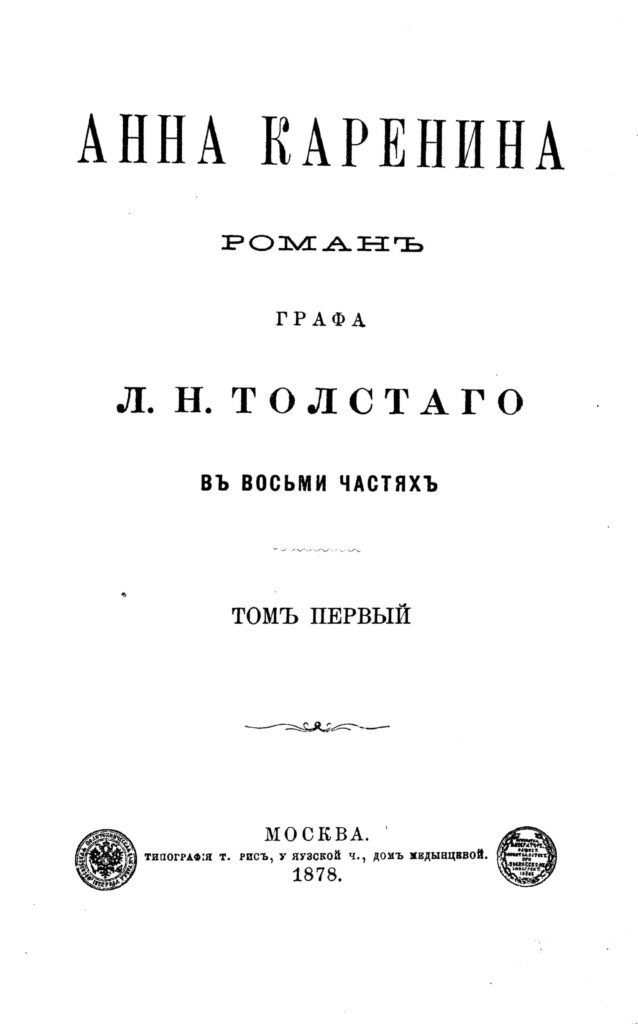
Anna Karenina is a novel by the Russian writer Leo Tolstoy, serialized from 1875 to 1877 and published as a book in 1878. It tells of Anna, a married woman in high society whose love affair with an army officer leads to scandal and tragedy. A second storyline, about the landowner Konstantin Levin, runs alongside hers and explores family life, work and faith.
Background and serial publication of Anna Karenina
Tolstoy began the novel in the early 1870s, after finishing War and Peace. It appeared in the monthly journal The Russian Herald, also translated as The Russian Messenger, in 13 installments from January 1875 to April 1877.
The serial did not run every month. There were no installments from May to December 1875 or from May to November 1876. The serialized text runs from the first chapter of Part 1 to the last chapter of Part 7, and Part 8 was issued separately as a pamphlet instead of in the journal.
The terms were generous. A page on the serial records that Tolstoy was offered 500 rubles for each printer’s sheet, against 400 for Turgenev and 300 for Dostoevsky in the same period. The title page of the first book edition dates from 1878.
Plot summary of Anna Karenina
The novel opens in Moscow with a household crisis. Stiva Oblonsky has been unfaithful to his wife Dolly, and his sister Anna Karenina travels from St. Petersburg to help reconcile them.
On the train and at a ball, Anna meets the dashing officer Count Alexei Vronsky, who has been courting the young Kitty Shcherbatskaya. Kitty, hoping for a proposal from Vronsky, has just turned down Levin. Anna and Vronsky fall in love, and Anna soon leaves the security of her marriage to the cold, correct official Alexei Karenin.
Society closes its doors on her. She loses access to her young son, becomes increasingly isolated and jealous, and begins to doubt Vronsky’s feelings. In a state of despair, she ends her life by throwing herself under a train.
Levin follows another path. After Kitty recovers from her illness, the two marry, spend their first years together learning to live with each other, and have a child. Levin struggles with questions about the meaning of life and finds a measure of peace through faith and family. In the Duke University summary, the novel follows two couples, and one ends in scandal and suicide while the other ends as a happy family.
Setting and social context of Anna Karenina
The story takes place in the 1870s, in the two great cities of the Russian Empire and on country estates. Railways run through the book, and a station is the place of Anna’s first meeting with Vronsky and of her death, so that the new technology becomes a mark of speed, chance and danger.
The countryside scenes show a society still adjusting to the end of serfdom in 1861, when landowners such as Levin had to rethink how to manage farms and treat the peasants who worked them.
Characters in Anna Karenina
Anna is intelligent, charming and passionate, and she is first seen as a sympathetic peacemaker. Vronsky is wealthy and honorable by his own standards but unable to give her a stable life. Karenin is a senior government official who values form and reputation, and he reacts to the affair with duty and then with cruelty.
Levin is a thoughtful landowner who cares about the land and its workers, and he is widely read as close to Tolstoy himself. Kitty grows from a sheltered girl into a mature wife and mother. Stiva Oblonsky is easygoing and self-indulgent, and Dolly is his long-suffering, hardworking wife.
Themes in Anna Karenina
Love, duty and social judgment are at the center. The novel shows that a woman who breaks the rules faces far harsher punishment than the men around her, and Stiva’s casual unfaithfulness is forgiven much more easily than Anna’s.
The book also presents different models of marriage. The Karenins’ union is formal and empty, Stiva and Dolly’s is strained, and the marriage of Levin and Kitty is an imperfect but growing partnership.
Retribution is a prominent idea, and early American reviewers noted it, along with the strong characterization of Anna and the novel’s realism. Readers have long debated whether Tolstoy condemns Anna, pities her or both.
Levin’s thread brings in questions about work, the peasantry, politics and religion. Topics that were being discussed in the Russian press of the time, such as education, spiritualism, labor and contemporary politics, appear in the issues that carried the installments.
Style and structure of Anna Karenina
The novel is divided into eight parts. Tolstoy alternates between Anna’s story and Levin’s and lets the two lines echo each other, so that a scene in one often casts light on a scene in the other.
His method is realist. He builds character from small gestures, inner thoughts and everyday detail, and moves easily between city drawing rooms, the countryside and the railway station.
Reception and legacy of Anna Karenina
The serial was well received by Russian critics and readers. That success helped lead to its publication abroad, and Thomas Y. Crowell and Company issued the complete novel in the United States in 1886 in a first edition of slightly under 800 pages.
Early American reviews were mixed. Critics praised its themes and the portrayal of Anna, but some objected to its length and to the way it depicts her death. Reviewers also disagreed on whether its Russian setting would be difficult for American readers or whether its themes were universal.
Anna Karenina has since become one of the most frequently translated and adapted works of Russian literature, with many films and television versions, and it is widely read as one of the central novels of the nineteenth century.
More in Literature
Key facts
- Anna Karenina was serialized in The Russian Herald in 13 installments from January 1875 to April 1877.1
- The journal ran Parts 1 to 7, and Part 8 was issued separately as a pamphlet.1
- The novel is divided into eight parts and follows two couples, Anna and Vronsky and Levin and Kitty.2
- Thomas Y. Crowell and Company published the complete novel in the United States in 1886, in slightly under 800 pages.2
- Early American reviewers praised its characterization of Anna and its realism but criticized its length.2
Related concepts
Quick checkWhen was Anna Karenina serialized?Show answer
It ran in The Russian Herald in 13 installments from January 1875 to April 1877, with Part 8 issued separately.
Sources
- Middlebury College, Russian course materials on Tolstoy (timeline and publication of Anna Karenina), https://community.middlebury.edu/~beyer/courses/RUSS0101a-f05/Tolstoy/literary_criticism.htm
- Duke University, Reviews of Anna Karenina (Unsuitable project), https://sites.duke.edu/unsuitable/reviews-of-anna-karenina/
Editorially reviewed by Specialty Digest Editorial TeamLast reviewed November 5, 2026Researched and drafted with AI assistanceReport an issue