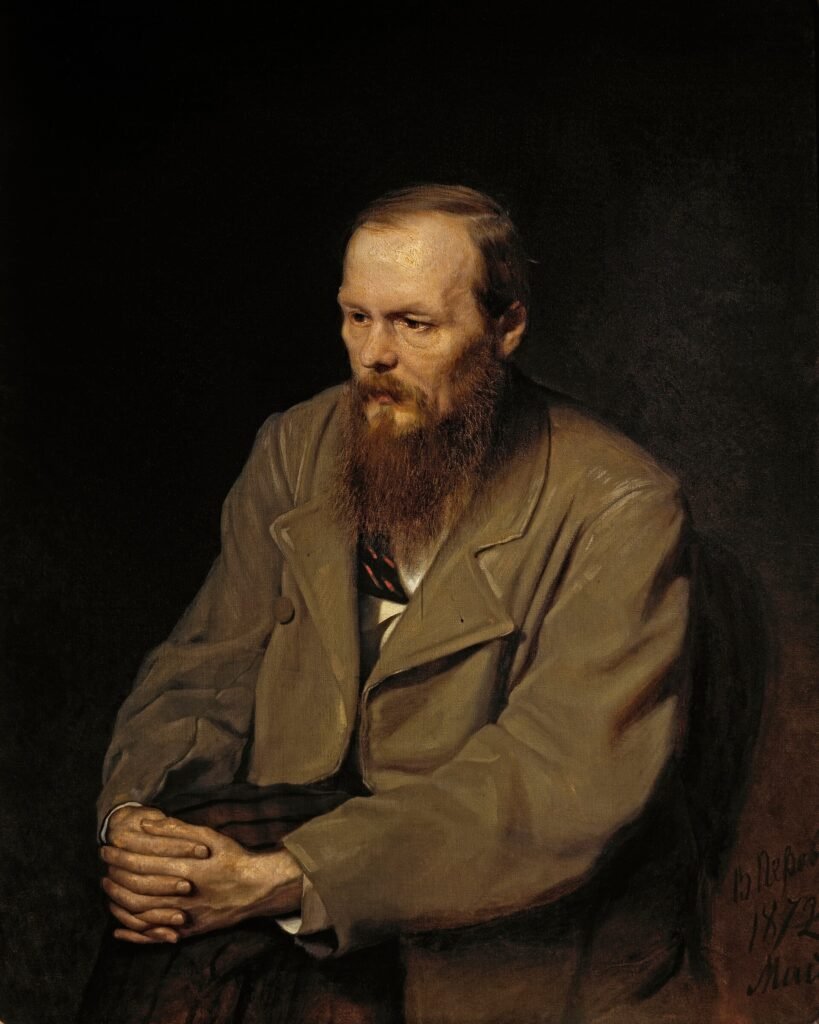
Crime and Punishment is a novel by the Russian writer Fyodor Dostoevsky (1821 to 1881), published in 1866. It follows Rodion Raskolnikov, a poor former law student in St. Petersburg, who plans and carries out the murder of an unscrupulous pawnbroker and is then consumed by confusion, paranoia and guilt. The novel is one of the best-known studies of conscience in world literature.
Background and writing of Crime and Punishment
Dostoevsky wrote the book at a time of personal strain. He had been arrested in April 1849 as part of the Petrashevsky circle, a group of intellectuals who met to discuss social ideas. He was sentenced to death, subjected to a mock execution, and then sent to hard labor in Siberia followed by further exile, and he returned to European Russia only at the end of 1859.
The novel appeared in installments in 1866 in the journal The Russian Herald, also known as The Russian Messenger, the same journal that was carrying parts of Tolstoy’s War and Peace. In that year Dostoevsky was also under pressure to deliver another work by a publisher’s deadline, and he dictated The Gambler to a stenographer, Anna Snitkina, who later became his wife.
Plot summary of Crime and Punishment
The story begins in the summer heat of the capital. Raskolnikov lives in a cramped room, owes rent and has dropped out of university. He visits an old pawnbroker, Alyona Ivanovna, and in a tavern he meets a drunken clerk, Marmeladov, whose family lives in desperate poverty. Letters from his mother tell him that his sister Dunya may marry a man she does not love to help him.
Convinced that a person of rare ability may break ordinary moral rules for a higher purpose, Raskolnikov kills the pawnbroker with an axe. Her half-sister Lizaveta arrives unexpectedly and he kills her as well. He narrowly escapes when two men arrive, and he takes only a few items.
Afterward he falls ill and withdraws from everyone. He is summoned to the police station, though only about a minor debt, and his behavior makes him suspect to the investigator Porfiry Petrovich, who engages him in long, probing conversations.
Raskolnikov grows close to Sonya Marmeladova, a young woman forced into prostitution to support her family, and she urges him to confess. He finally does, and the epilogue shows him serving a sentence of hard labor in Siberia, where Sonya follows him and his moral recovery begins.
Setting and historical context of Crime and Punishment
The action unfolds in the mid-1860s, in the poorer districts of the capital, during a stifling summer. Russia was changing quickly after the end of serfdom in 1861, and the city was crowded with students, clerks and former peasants looking for work.
New ideas about reason, utility and the individual were widely discussed among young intellectuals. Dostoevsky, who distrusted theories that treated people as numbers, used Raskolnikov to show how such ideas can lead a vulnerable mind to extreme action.
Characters in Crime and Punishment
Raskolnikov is proud, intelligent and isolated, divided between cold reasoning and sudden generosity. Sonya embodies humility, faith and endurance. Razumikhin, his loyal friend, offers practical warmth, and Dunya is a strong-minded young woman who resists her suitors.
Porfiry Petrovich is a patient investigator who relies on psychology more than on proof. Svidrigailov, a wealthy and morally corrupt man who pursues Dunya, serves as a dark mirror of Raskolnikov, and Luzhin, her calculating suitor, represents self-serving rationalism.
Themes in Crime and Punishment
The central idea is Raskolnikov’s theory of the extraordinary man. He believes that exceptional people, as Napoleon is often imagined to have been, have a right to cross moral lines for the sake of a greater good. The novel tests that belief against the reality of the crime, which leaves him anxious, feverish and cut off from other people.
Guilt and conscience drive the plot. Dostoevsky presents punishment as an inner process more than a legal one, and Raskolnikov suffers long before he is sentenced.
Poverty and urban misery are everywhere. Crowded rooms, taverns and bridges in the city show how need pushes people toward drink, crime and despair, and the plight of the Marmeladov family gives the book a social side.
Suffering, faith and redemption appear most clearly in the figure of Sonya and in the epilogue. The novel raises hard questions of ethics, in particular whether a rational calculation of benefit can ever justify taking a life.
Style and structure of Crime and Punishment
The narration stays close to Raskolnikov’s mind, moving between fever dreams, sudden impulses and sharp observation. The book is divided into six parts and an epilogue, and the long dialogues, especially those with Porfiry, work like psychological duels.
Doubles and mirrors give the book its shape. Svidrigailov, Luzhin and Razumikhin each answer in a different way the question of how a person should live in a harsh city, so that readers can compare their choices with those of the hero and see why none of them is a simple model.
Reception and legacy of Crime and Punishment
The novel was a major success and helped establish Dostoevsky’s reputation after his years of exile. It has been translated into many languages and adapted for film, television, theater and opera. English readers have long known it through the version by Constance Garnett, which the University of South Florida’s Lit2Go project reproduces, as well as through many later translations.
It remains a staple of university courses on world literature, philosophy and criminology, and it is often read as an early psychological novel about the mind of a killer. The Project Gutenberg catalog describes it as the story of a man who convinces himself that certain crimes are justified for extraordinary people, a summary that captures the book’s central dilemma.
More in Literature
Key facts
- Crime and Punishment was published in 1866 in the Russian journal The Russian Herald.1
- Fyodor Dostoevsky lived from 1821 to 1881, and was arrested in April 1849 and later exiled in Siberia.1
- The novel follows Rodion Raskolnikov, an impoverished former law student in St. Petersburg who plans to murder a pawnbroker.2
- Raskolnikov convinces himself that certain crimes are justified for extraordinary men, then suffers confusion, paranoia and guilt.2
- The 1866 serialization ran alongside Tolstoy's War and Peace in the same journal.1
Related concepts
Quick checkWho is the main character of Crime and Punishment?Show answer
Rodion Raskolnikov, an impoverished former law student in St. Petersburg who murders a pawnbroker and is then tormented by guilt.
Sources
- Cambridge Companion to Dostoevskii, sample chapter (Library of Congress catalog enrichment), https://catdir.loc.gov/catdir/samples/cam033/2002067684.pdf
- Project Gutenberg, Crime and Punishment by Fyodor Dostoyevsky (ebook record), https://www.gutenberg.org/ebooks/2554
- Lit2Go, Florida Center for Instructional Technology, University of South Florida, Crime and Punishment (chapter summaries), https://etc.usf.edu/lit2go/182/crime-and-punishment/
Editorially reviewed by Specialty Digest Editorial TeamLast reviewed November 5, 2026Researched and drafted with AI assistanceReport an issue