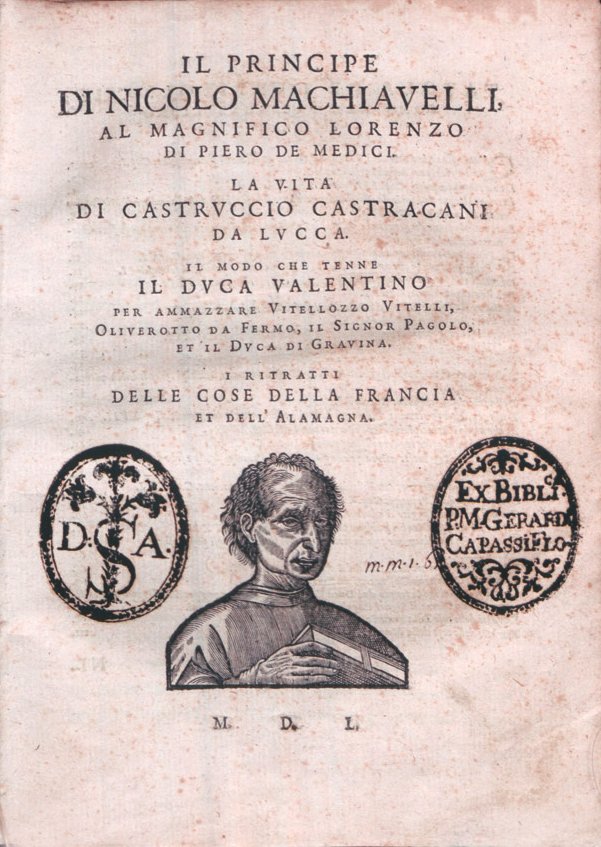
The Prince is a short work of political writing by the Florentine statesman Niccolò Machiavelli, written in 1513 and published after his death in 1532. It offers advice to a ruler on how to win, hold and expand power, and it is famous for treating political success as a practical problem rather than a moral one. Its blunt realism made Machiavelli’s name a byword for cunning.
Background and creation of The Prince
Niccolò Machiavelli was born in Florence on 3 May 1469 and served the Florentine republic as a diplomat and civil official. When the Medici family returned to power in 1512, he lost his post. In early 1513 he was wrongly suspected of conspiring against the Medici, and he was imprisoned and tortured for several weeks.
After his release, Machiavelli retired to his family farm outside the city. According to the Stanford Encyclopedia of Philosophy, the enforced retirement gave him the time and the impetus to turn to writing. The Prince was the first of his reflective works, written at the end of 1513 and perhaps early 1514.
He first intended it as a gift for Giuliano de’ Medici, hoping to show his knowledge of statecraft and win a new job. After Giuliano died, he changed the dedication to Lorenzo de’ Medici the Younger, who almost certainly did not read it when it reached him in 1516. The work was printed only in 1532, after Machiavelli’s death in 1527.
Content of The Prince
The book has twenty-six short chapters. The opening chapters classify states as republics or principalities and then divide principalities into hereditary, new and mixed. Machiavelli explains how each kind is acquired and kept, using examples from the ancient world and from recent Italian politics, including the Borgia family leader Cesare Borgia, whom he calls the Duke Valentino.
Cesare Borgia plays a special role as a model. Machiavelli praises the speed and planning with which Borgia built a state in central Italy with his father’s help, and he blames Borgia’s eventual fall mostly on extreme bad luck while noting one serious mistake. A neighboring chapter looks at rulers who rise by crime, such as the ancient tyrant Agathocles of Syracuse, and asks why cruelty works for some and ruins others. The appendix to the Gutenberg edition describes the methods Borgia used in one of his most notorious killings.
The middle chapters turn to military and personal qualities. He argues that a prince should rely on his own citizen army and not on mercenaries or borrowed troops, and he discusses how rulers should choose advisers and avoid flatterers. A well-known chapter weighs whether it is better to be loved or feared. His answer is that a prince should aim to be both, but if he must choose, fear is safer, provided it does not turn into hatred.
Another much-quoted chapter argues that a ruler need not be virtuous but must seem to be, because people judge by appearances and results. The twenty-fifth chapter considers how far fortune governs human affairs and how a skilled leader can prepare for her changes. The final chapter is an exhortation to free Italy from foreign rule, which shows that the book was written with a strong patriotic purpose.
Themes and interpretation of The Prince
The central concepts are virtù and fortuna. Virtù means a ruler’s energy, skill and willingness to act decisively, as opposed to the moral goodness the word suggests in English. Fortuna stands for chance and circumstance. Machiavelli argues that fortune decides about half of what happens, and that boldness and preparation can shape the rest.
Another practical thread concerns whom a ruler can trust. Machiavelli argues that a prince who comes to power with the support of ordinary people is safer than one who relies on nobles, because the nobles want to rule and the people only want to avoid oppression. This advice shows that the book is concerned with stability as much as with conquest.
His separation of politics from conventional morality was the book’s most radical move. Earlier writers had advised rulers to be just and pious. Machiavelli argued that a ruler who acts only on those principles in a world of dangerous rivals will be destroyed, and that political success sometimes requires harsh and deceptive actions. He does not celebrate cruelty, and he warns that rulers who use it badly will lose power.
Readers have long disagreed about what he meant. Some treat The Prince as a cynical manual for tyrants. Others, including Jean-Jacques Rousseau, read it as ironic advice that exposes how rulers really behave and so teaches ordinary people to resist them. The fact that Machiavelli also wrote the Discourses on Livy, which favors republican government, adds weight to the argument that his views were more complex than The Prince alone suggests.
Reception and legacy of The Prince
The Prince was widely read and widely condemned. Church authorities placed his writings on the Index of Prohibited Books in the sixteenth century, and the term Machiavellian came to mean scheming and unprincipled. Despite this reputation, later thinkers admired his frankness and treated him as a founder of modern political thought.
Machiavelli wrote many other works during his retirement. They include poetry, plays, short prose, a study of the art of war published in 1521, and historical writing on Florence and Italy. None of them matched the fame of The Prince, though the Discourses on Livy are often considered its necessary companion.
His emphasis on observing how rulers really behave, rather than how they should behave, shaped political realism, a tradition that remains influential in the study of international relations. The Prince is now a standard text in courses on political ideology, history and leadership, and it is freely available in English through Project Gutenberg in a translation by W. K. Marriott.
More in Government & Politics
Key facts
- Machiavelli was born in Florence on 3 May 1469.2
- The Prince was written at the end of 1513 and perhaps early 1514, and it was published posthumously in 1532.1
- It was written for Giuliano de' Medici, and the dedication was later changed to Lorenzo de' Medici the Younger, who received it in 1516.1
- Machiavelli was imprisoned and tortured in early 1513 after being wrongly suspected of conspiring against the Medici.1
- The book has twenty-six chapters, and the last urges the liberation of Italy from foreign rule.2
- Machiavelli died in 1527.2
Related concepts
Quick checkWhen was The Prince written, and when was it published?Show answer
Machiavelli wrote it at the end of 1513, and it was published in 1532, after his death.
Sources
- Stanford Encyclopedia of Philosophy, Niccolo Machiavelli (by Cary Nederman), https://plato.stanford.edu/entries/machiavelli/
- Project Gutenberg, The Prince by Nicolo Machiavelli, translated by W. K. Marriott (ebook 1232, dedication, contents and introduction), https://www.gutenberg.org/ebooks/1232
Editorially reviewed by Specialty Digest Editorial TeamLast reviewed November 5, 2026Researched and drafted with AI assistanceReport an issue