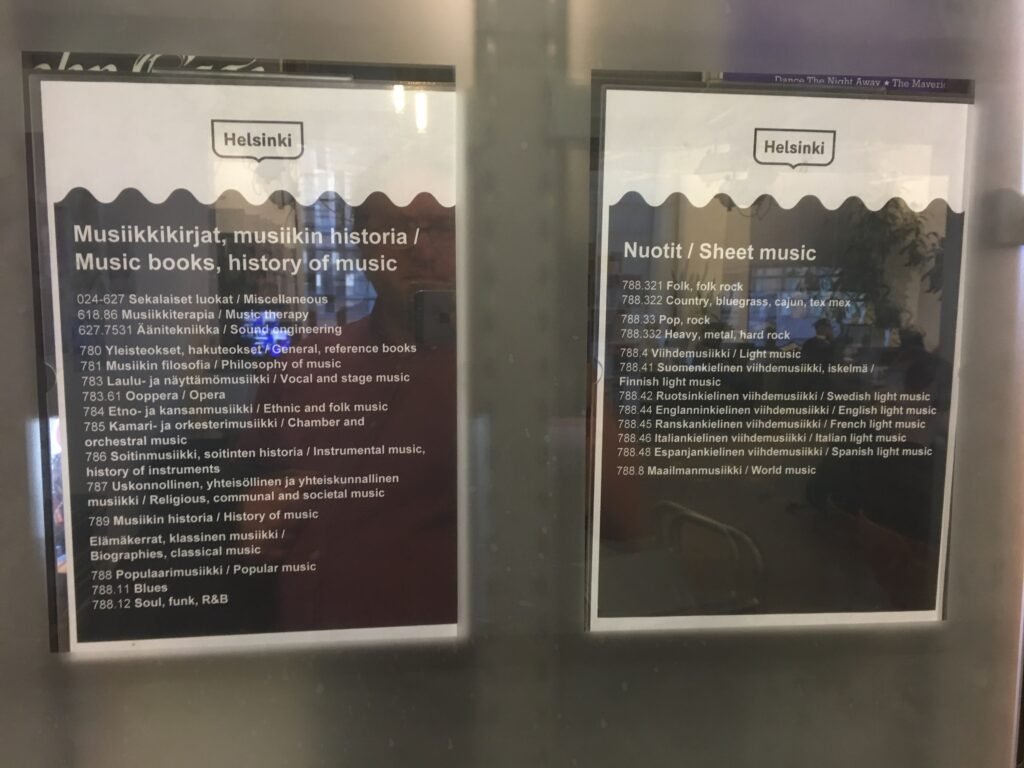
The Dewey Decimal Classification (DDC), also called the Dewey Decimal System, sorts library books by subject, using numbers. It splits all knowledge into ten main classes. Each class has ten divisions, and each division has ten sections. Decimals then narrow a topic as far as a collection needs.
The ten main classes
The first digit of a Dewey number gives the main class. OCLC, which publishes the system, lists them like this:
- 000: Computer science, information and general works
- 100: Philosophy and psychology
- 200: Religion
- 300: Social sciences
- 400: Language
- 500: Science
- 600: Technology
- 700: Arts and recreation
- 800: Literature
- 900: History and geography
How a number narrows a topic
OCLC’s summaries show three levels: ten main classes, one hundred divisions and one thousand sections. Each topic sits inside all the broader topics above it. So a Dewey number works like a path from general to specific. Digits after the decimal point extend the path to finer topics. Libraries turn the number into a call number. The call number sets the book’s place on the shelf.
Dewey sorts by discipline, not by topic alone. OCLC’s own example is garlic. It appears in botany (584). As a garden crop, it appears in agriculture (635.26). The same subject gets different numbers depending on the book’s viewpoint. Books that approach a subject in the same way stand together.
Where it came from and who maintains it
Melvil Dewey thought up the system in 1873. It was first published in 1876. It is proprietary. OCLC owns the copyright and licenses it for many uses. The Library of Congress has contributed Dewey numbers since 1930. Today its Dewey Program combines Library of Congress classification staff and OCLC editorial staff in one office. OCLC’s published introduction calls the DDC the most widely used classification system in the world. OCLC publishes it in numbered editions, such as DDC 22 and DDC 23.
Why libraries use it, and where it falls short
Subject numbers put related books side by side. A reader browsing one shelf finds neighbors on the same topic. But a physical book has only one shelf spot, even if it covers several subjects. That is one reason catalogs also use subject headings and search. Some libraries use other systems, such as the Library of Congress Classification. For related terms, see the entries on the Dewey Decimal Classification, the Library of Congress Classification, the call number, the classification scheme and subject headings.
FAQs
What does a number like 500 mean? The first digit shows the main class. 500 is the science class. A more specific number such as 584 narrows it to botany.
Why does Dewey use decimals? Digits after the decimal point describe a narrower topic. The broader classes do not need renumbering.
Is the Dewey Decimal Classification free to use? It is proprietary. OCLC owns the copyright and licenses it. Libraries and publishers use it under license terms.
Do all libraries use Dewey? No. OCLC calls it the most widely used system, but other systems exist and some libraries choose them.
More in Education
- OCLC, “Introduction to the Dewey Decimal Classification.” oclc.org (PDF)
- OCLC Research, “Learn more about the Dewey Decimal Classification (DDC) and the DDC Summaries.” oclc.org/research
- Joan S. Mitchell and Diane Vizine-Goetz, “Dewey Decimal Classification,” OCLC, 2009. oclc.org (PDF)
- Library of Congress, “The Dewey Program at the Library of Congress.” loc.gov/aba/dewey/about
- Library of Congress, history of Dewey numbers at the Library. loc.gov/aba/dewey/history