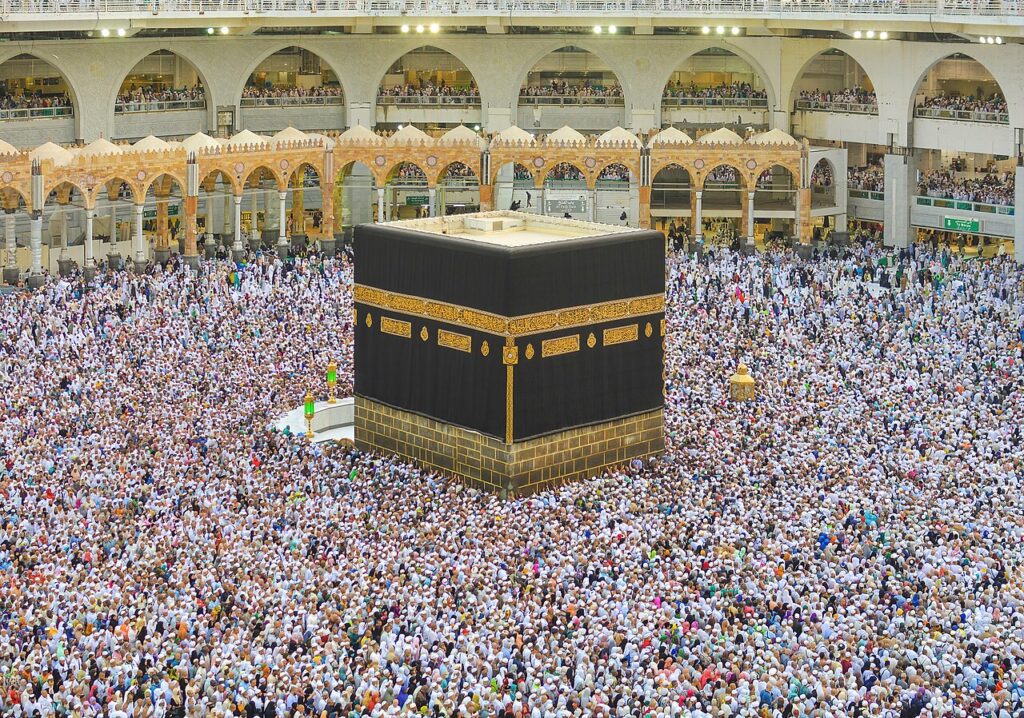
The five pillars of Islam are the five core acts of worship and devotion in Sunni Islam: the profession of faith (shahada), ritual prayer (salat), almsgiving (zakat), fasting in the month of Ramadan (sawm) and pilgrimage to Mecca (hajj). For readers asking what are the five pillars of Islam, Britannica describes them as the Muslim profession of faith, prayer, a levy on wealth for the poor and needy, fasting, and the pilgrimage that is required “if financial and physical conditions permit.”[1]
The list is a framework for practice, not a full account of belief. It is usually traced to a saying of the Prophet Muhammad, reported through his companion Ibn Umar, that Islam is “built on five.”[2] About 2.0 billion people, or 25.6 percent of the world’s population, were Muslim in 2020, according to the Pew Research Center, so the pillars shape the religious calendar of a quarter of humanity.[3]
| Pillar | Arabic term | Core requirement |
|---|---|---|
| Profession of faith | Shahada | Declare that there is no god but God and that Muhammad is God’s messenger |
| Prayer | Salat | Five set prayers a day, facing the Kaaba in Mecca |
| Almsgiving | Zakat | Generally 2.5 percent of accumulated wealth each year |
| Fasting | Sawm | Daily fast from dawn to sunset in Ramadan |
| Pilgrimage | Hajj | Once in a lifetime for those physically and financially able |
Origin and framework
The hadith of the five
The best-known grouping of the five comes from a hadith recorded in the collection of Muslim, in its Book of Faith. In it, Abdullah ibn Umar reports that the Prophet said Islam was raised on five: worship of God alone, establishing prayer, paying zakat, making pilgrimage to the House and fasting in Ramadan.[2] In this version the hajj is listed before the fast.[2]
Pillars as obligations
The Harvard Pluralism Project describes the pillars as the framework of Muslim life, a set of acts that organize daily, yearly and lifetime devotion.[4] Each is shaped by capacity: the sick may be excused from fasting, and the hajj is required only of those with the health and means to travel.[1][5]
The five pillars
1. Shahada: the profession of faith
The shahada is a short declaration of belief. In English it reads, “I bear witness that there is no god but God, and Muhammad is God’s Messenger.”[4] It is recited as part of every prayer, according to the Pluralism Project, and it marks the start of a lifelong commitment.[4] The formula joins two ideas: the oneness of God and the prophethood of Muhammad.
2. Salat: ritual prayer
Muslims pray five times a day: at dawn, midday, afternoon, sunset and nightfall.[4] Each prayer follows a set sequence of standing, bowing, kneeling and prostrating, with recitation from the Quran. Worshippers face the Kaaba in Mecca, and before praying they remove their shoes, perform ritual washing and state their intention.[4]
The washing has two forms. Wudu is a partial washing of designated body parts, and ghusl is a full ritual bath. Purity is a preliminary requirement for most Islamic practice.[5] Each prayer has a window of time. It may be offered at any point within the window, although it is best to begin soon after the call to prayer.[5]
3. Zakat: almsgiving
Zakat is an annual obligatory payment from wealth. The Pluralism Project gives the rate as 2.5 percent of accumulated wealth, including savings and nonessential property, and says it purifies the remaining wealth while supporting the needy and just causes.[4] A second reference work adds that the levy applies to valuables and savings held for a full lunar year, and only above a minimum threshold called the nisab, which is pegged to a quantity of gold.[5]
The Quran, in verse 9:60, names the eligible recipients. Commentators list eight categories: the poor, the needy, those who administer zakat, those whose hearts are to be reconciled, people in bondage, people in debt, those “in the path of God,” and the stranded traveler.[6] Scholars disagree about how some categories apply today, including the reconciliation category and the meaning of “in the path of God.”[6] A separate payment, zakat al-fitr, is given during Ramadan.[5] Collection is usually through local mosques and Muslim associations, and some countries collect it through the government.[4]
4. Sawm: fasting in Ramadan
Ramadan is the ninth month of the Islamic calendar. According to the Pluralism Project, adult Muslims abstain from food, drink, sexual activity and evil thoughts from dawn to sunset throughout the month.[4] Families usually eat a meal before dawn and break the fast after the sunset prayer, often beginning with dates.[7] National Geographic notes that Muslims mark the “Night of Power,” associated with the first revelation of the Quran around 610 CE.[7] The month ends with the festival of Eid al-Fitr.[7]
The fast is not required of everyone. Exemptions listed by reference works include children before puberty, the elderly, the ill, travelers, and women who are pregnant, nursing or menstruating. Missed days are generally made up later.[5][7]
The Islamic calendar follows the moon, so the start date of Ramadan shifts from year to year.[7] See also this explainer on why the moon changes shape. The start is set by the sighting of the new crescent. In 2026, Saudi Arabia, the United Arab Emirates, Qatar and several other countries began Ramadan on February 18, while Turkey, Malaysia, Indonesia and others began on February 19, after no crescent was confirmed on the previous evening.[8]
5. Hajj: pilgrimage to Mecca
The hajj takes place in Dhu al-Hijjah, the last month of the Islamic lunar year, and is required at least once in a lifetime of Muslims who are physically and financially able.[4][9] The British Museum traces its rituals to the time of Abraham and notes that Muhammad led the pilgrimage in 632 CE, the year he died.[9]
Al Jazeera’s step-by-step guide describes the rites in this order.[10] Pilgrims enter ihram, a state of ritual purity marked by a statement of intention and simple garments. Men wear two white cloths, and the identical clothing is meant to erase differences of class, wealth and nationality. Pilgrims circle the Kaaba seven times in the tawaf and walk seven times between the hills of Safa and Marwa in the sa’i, which the British Museum links to Hagar’s search for water.[10][9] They then spend a night at Mina and, on the next day, stand in prayer at Arafat from midday to sunset, which Al Jazeera calls the most important ritual. After a night at Muzdalifah they throw pebbles at pillars in Mina, offer an animal sacrifice, shave or trim their hair, and return to Mecca for further circling and a farewell tawaf.[10] The sacrifice coincides with the first day of Eid al-Adha.[10]
In 2026 the hajj ran from May 25 to May 27, according to Al Jazeera.[11] Saudi Arabia’s General Authority for Statistics reported 1,707,301 pilgrims, of whom 1,546,655 came from abroad and 160,646 were citizens and residents of the kingdom.[12]
How the pillars fit together
The shahada is a statement made once and repeated within prayer. The salat recurs daily, zakat annually, the Ramadan fast once a year and the hajj once in a lifetime. Mecca connects two of them, because Muslims face the Kaaba when they pray and travel to the city on pilgrimage.[4]
Variation among Muslims
Sunni and Shia perspectives
The five-pillar list is characteristic of Sunni Islam. Shia Islam shares the same practices but classifies them differently. New World Encyclopedia reports that Shia teachings divide religion into “roots,” including the justice of God and the leadership of the imams, and “branches,” which include prayer, fasting, the hajj, zakat and khums, a payment of one-fifth.[13] The same source says that general Shia and Sunni rituals are very similar, with minor differences, and that Shia Muslims add recognition of Ali as imam to the shahada.[13]
Observance in surveys
Pew Research Center surveyed more than 38,000 Muslims in 39 countries and territories. It reported global medians of 93 percent who say they fast during Ramadan, 77 percent who give zakat, 63 percent who pray all five daily prayers, and 9 percent who have made the hajj.[14] The report notes large differences by country. Fasting was at least 80 percent in every surveyed country in the Middle East and North Africa, while the share praying five times daily ranged from 88 percent in Afghanistan to 21 percent in Azerbaijan and 2 percent in Kazakhstan.[15] These are self-reported figures from a survey released in 2012, so they describe attitudes and behavior from that period.
What the pillars do not cover
The pillars describe practice and do not summarize everything Muslims believe or how they interpret Islamic law. Such questions fall to creeds, jurisprudence and mystical traditions such as Sufism. The sources used here describe the pillars in general terms and do not detail how daily observance differs among communities.
FAQs
What are the five pillars of Islam? They are the shahada (profession of faith), salat (five daily prayers), zakat (almsgiving), sawm (fasting in Ramadan) and hajj (pilgrimage to Mecca).
Is the hajj required for every Muslim? It is required once in a lifetime of Muslims who are physically and financially able to make it.
How much is zakat? The Harvard Pluralism Project gives the rate as 2.5 percent of accumulated wealth each year, generally payable above a minimum threshold known as the nisab.
Who is exempt from fasting in Ramadan? Reference works list young children, the elderly, the ill, travelers, and women who are pregnant, nursing or menstruating. Missed days are generally made up later.
Do Shia Muslims follow the five pillars? Shia Muslims practice the same acts but organize them within a different framework of roots and branches of religion, and add a phrase recognizing Ali to the shahada.
How many people made the hajj in 2026? Saudi Arabia’s statistics authority reported 1,707,301 pilgrims, including 1,546,655 from abroad.
More in Society
- Encyclopaedia Britannica, Pillars of Islam
- Sahih Muslim, Book of Faith, hadith 16b (Ibn Umar)
- Pew Research Center, Islam was the world’s fastest-growing religion from 2010 to 2020 (2025)
- Harvard Pluralism Project, The Five Pillars of Islam (PDF)
- New World Encyclopedia, Pillars of Islam
- Human Appeal, Who receives zakat: the 8 Quranic categories
- National Geographic, Ramadan
- The New Arab, When does Ramadan 2026 start and why does it vary?
- British Museum, Pilgrims walking around the Ka’ba at Mecca
- Al Jazeera, The Hajj explained visually
- Al Jazeera, When are Hajj and Eid al-Adha 2026?
- The Peninsula Qatar, 2026 Hajj season saw 1,707,301 pilgrims (GASTAT)
- New World Encyclopedia, Shi’a Islam
- Pew Research Center, Global median of 93% of Muslims say they fast during Ramadan (2013)
- Pew Research Center, The World’s Muslims: Religious Commitment (2012)
Photo: Adli Wahid (modified by Basile Morin) / Wikimedia Commons / CC BY-SA 4.0