Gold is the official state mineral of Alaska, designated in 1968, and gold mining has shaped the state’s history from the Juneau strike of 1880 through the Nome and Fairbanks rushes. Alaska produced 49,270,000 troy ounces of gold from 1880 through 2018, and in 2019 its output of 539,390 ounces was 8.4 percent of U.S. production, second only to Nevada [1][2].
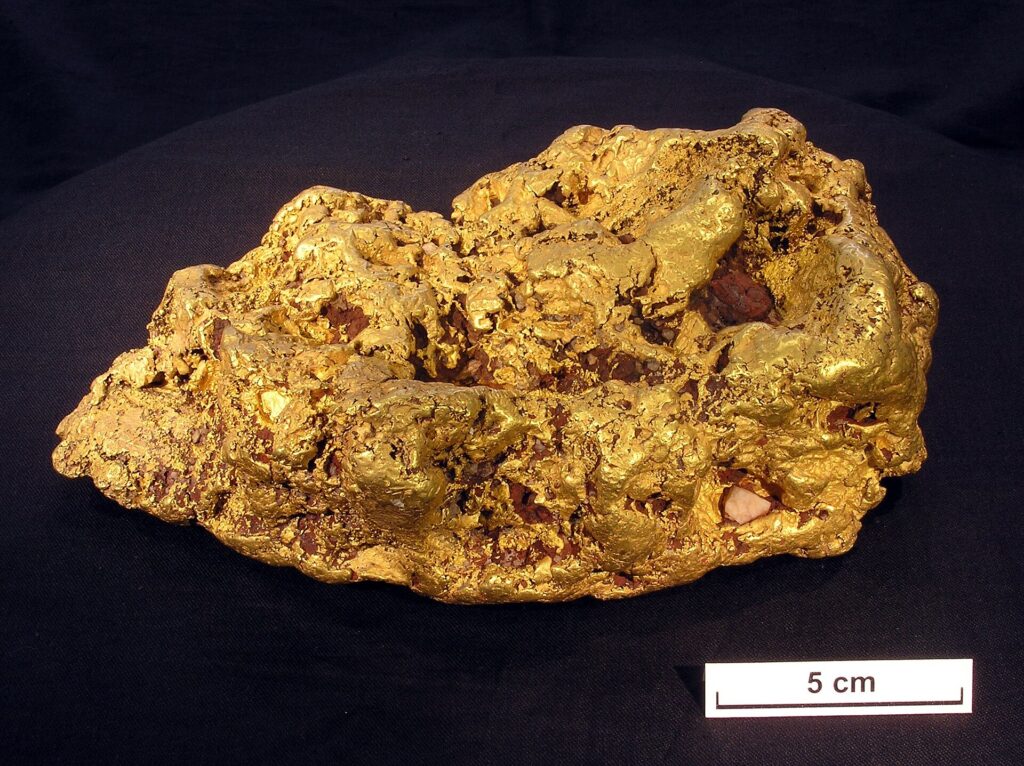
| State mineral since | 1968 |
|---|---|
| Production 1880–2018 | 49,270,000 troy oz |
| Peak year | 2013: 1,022,987 oz |
| 2019 output | 539,390 oz (8.4% of U.S.) |
| Largest 2019 mine | Fort Knox, 200,263 oz |
| Nome district | Over 3.6 million oz |
| Fairbanks district | Over 8 million oz from placers |
Major Discoveries
In 1880 Chief Kowee showed gold to prospectors Joe Juneau and Richard Harris at Gold Creek, which founded the city of Juneau and sparked the Juneau gold rush. The Klondike strike of 1896 was in Canada, but it drew miners away from Alaska’s Fortymile region. Jafet Lindeberg and two partners found placer gold on Anvil Creek near Nome in 1898, and a rush followed in spring 1899. Felix Pedro and Tom Gilmore discovered gold near Fairbanks in 1901, and placer mining began there in July 1902 [1].
District Production
A 1979 summary of Alaska districts listed Fairbanks as the largest producer, with well over 7 million troy ounces at that time, followed by Juneau with nearly 7 million, Nome with about 4 million and Iditarod with about 1.3 million [2]. More recent figures give the Nome district over 3.6 million ounces and the Fairbanks district over 8 million ounces from placers and over 4 million from lodes [1].
Production Totals
Alaska produced 49,270,000 troy ounces of gold from 1880 through 2018. Output peaked at 1,022,987 ounces in 2013, the highest since 1906, and has declined since. In 2018 gold worth $888,302,130 made up 28 percent of Alaska’s mining value [1].
Current Mines
In 2019, the Fort Knox mine operated by Kinross Gold, which opened in 1996, produced 200,263 troy ounces, the Pogo mine operated by Northern Star Resources produced 154,589 ounces and the Kensington mine operated by Coeur Mining produced 127,914 ounces [1].
Employment
Metals mining employed over 8,000 people in 1915, the peak cited in one history, fell to fewer than 300 workers by 1970 and rose again with renewed exploration when gold prices climbed [2].
State Mineral
Alaska designated gold its state mineral in 1968, the same year it designated jade the state gem [3]. See also the entries on the Alaska Native villages and cities that grew from gold rushes, and on the Territory of Alaska.
FAQs
What is the Alaska state mineral? Gold, designated in 1968.
When was gold discovered in Juneau? In 1880, at Gold Creek.
How much gold has Alaska produced? About 49.27 million troy ounces from 1880 through 2018.
What are Alaska’s largest gold mines? Fort Knox, Pogo and Kensington were the largest in 2019.
When was the Nome gold rush? Gold was found on Anvil Creek in 1898 and a rush followed in spring 1899.
Sources
- Wikipedia: Gold mining in Alaska
- Geophysical Institute, University of Alaska Fairbanks: Alaska’s Gold (Alaska Science Forum)
- Wikipedia: List of Alaska state symbols
More in Earth Sciences
Key facts
In the news
Quick checkIn which year did Alaska name gold its state mineral?Show answer
1968
Sources
- Wikipedia. Gold mining in Alaska. 2026 (accessed 2026-11-12)
- Geophysical Institute, University of Alaska Fairbanks. Alaska’s Gold (Alaska Science Forum). 1979 (accessed 2026-11-12)
- Wikipedia. List of Alaska state symbols. 2026 (accessed 2026-11-12)
Editorially reviewed by Specialty Digest Editorial TeamLast reviewed November 12, 2026Researched and drafted with AI assistanceReport an issue