Few subjects make people look away as quickly as toilets. That reluctance is the problem. For roughly two in five people on Earth, a safe place to go is not a given, and silence has helped keep it that way. World Toilet Day, observed every year on November 19, was created to break that silence and to treat sanitation as what it is: a matter of health, dignity and opportunity. It is a close companion of World Water Day, because clean water and safe sanitation depend on each other.
From campaign to United Nations day
The day began as a campaign before it became an official observance. Jack Sim’s World Toilet Organization, founded on November 19, 2001 to break the taboo around sanitation, chose that date as its own. Singapore then carried the idea to the United Nations. On July 24, 2013, the General Assembly adopted the resolution “Sanitation for All” and designated November 19 as World Toilet Day. More than 100 member states co-sponsored it, and the first official observance followed that November.
The resolution asked governments to encourage behavior change and policies that bring sanitation to poor communities, and it called for an end to open defecation, which it described as extremely harmful to public health. It also asked countries to see sanitation broadly, from hygiene to sewers, wastewater treatment and reuse. UN-Water was requested to help implement the day. The decision built on a 2010 General Assembly recognition of water and sanitation as a human right.
What a “safe toilet” really means
Owning a toilet is not the same as having safe sanitation. The standard, called safely managed sanitation, asks for a toilet that is not shared with other households and for waste that is dealt with properly. It must be treated or disposed of on site, stored safely and later emptied and treated elsewhere, or carried by a working sewer to a treatment plant. Take away that last link and a toilet simply moves the danger somewhere else.
Example 1: the toilet that is not enough. A family has a modern flush toilet, but its pipe leads to a drain that empties untreated into a stream where children play downstream. Down the road, a neighbor’s pit latrine is private, sealed and emptied on a schedule by a trained crew who take the waste to a treatment site. By the standard, the neighbor’s household is the safer one. What matters is where the waste ends up, not only the fixture in the bathroom.
The numbers behind the day
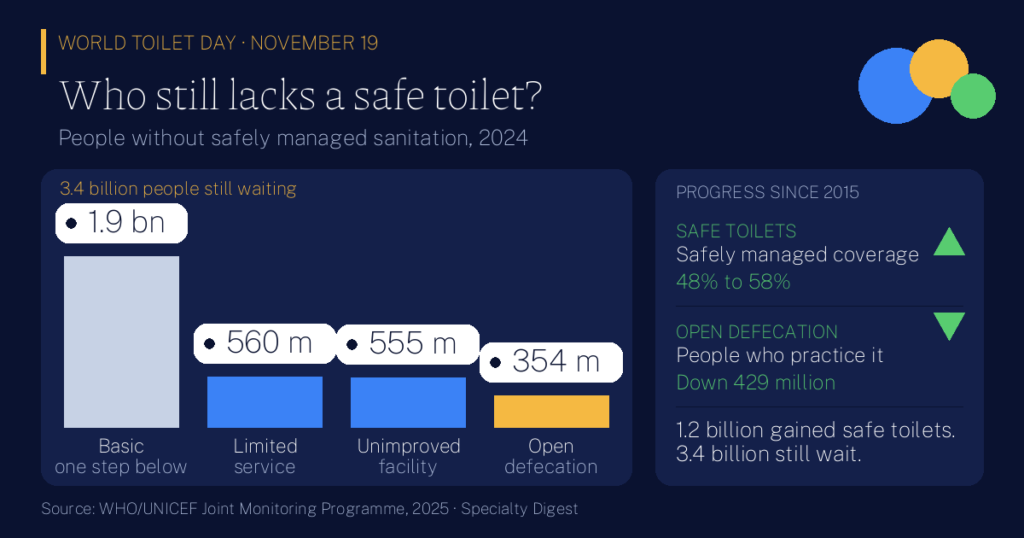
In 2024, 58 percent of the world’s people used a safely managed sanitation service. That leaves 3.4 billion people without one, including 354 million who still practice open defecation. The picture is not all bleak. Over the past decade, 1.2 billion people gained safe sanitation, and the number practicing open defecation has fallen by 429 million since 2015.
The pace is the worry. At current rates, about 3 billion people will still lack safe toilets in 2030. Reaching the global goal of sanitation for all would require a sixfold increase in the average rate of progress, and in low-income countries a 13-fold increase for basic sanitation and a 21-fold increase for safely managed sanitation.
Health, dignity and the school gate
Untreated human waste can contaminate rivers, lakes and groundwater, and children are especially vulnerable to diseases such as cholera that spread through exposure to it. The UN Secretary-General notes that diarrheal illness kills over 1,000 children a day. Sanitation failures are also linked to dysentery, hepatitis A and typhoid.
The harm is not only medical. Without clean, lockable, gender-segregated toilets, women, girls, older people and people with disabilities cannot fully take part in public spaces, workplaces and education. Nearly 1 in 5 adolescent girls aged 10 to 19, about 120 million, lack even basic sanitation.
- 427 millionchildren lack basic sanitation at school, 1 in 5
- 22%of schools worldwide have no basic sanitation service
- 39%of schools provide menstrual health information and advice
- 646 millionchildren lack basic hygiene services at school
Example 2: the missing school days. Suppose a girl has no private, safe toilet at school and stays home for one day each month of a ten-month school year. She loses about ten days of learning every year, and the gap compounds over time. The numbers are round and illustrative, but the pattern is what UN agencies describe: lack of safe, private toilets leads many girls to miss school, particularly during menstruation.
Sanitation in a changing climate
The environment pays too. About 44 percent of household wastewater is not treated properly. Ageing systems are failing in many places, and by 2050 around 1.6 billion people will be at risk of floods that could damage or destroy sanitation services. Poorly managed systems also release methane and nitrous oxide, which feed the climate crisis. Done well, the reverse is possible: safely managed sanitation can reuse treated wastewater as a source of water, nutrients and energy. That is why the 2025 campaign asked the world to invest in “future-ready” toilets that are accessible, resilient to floods and droughts, low in emissions and well funded.
The best investment you may not have heard of
Sanitation is one of the cheapest ways to improve lives. A WHO study found that every $1 invested in sanitation returns $5.50 in lower health costs, higher productivity and fewer premature deaths. The World Bank estimates a return of $7 for every $1 spent on water supply and sanitation in Africa.
Example 3: a city’s budget. Imagine a city invests $10 million in safely managed sanitation. At WHO’s average return, about $55 million comes back over time as fewer sick days, lower hospital bills and saved lives. The figures are rounded and illustrative, but they show why health economists call sanitation a best buy.
Who keeps it working, and how the day is marked
Behind every working system are sanitation workers, and UN-Water urges governments to protect them with legal safeguards, safe conditions and fair wages. Each year UN-Water coordinates a global campaign built around a theme. The 2026 campaign, led by UN-Water’s expert group on water, sanitation and hygiene and co-coordinated by UNICEF and WHO, puts sanitation and gender equality at the center. The 2025 campaign reached 10.2 billion accounts across social media and online channels.
- 2014Equality, Dignity and the link between gender-based violence and sanitation
- 2015Sanitation and nutrition, a vicious cycle
- 2017Wastewater
- 2025Sanitation in a changing world
- 2026Sanitation and gender equality
Key Takeaways
- A toilet is only safe if the waste is too. Waste must be contained, emptied and treated, not just flushed out of sight.
- Progress is real but unfinished. 1.2 billion people gained safe sanitation in a decade, and 3.4 billion still wait.
- Sanitation shields health, children first. Safe toilets cut the spread of cholera, dysentery and diarrheal disease.
- Schools are the leverage point. Clean, private, lockable toilets keep girls learning, and 427 million children still lack a basic one.
- Every dollar works hard. Estimated returns run from $5.50 globally to $7 in Africa for each $1 spent.
- Climate makes it urgent. Floods, ageing pipes and rising demand mean systems must be built for tomorrow.
- Talk about it. Breaking the taboo is where change starts, so ask how toilets in your school, workplace and community are maintained.
How solid is this? Coverage figures are modeled estimates from the WHO/UNICEF Joint Monitoring Programme for 2024 and are revised with each update. The return-on-investment figures come from a 2012 WHO study and a World Bank analysis and vary by region. The three worked examples use round, made-up numbers to show an idea. See also World Water Day, the International Days hub and the International Days Calendar.
More in Health
- UN General Assembly. Sanitation for All, draft resolution A/67/L.75 (24 July 2013).
- UN News. World Toilet Day: UN urges breaking taboos, making sanitation for all a global reality (2013).
- UN-Water. World Toilet Day 2025 fact sheet.
- UN-Water. World Toilet Day 2026 fact sheet: ten things to know.
- WHO and UNICEF Joint Monitoring Programme. Progress on household drinking water, sanitation and hygiene 2000-2024 (2025).
- World Health Organization. SDG targets 6.1, 6.2, 6.3 and 6.a: drinking water, sanitation, wastewater.
- World Bank. The Global Sanitation Crisis: Pathways for Urgent Action.