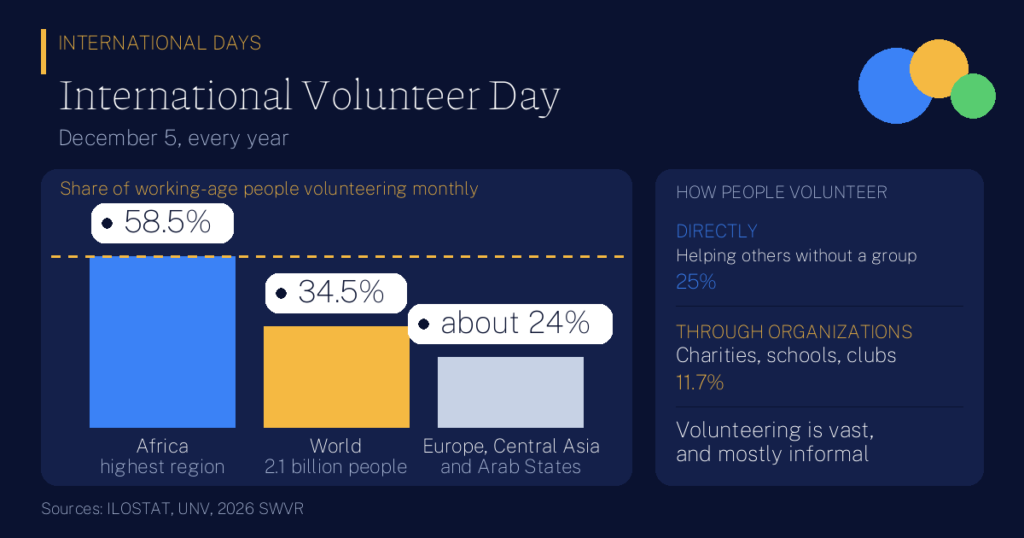
Every day, somewhere, a neighbor carries groceries to an older person, a student coaches a youth team, a nurse staffs a flood shelter on her day off. Almost none of it appears in a national budget or a company report. International Volunteer Day, observed every December 5, exists to make this work visible and to thank the people who do it. The numbers suggest that volunteering is not a niche activity. It may be one of the largest forms of human cooperation on Earth.
From a 1985 resolution to a global day
The United Nations has relied on volunteers almost from its start. In 1970 the General Assembly created the UN Volunteers programme through resolution 2659, and it has been operational since 1971. It is administered by the UN Development Programme, and according to the UN more than 17,000 UN Volunteers serve in over 170 countries each year, from more than 180 nationalities.
The day itself came later. On December 17, 1985, the General Assembly adopted resolution 40/212, which established the International Volunteer Day for Economic and Social Development and invited governments to observe it each year on December 5. The UN notes that the day is generally the result of a partnership among the UN system, governments, volunteer-involving organizations and individuals, while UNV coordinates the annual themes and campaigns.
What counts as volunteering
Ask people whether they volunteer and many will say no, even if they help a neighbor every week. Statisticians use a broader and more precise idea. Under the standard adopted by labor statisticians at the 19th International Conference of Labour Statisticians, volunteer work is unpaid, non-compulsory work done for others, measured over a recent four-week period. It has two main forms. Direct volunteering means helping people outside your household without going through a group, such as looking after a neighbor’s child or helping repair a storm-damaged roof. Organization-based volunteering happens through a charity, a school, a faith group, a club or a public agency.
The distinction matters because the two forms are counted very differently. Organizations keep lists, so organized volunteering shows up in records. Informal help leaves no trace unless someone asks about it in a household survey. Ask the wrong question, or ask no one at all, and a country can look far less generous than it really is.
The numbers behind the day
The 2026 State of the World’s Volunteerism Report, published by UNV in December 2025 with the International Labour Organization and university partners, gives the clearest global picture so far. Country estimates for 2022 to 2025 were combined to show that 34.5 percent of working-age people, approximately 2.1 billion, volunteer each month. The report treats this as a measurement milestone. The 2022 edition cited 14.9 percent, and the ILO’s statistics team says the difference reflects better measurement rather than a surge in giving.
Example 1: a town of volunteers. Picture a town with 10,000 working-age adults. At the global rate of 34.5 percent, about 3,450 of them give time in a typical month. That is more people than the town’s largest employer might have on its payroll, which is why planners who ignore volunteers miss a major resource. The figures are round and illustrative.
Who volunteers, and how
The ILO estimates show that 25 percent of working-age people volunteer directly, while 11.7 percent do so through or for organizations. These groups overlap, since many people do both. Globally, volunteer work is slightly more common among men, at 36.9 percent, than among women, at 32.1 percent, though the pattern varies by region. In Africa the rates are 63.1 percent for men and 54.0 for women. In Asia and the Pacific they are 34.6 and 29.0 percent. In Europe and Central Asia the ILO reports no difference between the sexes.
The UN also points out that much volunteering is informal and that volunteers play a key role in emergency response. Read together, these findings suggest a simple picture: most of the world’s volunteering is people helping the people around them, often with no badge, no sign-up sheet and no one keeping count.
Example 2: the invisible half. Suppose a district counts volunteers only through the sign-up sheets of local groups. Out of 1,000 working-age residents it finds about 117 volunteers. A household survey asking about direct help finds about 250. The district had been missing more than half of its helpers. The numbers are illustrative but follow the global ratio.
Why measuring it matters
The 2026 report introduces the Global Index of Volunteer Engagement, built on four equal dimensions: value to the individual, value to the community, economic value and the enabling environment. Its argument is that hours and dollar values alone are not enough, because they miss what volunteering does for trust, belonging and resilience. A 2025 UNV and ILO publication also examined volunteering, unpaid care work and gender in lower-income countries, a reminder that unpaid work is not shared equally.
- 2.1 billionpeople volunteer monthly, 34.5% of working-age adults
- 58.5%monthly volunteering rate in Africa, the highest region
- 25%of working-age people volunteer directly
- 11.7%volunteer through or for organizations
Example 3: a price tag that falls short. Imagine 100 volunteers who each give 4 hours a month, with a replacement wage of $15 an hour. The labor is worth about $6,000 a month. That sounds large, yet it leaves out the friendships formed, the skills gained and the neighborhood that now knows who to call in a crisis. The numbers are round and illustrative, and they show why the UN report urges broader measures.
How the day is marked, and why 2026 matters
Each December 5, UNV and its partners run a campaign with a theme, governments and civil society hold events, and communities thank local volunteers. The day is also a chance to recognize inclusion, since volunteering works best when people of every ability and background can take part. See our article on the International Day of Persons with Disabilities for that wider conversation.
The General Assembly designated 2026 as the International Year of Volunteers for Sustainable Development (resolution 78/127). It follows the 2001 International Year of Volunteers, which the Assembly proclaimed in 1997. The UN says the new year is meant to put volunteering into planning for the Sustainable Development Goals, and the 2026 report was launched to lay its foundations.
Key Takeaways
- The day has a clear legal origin. The General Assembly set December 5 in resolution 40/212 of December 17, 1985.
- Volunteering is vast. About 2.1 billion people, 34.5% of working-age adults, volunteer each month.
- Africa leads. Its monthly rate of 58.5% is the highest of any region.
- Most help is informal. Direct volunteering reaches 25% of adults, against 11.7% through organizations.
- Gaps exist. Men volunteer slightly more than women globally, 36.9% to 32.1%, with wide regional variation.
- Counting changes the story. The jump from 14.9% in the 2022 report reflects better measurement, not sudden generosity.
- 2026 is a volunteer year. Look for local ways to give time, and thank someone who already does.
How solid is this? The volunteering rates are modeled global estimates from ILO and UNV work covering 2022 to 2025, and they depend on how countries define and survey volunteer work. The three worked examples use round, made-up numbers to show an idea. See also the International Days hub and the International Days Calendar.
More in Society