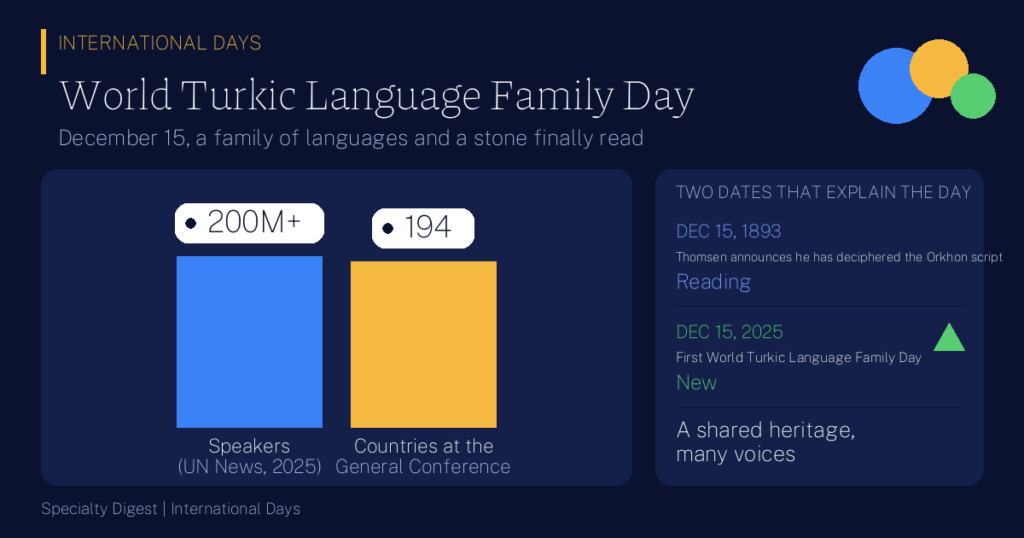
A language is more than a tool for ordering lunch or filling out a form. It carries songs, laws, jokes and memory from one generation to the next. World Turkic Language Family Day, observed every year on December 15, honors one of the great language families of Eurasia, a group that includes Azerbaijani, Kazakh, Kyrgyz, Turkish, Turkmen and Uzbek. UNESCO proclaimed the day in November 2025, and the first observance took place on December 15, 2025, which makes it one of the newest days on the international calendar. It shares a spirit with the World Day of Romani Language: the belief that protecting a language protects the people who speak it.
A date chosen for a discovery
Most international days mark a treaty, a tragedy or a founding. This one marks a moment of reading. The Orkhon inscriptions are stone monuments carved in the 8th century in the Orkhon Valley, in present-day Mongolia. UN News describes them as some of the oldest known written records of the Turkic language family. For centuries nobody alive could read the strange runic script on them. On December 15, 1893, the Danish linguist Vilhelm Thomsen announced that he had deciphered it, and the voices of the early Turkic world became readable again.
What a language family is
A language family is a group of languages that grew from a shared ancestor, much as Spanish, French and Italian grew from Latin. The Turkic languages share a great deal of structure. Many build words by attaching endings one after another to a root, and many follow a pattern called vowel harmony, in which the vowels inside a word match one another. Speakers of two Turkic languages often notice familiar sounds and words, though understanding varies widely from one pair to another and a shared family does not mean a shared dictionary.
Example 1: two neighbors. Imagine a traveler who learned one Turkic language and then visits a region where another is spoken. She may recognize a number, a greeting or a family word, and she may be able to follow a slow, simple conversation. Reading a newspaper is a different matter. The figures here are made up, but the pattern is real: relatives in a language family are close without being identical.
The numbers behind the day
The numbers reported around the proclamation give a sense of scale. UN News says more than 200 million people speak Turkic languages, across an area of roughly 12 million square kilometers. Neither figure comes with a stated source or year, and both are best read as broad estimates, not census counts. The decision itself was made at the 43rd session of UNESCO’s General Conference in Samarkand, Uzbekistan, which Anadolu Agency reported drew more than 5,000 participants from 194 countries.
- 200 million+speakers of Turkic languages, per UN News (2025)
- 12 million km²area covered, roughly, per UN News (2025)
- 194countries represented at the 43rd General Conference, per Anadolu Agency (2025)
- 8th centurydate of the Orkhon inscriptions
Why a day for a language family
Most language days honor a single language. This one honors a family, and that choice carries an idea: a shared heritage can be celebrated without erasing the differences between peoples. UN News places the day within the United Nations commitment to multilingualism, citing General Assembly resolution 71/328. Türkiye’s permanent representative to UNESCO, Gulnur Aybet, said the recognition “reaffirms the enduring commitment to multilingualism, cultural diversity and dialogue among peoples,” and described languages as carrying “collective memory, wisdom and identity across generations.”
There is also a practical side. Languages live through schools, books, broadcasts and the everyday talk of grandparents and children. When a language loses ground in classrooms or online, its oral traditions, songs and stories lose ground with it. Documenting a language and teaching it to the young are the quiet work that a day like this is meant to encourage.
Example 2: the elders’ archive. Suppose a district library invites 40 elders to record five hours of stories, proverbs and songs each. That adds up to 200 hours of speech that would otherwise live only in memory. The numbers are round and illustrative, but this is the kind of oral-heritage work the observance is meant to inspire.
Who proposed it, and how it was agreed
The proclamation came through a draft resolution at the General Conference. UN News reports a joint request from Azerbaijan, Kazakhstan, Kyrgyzstan, Türkiye and Uzbekistan, supported by 21 other member states. Anadolu Agency and the Astana Times report a somewhat different line-up that includes Turkmenistan and a count of 26 supporting states. Because the published accounts differ, this article does not give a single tally. UNESCO’s own record of the resolution is the best place to check the final list.
The Secretary General of the Organization of Turkic States, Kubanychbek Omuraliev, called the decision a milestone for the Turkic world, according to the Astana Times. The day is meant to promote a common language, culture and documentary heritage, and to encourage cooperation among Turkic-speaking states on language preservation, education and archives.
How the day is marked
UN News says the observance is expected to include exhibitions, lectures, literary events and artistic performances, along with awareness-raising, academic research and programs to safeguard Turkic languages and oral traditions. Because the day is so new, its customs are still forming, and each year offers a chance to shape them. One feature worth noting is the scripts. Turkic languages today are written in several different alphabets, and the Orkhon runes are a reminder that writing systems come and go while the spoken language endures.
Example 3: a classroom hour. A teacher with 30 students asks each to bring one proverb, song line or family word from home, in any language they speak. In one hour the class collects 30 pieces of living heritage and sees how many different languages sit in one room. The numbers are illustrative, but the exercise needs no budget and works anywhere.
Key Takeaways
- The date marks a reading. December 15 recalls Vilhelm Thomsen’s announcement in 1893 that he had deciphered the Orkhon inscriptions.
- The day is very new. UNESCO proclaimed it in November 2025, and the first observance was December 15, 2025.
- It honors a family, not one language. Azerbaijani, Kazakh, Kyrgyz, Turkish, Turkmen and Uzbek are among the examples named by UN News.
- The scale is large. UN News reports more than 200 million speakers over roughly 12 million square kilometers, without a stated source or year.
- Related is not identical. Shared roots help learners, but each language has its own words, history and community.
- Preservation is everyday work. Teaching children and recording elders keep a language alive more than any single event.
- Check the details. Published accounts differ on the number of supporting states, so consult UNESCO’s record for the final list.
How solid is this? The day, its date and its origin are confirmed by UN News and by news reports of the UNESCO decision. The speaker and area figures are unsourced estimates in UN News, and the count of supporting states differs between reports. The family tree is a simplified classification, and the three worked examples use round, made-up numbers. Explore more in the International Days hub and the International Days Calendar.
More in Education
- UN News, “UN marks first World Turkic Language Family Day” (December 14, 2025)
- UNESCO, “World Turkic Language Family Day” (UNESDOC, 2025)
- United Nations, List of International Days and Weeks
- United Nations, Presentation of Turkic Cultural Heritage Volumes and World Turkic Language Family Day (November 4, 2025)
- Anadolu Agency, “UNESCO designates Dec. 15 as World Turkic Language Family Day” (November 3, 2025)
- The Astana Times, “UNESCO Declares World Turkic Language Family Day in December” (November 2025)