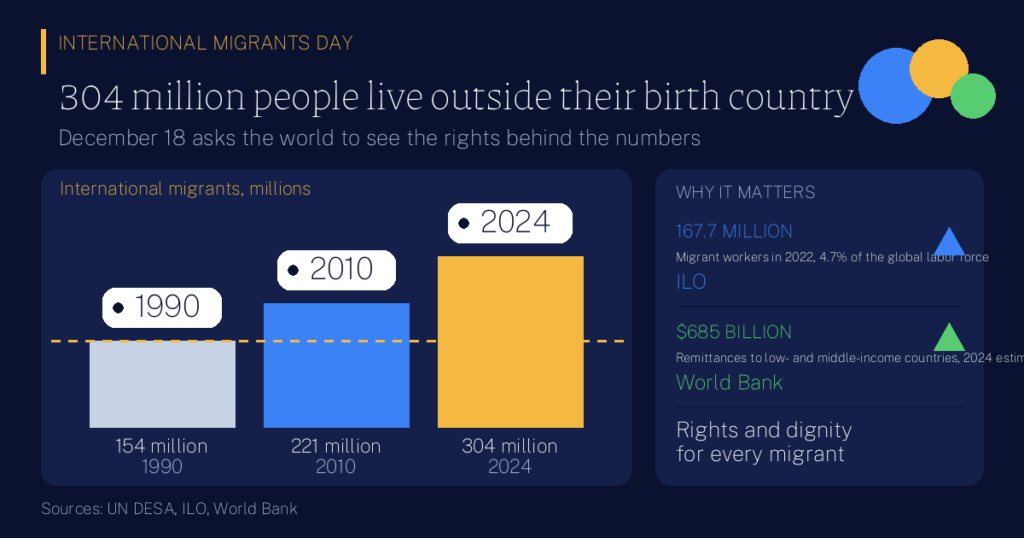
Nearly everyone knows a migrant, and many of us are descended from one. Yet few words divide opinion as sharply. International Migrants Day, observed every year on December 18, asks the world to look past the argument and see the people. In 2024, an estimated 304 million people lived in a country other than the one where they were born. That is 3.7 percent of humanity, a number larger than the population of most countries. The day is a prompt to ask who these people are, what they contribute and what they are owed. It falls just after Human Rights Day for a good reason: the rights of migrants are human rights.
How the day began
On December 4, 2000, the UN General Assembly adopted resolution A/RES/55/93, titled “Proclamation of 18 December as International Migrants Day.” It was adopted without a vote. According to the UN Digital Library summary, the resolution invites member states, and intergovernmental and nongovernmental organizations, to mark the day by sharing information on the human rights and fundamental freedoms of migrants. It also asks the Secretary-General to bring the decision to the attention of governments and relevant organizations. The day is built around knowledge and rights, not around any single policy.
A larger step followed in 2018. The Global Compact for Safe, Orderly and Regular Migration was adopted in Marrakech on December 10, 2018 by 164 member states, and the General Assembly endorsed it on December 19, 2018, with 152 votes in favor, 5 against and 12 abstentions. UN News describes it as the first negotiated global framework on a common approach to international migration in all its dimensions. It is not legally binding.
Who counts as a migrant
As a rule, UN statistics count an international migrant as a person living in a country other than the one where they were born. That wide definition covers a nurse recruited abroad, a student on a scholarship, a spouse joining family and a person fleeing danger. Refugees are one group within the total. In mid-2024, UN DESA counted close to 38 million refugees and 8 million asylum seekers. Adding others in need of international protection, about 51.7 million people were forcibly displaced across borders, roughly one in six international migrants. The other five in six moved for reasons such as work, study or family.
The numbers behind the day
The number of migrants has nearly doubled since 1990, when UN DESA counted 154 million, or 2.9 percent of the world’s people. By 2010 the count was 221 million, and by 2024 it reached 304 million, or 3.7 percent. Put the other way, about 96 of every 100 people still live in the country where they were born. Women and girls made up 48 percent of international migrants in 2024.
Where do they live? In 2024 the United States hosted the most, at 52.4 million, followed by Germany at 16.8 million and Saudi Arabia at 13.7 million. By region, Europe hosted 94 million migrants, Northern America 61 million, and Northern Africa and Western Asia 54 million. Migration is also more local than many assume: 45 percent of all migrants lived in the region where they were born.
Workers who keep economies running
Most adult migrants move to work, and the ILO has measured their weight in the labor market. In 2022 there were 167.7 million international migrants in the labor force of their destination countries, which is 4.7 percent of the global labor force. Of these, 102.7 million were men and 64.9 million were women. About 68.4 percent worked in high-income countries. ILO Director-General Gilbert F. Houngbo said that migrant workers are indispensable in addressing global labor shortages and contributing to economic growth.
- 167.7 millionmigrant workers in destination labor forces, 2022
- 4.7%of the global labor force, 2022
- 64.9 millionof those workers were women, 2022
- 28.8%of migrant women worked in the care economy, against 19.2% of non-migrant women, 2022
Example 1: the hospital ward. Imagine a hospital with 100 nursing and care staff, of whom 20 are migrants. If all 20 left, one shift in five would go uncovered. The numbers are round and made up for illustration, but they show why care systems in many countries lean on migrant workers.
Money sent home
Migrants also support families across borders. The World Bank estimated that remittances to low- and middle-income countries would reach $685 billion in 2024, up from $647 billion in 2023, a rise of 5.8 percent. Its analysis described this flow as larger than foreign direct investment and official development assistance combined. By volume, the largest recipients in 2024 were India ($129 billion), Mexico ($68 billion), China ($48 billion), the Philippines ($40 billion) and Pakistan ($33 billion). Measured against the size of the economy, Tajikistan (45 percent of GDP) and Tonga (38 percent) depended on remittances most.
Sending money costs too much. In the fourth quarter of 2023 the global average cost of sending $200 was 6.4 percent of the amount sent, against a Sustainable Development Goal target of 3 percent. Digital channels averaged 5 percent, compared with 7 percent for non-digital ones, and sub-Saharan Africa was highest at 7.9 percent.
Example 2: the cost of a transfer. A worker sends $200 each month. At 6.4 percent the fees come to $12.80 a transfer. At the 3 percent target they would be $6. Over 12 months the gap is about $80, money that could stay with the family. The amounts are round and illustrative.
Example 3: what a transfer can do. Suppose a household receives $300 a month, or $3,600 a year, from a relative abroad. If $100 of that each month goes to school fees and books, one transfer in three keeps a child in class. These figures are made up for illustration, but they reflect how remittances often fund education and health.
Who is left exposed
Migrants often face a harder road in the job market. In 2022 the unemployment rate was 7.2 percent for migrants and 5.2 percent for non-migrants, according to the ILO. Migrant women fared worst: 48.1 percent of them were employed, against 72.8 percent of migrant men, and their unemployment rate was 8.7 percent. Many migrants work in services, 68.4 percent against 51.5 percent of non-migrants, and care and domestic work is a major reason, especially for women. Migrants in danger or distress can contact the local office of IOM or UNHCR, and national labor and legal aid services can explain their rights.
- 2000General Assembly proclaims December 18 International Migrants Day
- 2018Global Compact for Migration adopted in Marrakech, endorsed by the General Assembly
- 2022ILO counts 167.7 million migrant workers
- 2024UN DESA counts 304 million international migrants
How the day is marked and what progress needs
Each year the UN, IOM and other organizations issue messages, and local groups hold exhibitions, food festivals and discussions. The day works best when it moves from awareness to action. The ILO has said that ensuring the rights of migrant workers and access to decent work is not only a moral imperative but also an economic necessity. In practice that means lower transfer fees, fair recruitment, access to health and legal help, and better data so that policy rests on facts. You can take part by learning your local migrant community’s story, supporting groups that offer language and legal help, and speaking about migrants as neighbors and colleagues.
Key Takeaways
- The day is about rights. General Assembly resolution A/RES/55/93 invites sharing information on migrants’ human rights and freedoms.
- Migration is large but not universal. 304 million people, 3.7 percent of the world, lived outside their birth country in 2024.
- Most migrants are not refugees. About one in six international migrants was forcibly displaced across borders in mid-2024.
- Migrants work. The ILO counted 167.7 million migrant workers in 2022, 4.7 percent of the global labor force.
- Remittances rival big capital flows. An estimated $685 billion reached low- and middle-income countries in 2024.
- Costs and gaps remain. Transfers still cost 6.4 percent against a 3 percent target, and migrant women face the widest job gaps.
- Everyone can help. Learn, listen and back fair treatment of migrants in your community.
How solid is this? Migrant counts are UN DESA estimates and the 2024 file is an advance, unedited release. Labor figures are ILO estimates for 2022. Remittance figures for 2024 are World Bank estimates, and the 2023 total was revised between releases. The cost figure is from the fourth quarter of 2023. The three worked examples use round, made-up numbers. The article does not state why December 18 was chosen, because the sources reviewed did not confirm it. See the International Days hub and the International Days Calendar.
More in Society
- UN General Assembly. Proclamation of 18 December as International Migrants Day, A/RES/55/93 (2000).
- UN DESA Population Division. International Migrant Stock 2024: Key facts and figures (2025).
- UN. International migration, Global Issues.
- International Labour Organization. International migrants are a vital force in the global labour market (2024).
- World Bank. Remittance flows to low- and middle-income countries in 2024 (2024).
- World Bank. Remittances slowed in 2023, expected to grow faster in 2024 (2024).
- UN News. General Assembly officially adopts roadmap for migrants (2018).