Behind every statistic about missing people is a family asking one question: where is my person? In many communities the ones who go out to ask it, again and again, are women. Mothers, wives, sisters and daughters walk the roads, press officials for answers, share photographs, comb open ground and file report after report, often for years. In late summer 2026 the United Nations General Assembly decided to recognize them. December 19 is now the International Day of Recognition for Women Searchers of Missing Persons. It is a close companion of the International Day for the Elimination of Violence against Women, because the two share a theme: protecting women who speak and act in public.
A new day for an old kind of work
According to UN News, the General Assembly adopted the resolution on Monday, August 31, 2026, designating December 19 for this purpose. The idea grew from the lived experience of families. In many countries, groups of relatives, led largely by women, began searching long before any institution did, and they built the knowledge, networks and persistence that formal efforts later relied on.
Voices at the adoption reflected that. Syria’s ambassador said the aim was not only to remember suffering but to recall the resilience and the efforts made. Carla Quintana, president of the Independent Foundation for Missing Persons in Syria, called the decision a tribute to the courage, perseverance and exceptional contribution of these women. Because the day is new, formal themes and campaigns are still taking shape, and the exact English wording of its name varies slightly between UN sources.
Missing, disappeared and the searcher
People go missing for many reasons: armed conflict and other violence, migration, disasters, and enforced disappearance, which means a person is taken by or with the approval of state agents and their fate is concealed. The legal terms differ, but families share the same experience, which is uncertainty. There is no funeral, no certainty, and often a legal limbo over property, pensions and marriage.
A searcher is any relative or friend who takes on the task of finding out. The work rarely looks like one job. It looks like a chain of steps, each of which can take years.
Example 1: the hours add up. Imagine a collective of 40 women who each give 6 hours a week to searching, with phone calls, office visits and field days. That is 240 hours a week and 12,480 hours a year, the equivalent of six full-time jobs, mostly unpaid. The numbers are round and illustrative, but they show why recognition matters.
The numbers behind the day
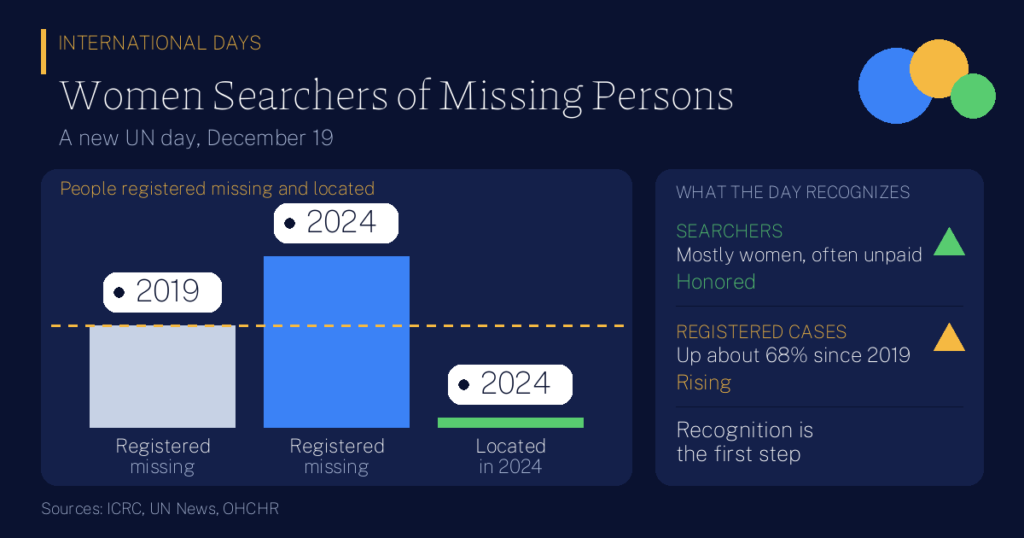
Nobody can count every missing person, but the Red Cross and Red Crescent Movement keeps the most widely cited tally. Its Family Links Network statistics show about 284,400 people registered as missing at the end of 2024, up from 169,500 in 2019, an increase of about 68 percent. The ICRC says this counts only documented cases and that the true total is likely far higher.
- 284,400registered missing, end of 2024
- 68%rise in registered cases since 2019
- 16,000+people located in 2024
- 130,000 to 300,000estimated missing in Syria, per the Independent Foundation for Missing Persons in Syria
Behind the rise sit many crises. The same Red Cross work also shows progress: in 2024 it helped locate more than 16,000 people and reunite more than 7,000 with their families, delivered nearly 90,500 Red Cross messages and facilitated close to 2.3 million phone calls. Every one of those is a family that stopped waiting.
Example 2: reading the gap. Suppose a registry holds 1,000 cases and 6 in every 100 are located in a year. That means 60 families get an answer and 940 keep waiting. The numbers are made up for illustration, but they show why searching is measured in years, and why families do not stop.
What searching can cost
The work is hard on the people who do it. Searchers give up paid work, travel long distances, pay for documents and transport, and face the weight of not knowing. UN human rights experts have also drawn attention to risk. In a statement dated September 30, 2026, they said that while international efforts have succeeded in recognizing and honoring women searching for disappeared persons, in Mexico these women continue to face alarming levels of violence. They described incidents reported in 2026, including an attack on a searcher, the disappearance of a defender, and the killing of a member of a searchers’ collective. The statement welcomed the Assembly’s resolution.
Example 3: the monthly bill. Imagine a searcher who makes three trips a month to offices and sites, spending $20 on each trip, plus $10 a month on printing and calls. That is $70 a month and $840 a year, a heavy burden for a household that may have lost an earner. The figures are round and illustrative.
What recognition can lead to
A day on the calendar does not find anyone. What it can do is give searchers standing. Recognition can encourage governments to protect them, to include them in search and identification processes, to help families with the legal and financial problems that follow a disappearance, and to keep records that make matches possible. It also tells searchers that their work is seen, which can matter on a long, lonely road. Because the resolution is new, how states carry it out remains to be seen.
If you are looking for a relative separated by conflict, disaster or migration, tracing services run by the Red Cross and Red Crescent can register a case and help search. Contact your national society or the ICRC. If you are supporting a searcher, listening is a real contribution.
Why a day, and why now? Awareness days work best when they give people something specific to do. This one invites governments, UN bodies, civil society and ordinary citizens to notice a group that is too often invisible. The searchers are rarely officials or experts by training. They become investigators, record keepers, advocates and organizers because nobody else will do the work for them. Naming them also helps clarify what good support looks like: safety, respect, access to information, and a seat at the table when decisions about search and identification are made. Even a small gesture counts, whether it is learning how the Red Cross tracing service works, listening to a local family group, or sharing accurate information instead of rumor.
Key Takeaways
- The day is new. The General Assembly designated December 19 in a resolution adopted on August 31, 2026.
- It honors a specific kind of work. Women who search for missing relatives often start before any institution does.
- The scale is large. About 284,400 people were registered missing with the Red Cross and Red Crescent Movement at the end of 2024, up about 68 percent since 2019.
- The count is incomplete. The ICRC says the true total is likely far higher.
- Searching has real costs. It takes time, money and sometimes safety, as UN experts noted for Mexico in 2026.
- Answers do come. More than 16,000 people were located and more than 7,000 reunited with their families in 2024.
- Recognition is a start. Protection, legal support and inclusion in search efforts are what turn it into change.
How solid is this? The resolution date comes from UN News coverage, and the official resolution text was not available to us, so we do not cite a resolution number. Registry figures are documented cases, not a full count. The three worked examples use round, made-up numbers. See also the International Days hub and the International Days Calendar.
More in Society
- UN News, Don’t give up: Syrian women’s ongoing search for the missing, September 2, 2026
- OHCHR, Mexico: Women searchers for disappeared persons face brutal violence, UN experts, September 30, 2026
- ICRC, Number of missing people registered with the Red Cross and Red Crescent Movement up nearly 70% in five years, August 30, 2025
- UN General Assembly, 80th session, 109th plenary meeting
- United Nations, List of International Days and Weeks