Energy is the quiet foundation of modern life. It lights a classroom after dark, keeps vaccines cold, powers a water pump and lets a small shop stay open. Yet energy is also the largest source of the emissions that warm the planet, and for hundreds of millions of people it still means smoke in the kitchen or no power at all. The International Day of Clean Energy, observed every year on January 26, asks the world to hold both facts in mind and to speed up the shift toward energy that is clean, affordable and available to everyone.
Why January 26
The date has a specific origin. January 26, 2009 is the day the International Renewable Energy Agency, known as IRENA, was founded. In a press release dated August 25, 2023, IRENA announced that the United Nations General Assembly had adopted a resolution proclaiming January 26 as the International Day of Clean Energy, marking the anniversary of that founding. The agency said the decision reflected the 193 member states of the Assembly acknowledging IRENA’s leading role, and it named the United Arab Emirates and Panama as co-facilitators of the text. The first observance followed in January 2024, when IRENA turned 15.
What “clean energy” means
Clean energy is energy that produces little or no pollution or greenhouse gas when it is made and used. The best-known sources are solar, wind, hydropower, geothermal and modern bioenergy, which together make up renewable power. The idea also covers clean cooking, meaning stoves and fuels that do not fill a home with smoke, and efficiency, meaning getting the same light, heat or motion from less energy. A useful way to think about it is as three promises: energy that is available, energy that is affordable and energy that does not damage health or climate. The United Nations frames these under Sustainable Development Goal 7, which seeks affordable, reliable, sustainable and modern energy for all by 2030.
The numbers behind the day
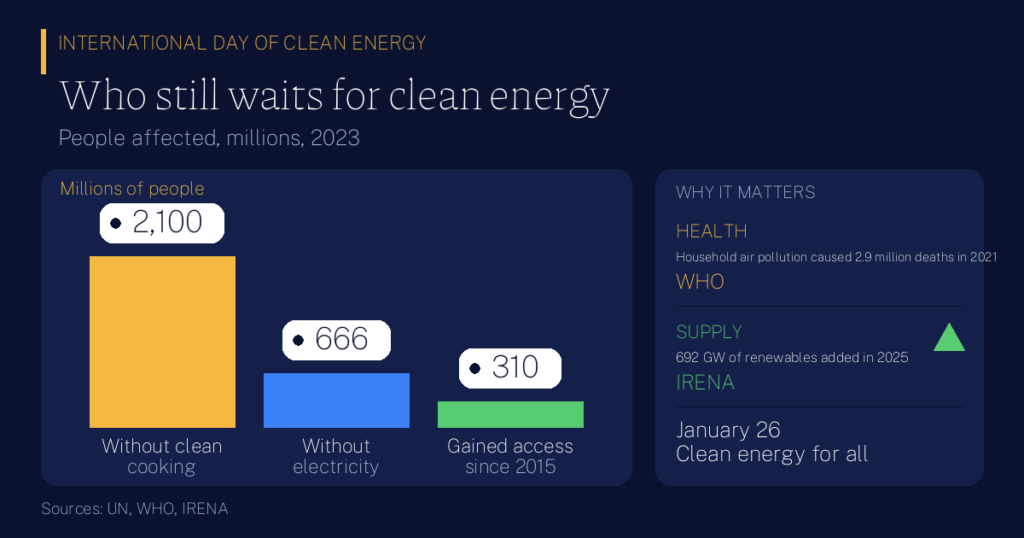
The picture is one of real progress and stubborn gaps. According to the 2025 edition of the Tracking SDG 7 report, released in June 2025 by the UN and its partners, almost 92 percent of the world’s people had basic electricity access in 2023. About 310 million people gained access after 2015. Even so, over 666 million people remained without electricity in 2023.
Cooking is the larger gap. In 2023, about 2.1 billion people still depended on polluting fuels and technologies for cooking. Access to clean cooking did improve, rising from 64 percent of the world’s people in 2015 to 74 percent in 2023.
On the supply side, the news is strong. IRENA’s statistics show that renewable power capacity grew by 692 gigawatts, or 15.5 percent, in 2025, reaching 5,149 gigawatts at the end of the year. Renewables made up 85.6 percent of all new power capacity that year, down from 92.0 percent in 2024, and 49.4 percent of total installed capacity, up from 46.3 percent in 2024. IRENA notes that 2025 data could be revised again.
Why it matters: the smoke in the kitchen
The case for clean energy is often told through climate, but the most immediate harm is to health. The World Health Organization reports that household air pollution caused 2.9 million deaths in 2021, including more than 309,000 deaths of children under five. These deaths come from breathing smoke produced by cooking over open fires or with inefficient stoves, and the burden falls hardest on women and young children, who spend the most time near the fire. Collecting fuel also costs hours that could go to school, work or rest.
- 2.9 milliondeaths a year from household air pollution, 2021
- 309,000+of those deaths were children under five
- 74%of people had clean cooking access in 2023, up from 64% in 2015
- 1.8 billionstill without clean cooking in 2030 at current rates, per WHO
Example 1: a kitchen switch. Imagine a household of five that cooks over an open fire for four hours every day. If it moves to a clean stove and fuel, the family spends far less time gathering wood, and the air indoors improves. The numbers are round and illustrative, but they show why cooking is treated as a health issue and an energy issue at once.
Who is left behind
Access is deeply uneven. The Tracking SDG 7 report found that installed renewable capacity averaged 478 watts per person worldwide in 2023, but only 40 watts per person in sub-Saharan Africa, roughly twelve times less. Money follows the same pattern. International public financial flows to developing countries for clean energy reached USD 21.6 billion in 2023, up 27 percent from 2022, yet still below the 2016 peak of USD 28.4 billion. Meanwhile, renewables supplied 17.9 percent of total final energy consumption in 2022, which includes heat and transport and not only electricity, a reminder that the power sector is only part of the job.
Example 2: a village mini-grid. Suppose a solar mini-grid of 50 kilowatts serves 500 households. Shared evenly, that is about 100 watts each, enough for lights, phone charging and a small fan, but not for heavy appliances. The figures are made up for illustration, and they show why counting people with access is different from counting how much energy they can use.
Example 3: closing a per-person gap. Take a country of 10 million people with 400 megawatts of renewable capacity, or 40 watts per person. Reaching the 2023 world average of 478 watts per person would take about 4,780 megawatts, nearly twelve times more. The example is illustrative, but it explains why the gap is measured in multiples and not in small steps.
Where progress must go next
The UN’s own projection is sobering. If current trends continue, only 78 percent of the world’s people will have access to clean cooking by 2030. Reaching universal access to electricity will also require faster connection, especially where homes are far from the grid. Clean energy links to other global goals as well, from health and education to water supply, since pumping and treating water takes power. The day gives governments, utilities, schools and communities a shared date to report progress, announce projects and ask hard questions about who is still waiting.
There are practical ways to take part. Households can improve efficiency, from lighting to insulation. Communities and companies can back clean cooking and off-grid solar. Students can map how their own school or town gets its power. Each step matters most when it is aimed at the people who currently have the least.
Key Takeaways
- The day marks an anniversary. January 26 is the date IRENA was founded in 2009, and the UN General Assembly proclaimed the day in 2023.
- Clean energy has three promises. It should be available, affordable and free from harm to health and climate.
- Renewables are surging. The world added 692 GW of renewable capacity in 2025, reaching 5,149 GW.
- Electricity gaps remain. Over 666 million people still lacked electricity in 2023.
- Cooking is the bigger gap. About 2.1 billion people relied on polluting cooking fuels in 2023.
- Smoke kills. Household air pollution caused 2.9 million deaths in 2021, per WHO.
- Equity is the test. Sub-Saharan Africa had 40 watts of renewable capacity per person in 2023, against a world average of 478.
How solid is this? Access and cooking figures are 2023 estimates from the Tracking SDG 7 report, and the health figures are WHO estimates for 2021, both modeled and subject to revision. IRENA says its 2025 capacity data could be revised. The three worked examples use round, made-up numbers. See the International Days hub and the International Days Calendar.
More in Science
- United Nations, Tracking SDG 7 joint press release, June 2025
- IRENA and partners, Tracking SDG 7: The Energy Progress Report 2025
- World Health Organization, Household air pollution fact sheet, December 2025
- IRENA, UN Declares IRENA’s Founding Date as International Day for Clean Energy, August 2023
- IRENA, Renewable Power Capacity Highlights 2026