Every major global decision, from ending a war to pricing carbon, is made in rooms where many countries sit together. Those rooms are meant to speak for everyone, yet for most of their history women have been scarce in them. The International Day of Women in Multilateralism, marked each January 25 and led by UNESCO, asks a plain question: if the world decides together, who is actually at the table? The answer, as the numbers below show, is still mostly men.
What multilateralism means
Multilateralism is the practice of countries working together, usually through institutions such as the United Nations, to solve problems that no single government can solve alone. Climate, pandemics, trade, migration and peace all cross borders. Decisions are made by delegations of diplomats, ministers and negotiators who speak for their governments and shape rules that affect billions of people.
That is why the identity of the people in the room matters. Half of humanity has a right to a voice in decisions that govern its life. A table that is mostly one gender is not only unfair; it is also missing knowledge about the people it is meant to serve, from the safety of a route to school to the design of a clinic.
A day about who sits at the table
UNESCO uses the day to highlight women’s role in building peace and sustaining development. In January 2023, UNESCO Director-General Audrey Azoulay marked it with a message noting that, at the current rate, it would take more than 130 years to reach gender parity, citing the World Economic Forum. Her focus that year was a barrier less visible than a closed door: harassment and violence against women in the digital environment. She cited a UNESCO survey in which 73 percent of women journalists reported online violence in the course of their work, and UNESCO held a dialogue in Paris on online gendered disinformation.
The day belongs to a family of related observances. The General Assembly declared June 24 the International Day of Women in Diplomacy by consensus, in resolution A/RES/76/269 at its 76th session. The two days point at the same gap from different angles. The theme also connects to World Toilet Day, whose 2026 focus on sanitation and gender equality shows how everyday needs can be overlooked when women are missing from decisions.
The numbers: women in political power
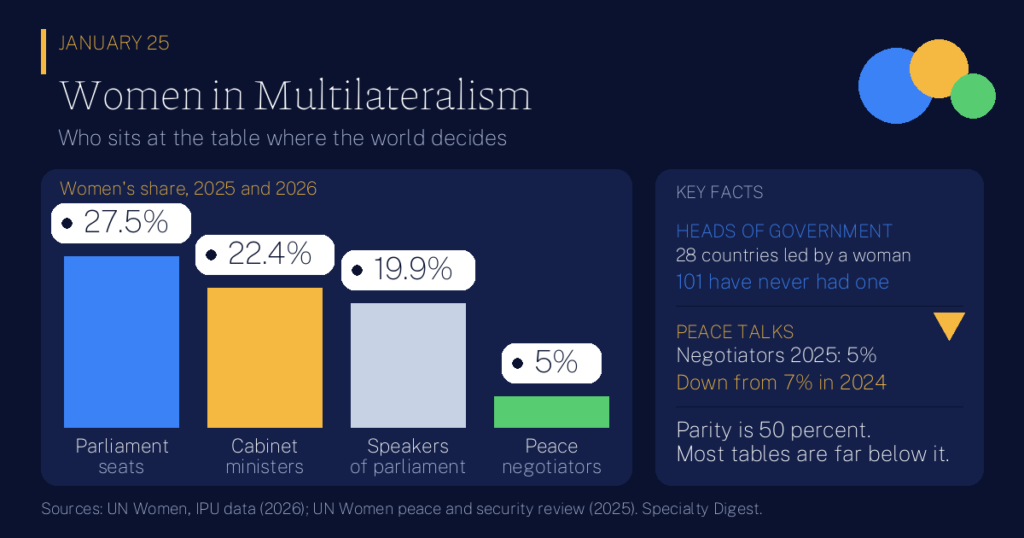
In March 2026, UN Women, using Inter-Parliamentary Union data, reported that only 28 countries are led by a woman Head of State or Government, while 101 countries have never had a woman leader. Women hold 27.5 percent of parliamentary seats, up slightly from 27.2 percent in 2025. They hold 22.4 percent of cabinet minister positions, down from 23.3 percent in 2024. As of January 2026, 54 women served as Speakers of Parliament, or 19.9 percent of all Speakers.
Example 1: a cabinet table. Picture a cabinet of 20 ministers. At the global cabinet average of about 22 percent, roughly 4 would be women. Parity would mean 10. The numbers are round and illustrative, but they show how large the gap is in a single meeting.
The ambassadors’ bench
The gap is just as visible at the United Nations itself. As of May 2026, according to the UN Women knowledge hub, men held 83 percent of Permanent Representative positions in New York, 72 percent in Geneva and 69 percent in Vienna. Permanent Representatives are the ambassadors who negotiate on their countries’ behalf week after week, so these posts decide who speaks in the rooms where global rules are written.
Example 2: a delegation. If a country sends 30 diplomats to a negotiation and the team mirrors the Geneva figure, about 8 or 9 would be women and 21 or 22 men. Even a modest shift in who is chosen to lead would change what is raised in committee. The numbers are round and illustrative.
Peace tables: the widest gap
Few places show the stakes more clearly than peace negotiations. UN Security Council resolution 1325, adopted unanimously in 2000, put women, peace and security on the Council’s agenda. More than two decades later, UN Women reports that across 57 peace processes reviewed in 2025, women were in negotiating delegations in 13 of them, or 23 percent. On average women made up 5 percent of negotiators, down from 7 percent in 2024, while women were 14 percent of mediators, unchanged from the year before. Of 53 peace agreements concluded in 2025, 10 (19 percent) referenced women, girls, gender or sexual violence.
Example 3: a negotiating table. Suppose a peace conference seats 40 negotiators. At the 5 percent average, 2 would be women. At the 14 percent mediator share, a panel of 7 mediators would include 1. The figures are round and illustrative, yet they make plain how easily a single table can end up with no women at all.
Why the door stays narrow
The barriers are practical and sometimes hostile. In UN Women’s March 2026 release, 76 percent of women parliamentarians surveyed reported intimidation by the public, compared with 68 percent of men. Women also lead 90 percent of gender-equality ministries and 73 percent of ministries for family and children’s affairs, which suggests that women are often steered toward certain portfolios rather than the full range. The UNESCO survey on women journalists adds the digital dimension: online abuse can push women out of public life before they reach the table.
- 28countries led by a woman Head of State or Government, 2026
- 101countries have never had a woman leader
- 33%of UN mission heads and deputies are women, after parity in 2021
- 130+years to parity at the current rate, as cited by UNESCO in 2023
How the day is marked, and what progress needs
UNESCO and partners mark January 25 with statements, dialogues and campaigns that connect women’s leadership to peace, education, science and culture. The practical agenda is not mysterious. Governments can set targets for delegations, publish their own numbers, and appoint more women as ambassadors and chief negotiators. Institutions can protect women from harassment, online and offline, and make room for caregivers. Citizens can ask who their country sends to international meetings. One encouraging sign is in UN-led peace processes: in three processes in 2025, women averaged 22 percent of negotiators, and all three UN lead mediators were women.
Key Takeaways
- Multilateralism needs everyone. Decisions made by many countries affect everyone, so the people deciding should reflect them.
- Political power is still male-led. In 2026 only 28 countries have a woman Head of State or Government, and 101 have never had one.
- The ambassador bench is uneven. Men held 83 percent of Permanent Representative posts in New York as of May 2026.
- Peace tables are the widest gap. Women averaged 5 percent of negotiators in 2025, down from 7 percent.
- Barriers include abuse. 76 percent of women parliamentarians surveyed reported public intimidation.
- Progress can be shaped. UN-led processes with women mediators averaged 22 percent women negotiators in 2025.
- Ask who is at the table. Counting is the first step toward changing the answer.
How solid is this? The political figures come from UN Women, drawing on Inter-Parliamentary Union data, and the peace figures from UN Women’s 2025 review; both are revised each year. The 130-year estimate was cited by UNESCO in 2023 from the World Economic Forum. The establishing instrument for this day could not be confirmed from the sources read for this article, so the article states only that UNESCO leads and marks it. The three worked examples use round, made-up numbers. See also the International Days hub and the International Days Calendar.
More in Society
- UN News. Equal rights cannot wait on International Day of Women in Multilateralism (25 January 2023).
- UN Women. Only 1 in 7 countries is led by a woman as global political power remains dominated by men (March 2026).
- UN Women. Facts and figures: Women, peace and security.
- United Nations. International Day for Women in Diplomacy, 24 June.
- UN Press. Declaring 24 June International Day, General Assembly stresses women’s participation in diplomacy (2022).