A hotel room, a boat tour, a market stall and a flight attendant’s job all depend on one fragile thing: people feeling able to travel. When that confidence breaks, whether through a pandemic, a storm or an earthquake, the damage spreads far beyond the beach. Global Tourism Resilience Day, observed every year on February 17, asks the world to prepare for that moment before it arrives. Like World Water Day, it is about protecting communities from shocks such as drought and flood.
From a pandemic lesson to a United Nations day
The day was proclaimed by the United Nations General Assembly in resolution A/RES/77/269 and falls on February 17. According to the UN, it aims to emphasize the need to foster resilient tourism development to deal with shocks, taking into account how vulnerable the tourism sector is to emergencies. It is also a call for action for Member States to develop national strategies for rehabilitation after disruptions, including through private-public cooperation and the diversification of activities and products.
Behind that wording lies recent memory. According to UNWTO figures reported by UNCTAD, international tourist arrivals declined by about 1 billion, or 74 percent, between January and December 2020. In a September 2020 article, UNWTO Secretary-General Zurab Pololikashvili wrote that arrivals could fall by as much as 70 percent that year compared with 2019. The General Assembly has since built on the theme. The UN observance page cites a February 2024 decision to proclaim 2027 the International Year of Sustainable and Resilient Tourism, and it lists an earlier resolution on promoting sustainable and resilient tourism, including ecotourism, for poverty eradication and environmental protection (A/RES/77/178).
What resilience means for a tourism economy
The UN page does not offer a formal definition, but its language points to three ideas. First, planning: countries should have a strategy ready for rehabilitation after a disruption, rather than inventing one in the middle of a crisis. Second, partnership: governments and private businesses each hold part of the solution, so they are asked to cooperate. Third, diversification: an economy that offers a wider range of activities and products has more ways to earn when one of them stops.
Example 1: the single-product island. Imagine an island where 6 out of every 10 dollars of local income come from visitors. If arrivals fall by 70 percent and spending falls in step, income drops by about 42 percent, because 70 percent of 60 is 42. A neighboring island with the same visitors but a working fishery and a food-processing plant, together supplying half its income, would lose only 21 percent. The numbers are round and illustrative, but the logic is the case for diversification.
The numbers behind the day
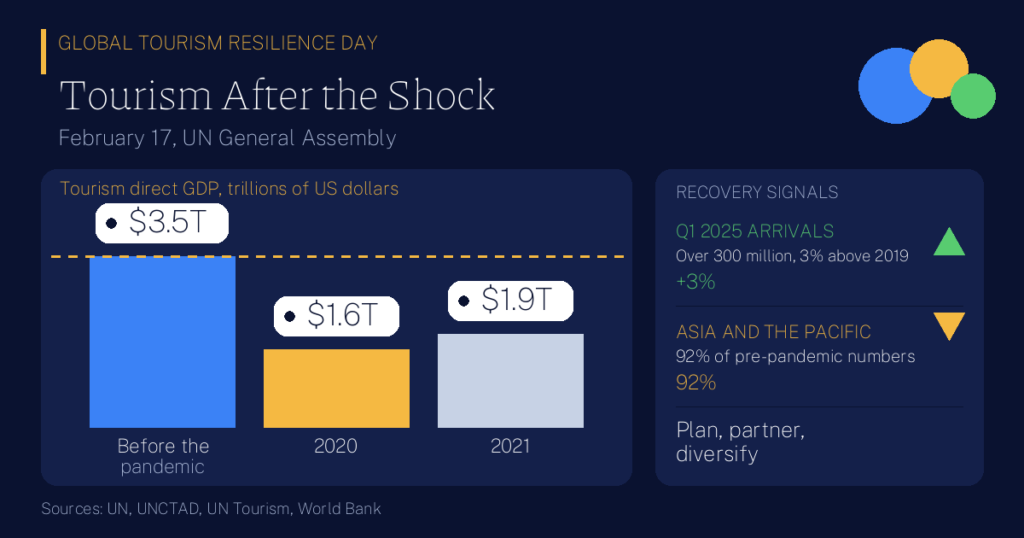
A General Assembly report, A/77/219, cited on the UN page, estimated the economic contribution of tourism, measured as tourism direct GDP, at $1.9 trillion in 2021. That was higher than the $1.6 trillion recorded for 2020, but still well below the pre-pandemic value of $3.5 trillion. Put differently, even after a partial rebound, 2021 reached only a little over half of the pre-pandemic level.
- $2.0 trillioninternational tourism export revenues in 2024, up 11% in real terms
- 6%of the world’s total exports of goods and services, 2024
- 23%of global trade in services, 2024
- 1 in 10jobs supported by tourism worldwide, per UNWTO in 2020
Who is most exposed
Resilience matters most where tourism is the main earner. The UN page notes that for some small island states and developing countries, tourism accounts for over 20 percent of gross domestic product. The UNWTO Secretary-General wrote in 2020 that tourism accounts for 30 percent of export revenues for small island developing states, and that in Palau it generates 90 percent of all exports. He also noted that tourism supports one in ten jobs worldwide and that 80 percent of the sector is made up of small businesses. The UN page adds that tourism supports millions of direct and indirect jobs, in particular for women and young people.
Those facts explain why a shock is felt unevenly. A projection at the time warned that the fall in tourist numbers could translate into as many as 120 million lost jobs. UNCTAD estimated that the pandemic cost the global economy $2.4 trillion in 2020 through direct and indirect effects, and that developing countries could account for up to 60 percent of GDP losses in its scenarios.
Example 2: one small business. Picture a family guesthouse that earns $12,000 in a normal month and spends $9,000 on wages, food and upkeep. If bookings fall by three quarters, income drops to $3,000, a shortfall of $6,000 against costs every month. A reserve of three months of costs, $27,000, could cover that gap for 4.5 months. The figures are made up for illustration, but they show why savings, flexible loans and shared recovery plans matter to small firms.
A recovery that is real but uneven
The good news is that travel has returned. UN Tourism reported that international tourist arrivals increased by 5 percent in the first quarter of 2025, with over 300 million tourists traveling internationally, 3 percent more than in the pre-pandemic year 2019. The World Bank, in its February 2026 Tourism Watch, reported that arrivals in the third quarter of 2025 grew 4 percent year on year, with an estimated 467 million international tourists traveling between July and September.
The picture differs by region. UN Tourism reported that Africa exceeded pre-pandemic traveler numbers by 16 percent and the Middle East stood 44 percent above pre-pandemic levels, while Europe was 5 percent above and Asia and the Pacific had reached 92 percent. Shocks have not stopped either. The World Bank noted that Vanuatu’s surge in arrivals followed the December 2024 earthquake disruption, driven by targeted recovery campaigns, restored flight connectivity and renewed traveler confidence. It also warned that elevated travel prices and a challenging geopolitical environment may weigh on demand.
Example 3: a recovery campaign. Suppose a destination normally welcomes 1 million visitors a year and loses 400,000 after a disaster. A campaign that wins back 100,000 visitors in the first year has recovered one quarter of the loss, and at that pace full recovery takes four years. The numbers are illustrative only.
How the day is marked, and what progress looks like
Because the observance is a call to action, progress is measured in preparation rather than ceremony: a rehabilitation plan that exists on paper, a partnership between a tourism board and local businesses, a new visitor offer that does not depend on a single season or attraction.
- 2020Arrivals fall by about 1 billion, or 74%, over the year
- 2021Tourism direct GDP reaches $1.9 trillion, below the pre-pandemic $3.5 trillion
- Feb 2024General Assembly decision to proclaim 2027 the International Year of Sustainable and Resilient Tourism
- 2027International Year of Sustainable and Resilient Tourism
Key Takeaways
- Tourism is a shock absorber that can fail. A 74 percent fall in arrivals in 2020 showed how fast a sector can stall.
- The UN asks for three things. Plan for rehabilitation, link public and private sectors, and diversify activities and products.
- The pandemic loss was large. Tourism direct GDP fell from $3.5 trillion before the pandemic to $1.6 trillion in 2020.
- Dependence raises the stakes. For some small islands, tourism is over 20 percent of GDP, and the share of exports can be far higher.
- Small firms need buffers. With 80 percent of the sector made up of small businesses, savings and shared plans matter.
- Recovery is uneven. Africa and the Middle East are above 2019 levels, while Asia and the Pacific stood at 92 percent in early 2025.
- Prepare before the next shock. The day is a reminder to build plans and partnerships in calm times.
How solid is this? Pandemic-era loss figures from UNCTAD and UNWTO are estimates and projections made in 2020 and 2021, and the pre-pandemic GDP value is cited as given by the UN page without a named year. Regional arrival figures cover the first quarter of 2025 and are revised as data arrive. The three worked examples use round, made-up numbers to show an idea. See also World Water Day, the International Days hub and the International Days Calendar.
More in Society
- United Nations, Global Tourism Resilience Day, 17 February
- UN Chronicle, Tourism Can Help Lead the World to Recovery (UNWTO Secretary-General, September 2020)
- UNCTAD, Global economy could lose over $4 trillion due to COVID-19 impact on tourism
- UN Tourism, International tourist arrivals grew 5% in Q1 2025
- World Bank, Tourism Watch Quarterly Report, February 2026 Edition