When classrooms closed in 2020, families learned that studying at home depends on far more than a good lesson. It needs a device, a connection, electricity, a teacher who can use the tools and an adult who can help. The International Day for Digital Learning, observed every year on March 19, asks a practical question: how can technology serve education, and who is left out when it does not? It is a natural companion to the International Day of Education, which celebrates learning itself.
A lesson the pandemic taught the world
The day grew from a hard experience. In August 2020, UNICEF reported that at least 31 percent of schoolchildren, about 463 million, could not be reached by remote learning during school closures. The analysis covered 100 countries, and UNICEF said about 1.5 billion schoolchildren were affected by closures at the height of lockdowns. Those figures are upper estimates of potential reach, based on whether homes had television, radio or Internet, not on whether children actually used them.
In 2023, UNESCO Member States decided to proclaim March 19 of every year as the International Day for Digital Learning, through a resolution of UNESCO’s General Conference. It is therefore a UNESCO day, not a General Assembly one. UNESCO describes it as an occasion to share the many ways schools, teachers, learners and families use digital technologies to improve education. The first observance put young people at the center, with a webinar and regional dialogues organized by UNESCO’s Global Education Monitoring Report with youth and student groups.
What digital learning really means
Digital learning is not just a tablet in a bag. It covers any teaching or studying that uses digital tools, from a recorded lesson on a basic phone to a national learning platform, a school’s shared devices or a classroom that uses artificial intelligence. What counts is whether the tools help a child learn something worthwhile. A device that sits unused because there is no electricity, no trained teacher or no lesson in the child’s language does nothing for learning.
Example 1: the missing step. Imagine a village school receives 30 tablets and a free learning app. The solar charger fails in the second week and the app is only in a language most pupils do not speak. All four steps looked covered on paper, yet only two worked. The numbers are made up and rounded, but the pattern is a common one.
The numbers behind the day
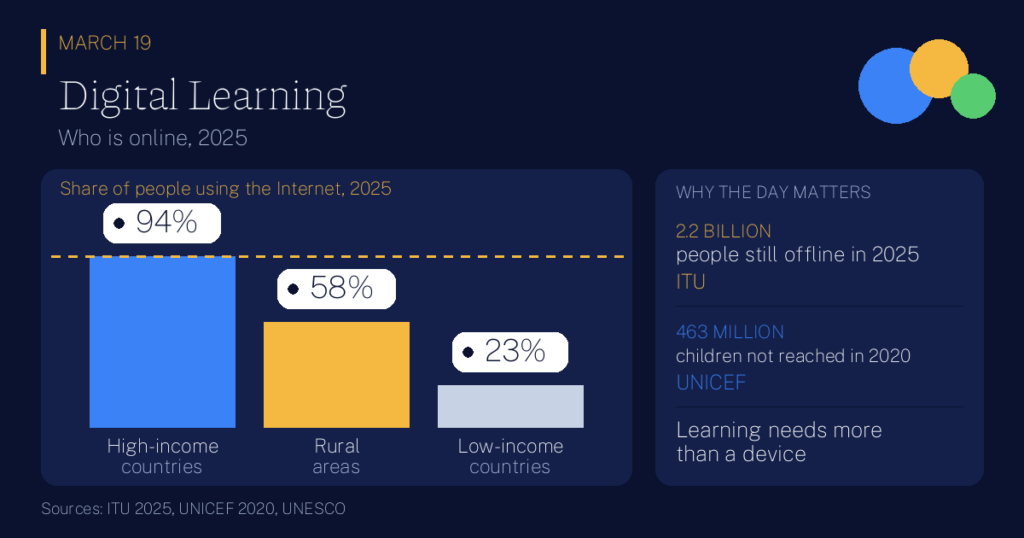
Access is the first gap. The International Telecommunication Union (ITU) estimated in 2025 that about 6 billion people, roughly three-quarters of humanity, use the Internet. About 2.2 billion people remain offline, and 96 percent of them live in low- and middle-income countries. The ITU’s 2025 edition reports that 85 percent of people in urban areas are online, against 58 percent in rural areas, and that 94 percent of people in high-income countries use the Internet, against only 23 percent in low-income countries.
- 6 billionpeople used the Internet in 2025, about three-quarters of the world
- 2.2 billionpeople were still offline in 2025
- 96%of those offline live in low- and middle-income countries
- 463 millionschoolchildren at least were not reached by remote learning in 2020
Estimates are revised each year. The ITU’s 2025 edition restated the 2024 total as 5.8 billion people online (71 percent), higher than the 5.5 billion (68 percent) first reported in 2024, so compare years with care. The ITU also found that 77 percent of men were online in 2025 against 71 percent of women.
Closures showed who was left behind
The 2020 UNICEF analysis showed that the gap was deepest where connections were scarce. In eastern and southern Africa, at least 49 percent of schoolchildren could not be reached, and in west and central Africa at least 48 percent. In Latin America and the Caribbean the minimum was 9 percent. Across the data, 72 percent of the children who could not be reached came from the poorest households in their countries, and three quarters lived in rural areas.
Example 2: one lesson, two homes. A teacher in a city sends the same video lesson to a class of 40. In 30 homes it plays on a shared phone with a good connection. In the other 10 there is no data plan, so those children get nothing until the teacher prints packets. The class and its numbers are invented and rounded, but they show how one lesson can reach some children and miss others.
Why this year’s theme is about the public
The 2026 observance focuses on building digital futures for public education. UNESCO invites countries, provinces and school districts to show where and how they are building, and using, digital commons to strengthen public education and improve its outcomes. In plain terms, a digital commons is shared digital infrastructure and content, such as open lesson libraries and public platforms, that belongs to the education system rather than to a private seller.
UNESCO’s page says UNESCO, UNICEF and the ITU were to mark the day with the launch of the Charter for Public Digital Learning Platforms. UNESCO Director-General Khaled El-Enany called on States, partners and the education community to make digital technology a tool for more accessible education that serves, first and foremost, the interests of people worldwide. The question behind the theme is who controls the tools children learn with, and whether they serve the public good.
Example 3: buying wisely. Suppose a district has $100,000 for digital learning. It could spend all of it on licenses that expire in a year, or put $60,000 into open, reusable lessons and $40,000 into teacher training. Next year the lessons are still there and the teachers are better at using them. The sums are made up for illustration, but the idea of building something that lasts is what the theme describes.
How the day is marked, and what progress needs
UNESCO invites schools, teachers, learners and families to share how they use digital tools to improve education. Past events have included online discussions and youth consultations. UNESCO also lists guidance on its page for policymakers, including its 2023 guidance on generative AI in education and research and 2022 guidelines on ICT in education policies and masterplans.
Progress needs the whole ladder: affordable connections, devices that work, content in learners’ own languages, teachers who are trained and supported, and clear rules on privacy and fairness. You can take part by asking your child’s school which tools it uses and why, or by sharing a lesson, a library or a skill with someone who is learning.
Key Takeaways
- The day is UNESCO’s. Its Member States decided in 2023 to mark March 19 every year.
- Access is still uneven. About 2.2 billion people were offline in 2025, and 96 percent of them live in low- and middle-income countries.
- Location and income matter. In 2025, 94 percent of people in high-income countries were online against 23 percent in low-income ones.
- Closures exposed the gap. At least 463 million schoolchildren could not be reached by remote learning in 2020.
- Technology is a tool, not a teacher. A device without power, content or training does not produce learning.
- The 2026 theme is public. It asks how countries build shared digital commons for public education.
- You can help. Ask how your school uses technology, and share what you know with a learner.
How solid is this? Connectivity figures are ITU estimates that are revised each year, and the 2020 reach figures are upper estimates of potential access, not proof of actual use. The 2025 urban, rural and income splits come from the ITU’s 2025 release without a stated reference year of their own. The three worked examples use round, made-up numbers. See also the International Days hub and the International Days Calendar.
More in Education
- UNESCO, International Day for Digital Learning
- UNESCO Global Education Monitoring Report, Celebrating UNESCO’s first International Day for Digital Learning
- ITU, Facts and Figures 2025 press release, November 17, 2025
- ITU, Facts and Figures 2024 press release, November 27, 2024
- UNICEF, At least a third of the world’s schoolchildren unable to access remote learning during school closures, August 2020
- UNESCO, UNICEF and ITU, Charter for Public Digital Learning Platforms