Every living thing you have ever met depends on the same thin layer of soil, water, air and life. We rarely notice it, the way we rarely notice the floor of a house. International Mother Earth Day, observed every April 22, asks the world to look down and notice. It is a United Nations day built on a simple idea: people are not outside nature, looking in, but part of it, and the health of one decides the health of the other. It pairs naturally with World Water Day, because water is the most visible thread in that web.
A day born in the General Assembly
The day has a clear birth date. On April 22, 2009, the UN General Assembly adopted by consensus a resolution designating April 22 as International Mother Earth Day. The text is catalogued as A/RES/63/278. According to the UN press record of that session, the resolution was spearheaded by the government of Bolivia and supported by more than 50 member states. In the debate, speakers pointed to receding snow on the Andean peaks and to human-caused climate change as signs of why the planet needed a day of its own.
The choice of words matters. “Mother Earth” is an expression many peoples use to describe a living home that sustains us, and the UN has since framed the day around harmony with nature. The General Assembly has marked the day in several years with an interactive dialogue on that theme, and the Secretary-General issues a message each April.
What the name asks us to see
The day is not about one problem. It is about the connections among many. The UN’s observance page lists the pressures on nature: deforestation, land-use change, intensified agriculture and livestock production, the illegal wildlife trade and climate change. Each one pushes on the others. Clear a forest and you lose habitat, but you also change local rainfall, soil and the carbon that was stored in the trees.
Example 1: a valley in motion. Imagine a river valley with 1,000 hectares of forest. Farmers clear 200 hectares for crops, which looks like a gain. But the cleared slopes lose soil in every storm, the river silts up, and a downstream town pays for water treatment it never needed before. The numbers are round and illustrative, but the chain of cause and effect is the one the UN describes: one change ripples outward.
The numbers behind the day
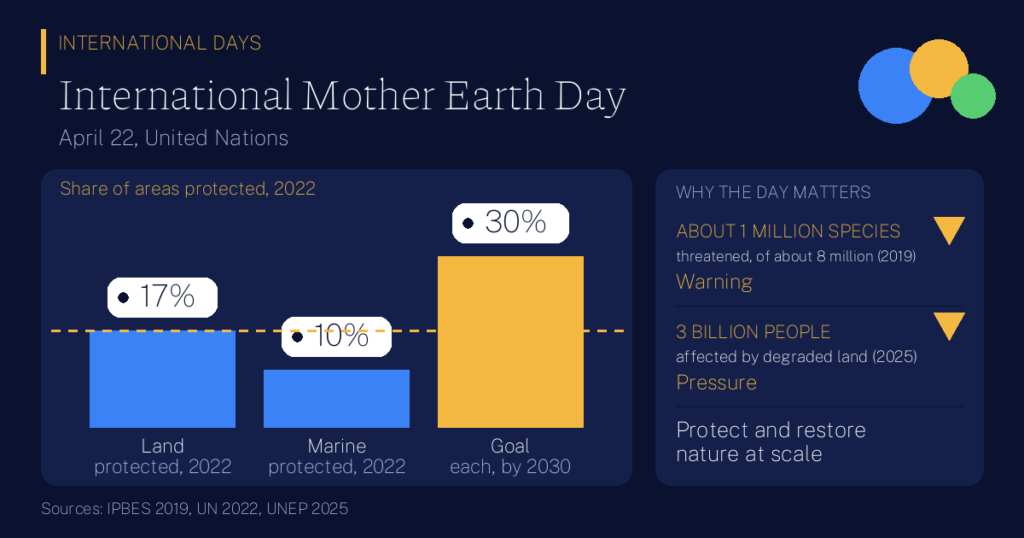
The most cited assessment is the 2019 Global Assessment of the Intergovernmental Science-Policy Platform on Biodiversity and Ecosystem Services (IPBES), approved in Paris. It found that around 1 million of an estimated 8 million animal and plant species, including 5.5 million insect species, are threatened with extinction. At least 680 vertebrate species have been driven to extinction since the 16th century. More than 40 percent of amphibian species and almost 33 percent of reef-forming corals are threatened.
The assessment also measured how much of the planet people have changed. Three-quarters of the land-based environment and about 66 percent of the marine environment have been significantly altered. About 23 percent of the global land surface has reduced productivity because of land degradation, and 33 percent of marine fish stocks were harvested unsustainably in 2015.
A newer UN Environment Programme release, from December 2025 on its seventh Global Environment Outlook, reports that between 20 and 40 percent of land worldwide is estimated to be degraded, affecting over 3 billion people, and repeats the figure of one million of eight million species threatened with extinction.
The promise made in Montreal
In December 2022, at the UN biodiversity conference in Montreal, nations adopted the Kunming-Montreal Global Biodiversity Framework, with four goals and 23 targets for 2030. Target 3 calls for at least 30 percent of land, inland waters, and coastal and marine areas to be effectively conserved and managed. The UN release that announced it noted that 17 percent of the world’s land and 10 percent of its marine areas were then under protection. Target 2 asks that at least 30 percent of degraded ecosystems be under effective restoration.
Example 2: counting the gap. Suppose a country has 100,000 square kilometers of land, with 17,000 protected. Reaching 30 percent means 30,000, so it must add 13,000 square kilometers, or an area almost as big as the protected land it already has. The figures are round and illustrative, but the arithmetic shows why the goal is ambitious.
Who is affected, and who protects
Nature loss lands unevenly. Degraded land affects over 3 billion people, and many of them are farmers, herders and fishers whose income comes straight from the ground and the water. IPBES notes that Indigenous-managed areas include approximately 35 percent of the area that is formally protected, a reminder that people who live closest to nature are often its most effective guardians.
- 1 millionspecies threatened, of about 8 million (IPBES, 2019)
- 3 billionpeople affected by degraded land (UNEP, 2025)
- $200 billionper year to be mobilized for nature by 2030 (Target 19)
- $700 billionyearly biodiversity finance gap named by the framework
Example 3: a farm and a field. Imagine a village whose degraded field yields 2 tons of grain per hectare. After restoring the soil with trees and cover crops, it yields 2.5 tons. On 100 hectares that is 50 extra tons a year, enough to change a village’s food security. The numbers are round and illustrative, but they show why restoration is also a livelihood matter.
The money, and how the day is marked
The framework counts the cost in dollars. It asks for at least $200 billion per year from all sources by 2030, with international flows reaching at least $20 billion per year by 2025 and $30 billion per year by 2030. It also calls for cutting harmful subsidies by at least $500 billion per year by 2030. The December 2025 UNEP report estimates that about $8 trillion a year of investment is needed until 2050 to reach net zero and fund biodiversity and restoration, and says the benefits could reach $20 trillion per year by 2070.
On the day itself, the Secretary-General issues a message, governments and schools hold events, and the General Assembly has held dialogues on harmony with nature. The most useful way to mark it is local: learn what is protected, restored or threatened near you, and ask how your city, school or workplace treats land and water.
Key Takeaways
- The day has a precise origin. The General Assembly adopted A/RES/63/278 by consensus on April 22, 2009, led by Bolivia.
- Nature is a web. Deforestation, farming, climate change and wildlife trade act on one another, so problems rarely come alone.
- The scale is large. About 1 million of 8 million species are threatened, and three-quarters of land has been significantly altered.
- The goal is clear. The 2022 framework aims to protect at least 30 percent of land, water and sea areas by 2030.
- People are part of the answer. Indigenous-managed lands cover about 35 percent of formally protected areas.
- Money is the bottleneck. The framework names a $700 billion yearly finance gap, and restoring land can pay back in food and income.
How solid is this? Species and land figures come from the 2019 IPBES assessment and a December 2025 UNEP release, and are estimates that carry uncertainty. Protected-area shares are those quoted at the 2022 adoption and have since changed. The three worked examples use round, made-up numbers to show an idea. See also the International Days hub and the International Days Calendar.
More in Nature
- UN General Assembly. International Mother Earth Day, resolution A/RES/63/278 (22 April 2009).
- UN Press. General Assembly proclaims 22 April International Mother Earth Day, GA/10823 (2009).
- United Nations. International Mother Earth Day: background.
- IPBES. Nature’s dangerous decline unprecedented; species extinction rates accelerating (2019).
- UN Sustainable Development and CBD. Nations adopt four goals, 23 targets for 2030 in landmark UN biodiversity agreement (19 December 2022).
- UN Environment Programme. Investing in planetary health would deliver higher GDP, fewer deaths, less poverty (9 December 2025).