Every song you stream, every medicine on a pharmacy shelf and every logo on a running shoe began as an idea that someone decided was worth protecting. Intellectual property, or IP, is the set of rules that lets people own, share and earn from what their minds create. World Intellectual Property Day, observed each April 26, asks a simple question: how do those rules help creativity and innovation flourish for everyone? The day pairs naturally with World Book and Copyright Day, because copyright is one of the main branches of the same tree.
A day born from a treaty
The date has a precise origin. In 2000, WIPO’s member states designated April 26 as World Intellectual Property Day, choosing the date on which the WIPO Convention came into force in 1970. WIPO itself, established in 1967 and based in Geneva, now has 194 member states. The first observance followed in 2001, and since then IP offices, governments, universities, law firms, businesses and schools have marked it in their own ways.
The ideas behind the day are older than the organization. The Berne Convention, adopted on September 9, 1886, was an early agreement on protecting literary and artistic works across borders. A writer in one country could finally count on recognition in another. Treaties like this are why a novel, a film or a design can travel the world and still carry its creator’s name.
What intellectual property actually means
WIPO describes intellectual property as creations of the mind: inventions, literary and artistic works, designs, and the symbols, names and images used in commerce. It groups them into familiar families. Patents protect new technical inventions. Trademarks protect the names and logos that tell customers who made something. Industrial designs protect the look of a product. Copyright protects books, music, films and software code, and the list also includes geographical indications and trade secrets.
The bargain is the heart of the system. Creators receive a limited period of exclusive rights, and in return society receives disclosure, competition and a steady flow of new work. A patent, for example, requires an inventor to explain how the invention works, which lets others learn from it.
Example 1: the small workshop. Imagine a three-person company that invents a lighter bicycle helmet. Without protection, a large manufacturer could copy the design within months and sell it at a lower price, because the copier never paid for the research. With a patent and a registered design, the workshop can license the helmet, raise funds and keep making it. The company and numbers are made up for illustration, but the logic is exactly why the system exists.
The numbers behind the day
WIPO’s World Intellectual Property Indicators report for 2025 gives a snapshot of 2024. Patent applications worldwide rose from 3.6 million in 2023 to 3.7 million in 2024, an increase of 4.9 percent and the fifth consecutive year of growth. Industrial design applications grew 2.2 percent to 1.6 million. Trademark applications stayed flat at 15.2 million classes, down 0.1 percent.
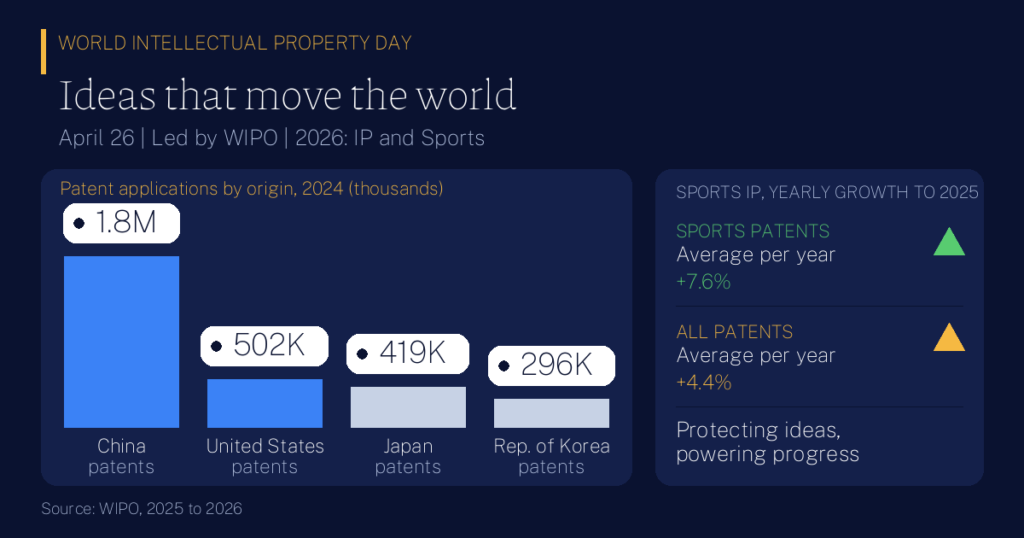
Where do the inventions come from? By applicant origin in 2024, China filed about 1.8 million patent applications, the United States 501,831, Japan 419,132, the Republic of Korea 295,722 and Germany 133,485. The picture is more spread out for designs, where Germany, the United States, Italy and the Republic of Korea follow China, which filed 906,849.
- 194WIPO member states
- 3.7 millionpatent applications worldwide in 2024
- 15.2 milliontrademark classes filed in 2024
- 65,700+sports-related inventions published, 2016 to 2025
Why ideas are an economic engine
IP is not only a legal matter. It is tied to how nations invest in the future. The Global Innovation Index 2025, WIPO’s 18th edition covering nearly 140 economies, ranked Switzerland first, followed by Sweden, the United States, the Republic of Korea and Singapore. China entered the top 10 for the first time, at tenth place. The report also sounded a caution: growth in research and development spending fell to 2.9 percent in 2024, down from 4.4 percent, and the value of venture capital deals rose 7.7 percent even as the number of deals fell 4.4 percent. In plain terms, money for new ideas is still flowing, but it is concentrating in fewer bets.
Who benefits, and who is left out
A good IP system protects more than companies. It protects the musician who wants to be paid, the farmer who names a regional product, and the student who builds an app. Yet rights are also designed with limits so that knowledge stays within reach. The Marrakesh Treaty, adopted on June 27, 2013, is a clear example. It created mandatory limitations and exceptions in copyright law for people who are blind, visually impaired or otherwise print disabled, so that books can be converted into accessible formats and shared across borders.
Access matters on the other side of the ledger too. Filing is concentrated in a handful of economies, and applying for protection costs money and expertise that many small creators lack. That is one reason WIPO, along with national IP offices, runs awareness and training programs around April 26.
Example 2: a musician and a market. Suppose a songwriter earns about $0.004 each time a song is streamed. If a million listeners stream it once, that is about $4,000 before any shares are taken out by others. The figures are made up for illustration. Without copyright, nothing would stop anyone from copying and selling the track, and the songwriter would earn nothing from the same listeners.
2026: IP and Sports, Ready, Set, Innovate
The 2026 theme turns to sports. According to WIPO, patents, designs, trademarks and copyright encourage innovation and link sport with fashion, entertainment, media, health, gaming and consumer goods. Better shoes, lighter equipment, smarter training tools and the badges on a jersey all rest on protected ideas.
WIPO’s Technology SPARK report, published on April 25, 2026, puts numbers on it. From 2016 to 2025, it counted more than 65,700 sports-related inventions, over 1.25 million trademarks and more than 70,000 designs. Over the decade, sports patents grew 7.6 percent a year, compared with 4.4 percent for all patents. Sports designs grew 8.3 percent a year and sports trademark registrations 6.1 percent. Golf, swimming and racket sports were the most patent-intensive sports, and gym and fitness technologies led design filings.
Geography follows the same pattern as the wider economy. In the report, Asia accounts for 63 percent of sports patents and 76 percent of sports designs, while Europe holds 43 percent of sports trademarks. For young people, WIPO also runs a Youth Video Competition on the theme “Game Changers: IP powering Sports Innovation.”
Example 3: a running shoe. Picture a shoe company that spends $2 million developing a foam sole. It might patent the foam, register the sole’s shape as a design, trademark the brand name and hold copyright in the advertising film. Four kinds of protection can attach to one product. The amounts are made up for illustration, but they show how a single pair of sneakers touches the whole IP system.
Key Takeaways
- The date marks a treaty. April 26 recalls the 1970 entry into force of the WIPO Convention, and member states designated the day in 2000.
- IP is a bargain. Creators get limited exclusive rights, and society gets disclosure, competition and new work.
- Filings keep climbing. Patent applications reached 3.7 million in 2024, up 4.9 percent, while trademarks held flat at 15.2 million classes.
- Innovation is concentrated. A few economies file most applications, and research spending growth slowed to 2.9 percent in 2024.
- Rights have limits for good reasons. The Marrakesh Treaty lets accessible books cross borders for people who are blind or print disabled.
- Sports show the system at work. Sports patents grew 7.6 percent a year over the decade, faster than the 4.4 percent for all patents.
- You use IP every day. Look at the shoes, songs and phone near you and ask which ideas, and whose, they carry.
How solid is this? Filing counts and growth rates come from WIPO’s World Intellectual Property Indicators 2025 and its Technology SPARK report, and they are revised as offices report late data. Rankings come from the Global Innovation Index 2025. The three worked examples use round, made-up numbers to show an idea. See also the International Days hub and the International Days Calendar.
More in Society
- WIPO, Frequently Asked Questions: World Intellectual Property Day
- WIPO, World Intellectual Property Day, April 26, 2026
- WIPO, World Intellectual Property Indicators 2025 press release (November 12, 2025)
- WIPO, Global Innovation Index 2025 press release (September 16, 2025)
- WIPO, Technology SPARK: sports and IP (April 25, 2026)
- WIPO, Berne Convention for the Protection of Literary and Artistic Works
- WIPO, Marrakesh Treaty