A language is more than a tool for ordering coffee or filling in a form. It carries memory, humor, law, song and the habits of thought of the people who use it. Portuguese is a vivid example. It was born on the Iberian Peninsula, carried across oceans, and today is spoken on every continent. World Portuguese Language Day, observed each May 5, invites the world to notice that story and to ask what it takes to keep a language alive, shared and respected.
From a community day to a world day
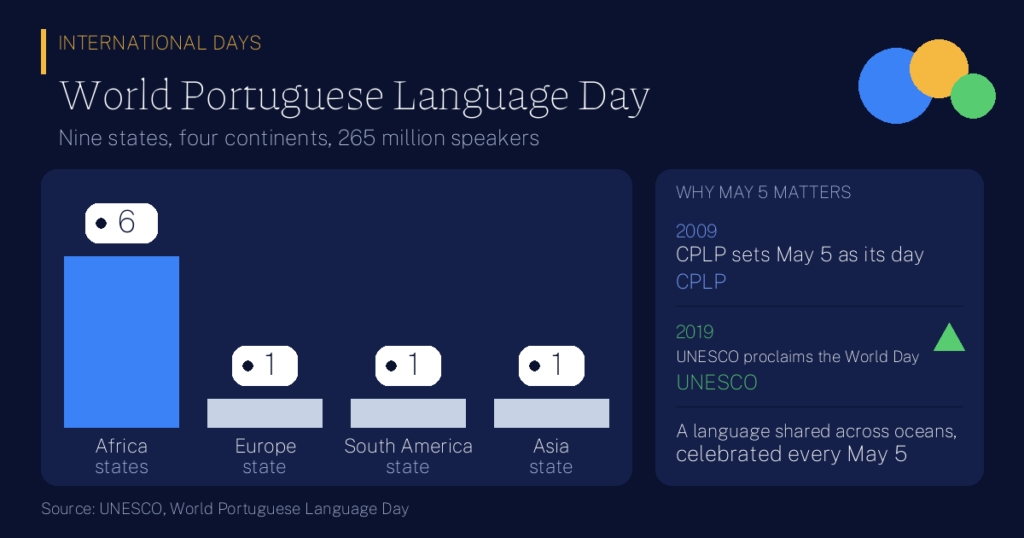
The day grew in two steps. The first came from the countries that share the language. The Community of Portuguese-speaking Countries, known by its initials CPLP, was established in 1996. According to UNESCO, the CPLP is an intergovernmental organization that has been in official partnership with UNESCO since 2000. In 2008 it launched a strategy to project the language internationally, and in 2009 it set May 5 as its own day for the Portuguese language and culture.
The second step came from UNESCO. In 2019, at its 40th session, UNESCO’s General Conference decided to proclaim May 5 of each year as World Portuguese Language Day. UNESCO’s own account of the first celebration, in 2020, describes it as the first time the organization marked the day in partnership with the embassies of the CPLP member states. That year the celebration was also tied to the 60th anniversary of Brasilia, a World Heritage city.
A language of nine states and more
UNESCO’s proclamation states that Portuguese is the official language of nine states: Angola, Brazil, Cabo Verde, Equatorial Guinea, Guinea-Bissau, Mozambique, Portugal, Sao Tome and Principe and Timor-Leste. It is also an official language of the Macau Special Administrative Region of China. Beyond national borders, it is an official language of the African Union, the Organization of American States and the European Union, and it is among the official languages of UNESCO’s General Conference.
The spread is striking when you sort the nine states by continent. Six are in Africa, one is in Europe, one is in South America and one is in Asia. That scattered map is the legacy of centuries of travel, trade and migration, and it means Portuguese is not the property of any single country.
Example 1: a language in one household. Picture a family whose grandparents speak Portuguese in Maputo, whose cousins study in Lisbon and whose neighbors in Sao Paulo share the same words with different accents. The family is made up, but the pattern is real: one language, many voices, and a shared way to tell a story across an ocean.
The numbers behind the day
UNESCO reports that Portuguese has more than 265 million speakers and that it is the most widely spoken language in the Southern Hemisphere. Its users live on all continents. A 2019 UN News report quoted the Institute for the International Language Portuguese, the IILP, as counting at least 7 million Portuguese speakers living outside their countries of origin. The figure is an estimate, and language counts vary with how a speaker is defined, so treat any single number as a good guide rather than a census.
- 265 million+speakers worldwide, per UNESCO
- 9states with Portuguese as an official language
- 7 million+speakers living outside their countries of origin, 2019 estimate
- 1996year the CPLP was established
Why a language day matters
Languages are how knowledge, rights and culture travel. The UN General Assembly’s 2017 resolution 71/328 on multilingualism, cited by UNESCO, shows why the organization treats language as a public good: people who can use their own language can learn, vote, work and take part in public life more fully. A language day makes that principle concrete by giving schools, libraries, embassies and families a shared date to celebrate.
The UN Secretary-General António Guterres has said that languages of global communication, such as Portuguese, play a crucial role in promoting understanding, affection, mutual respect and coexistence. That line points to the real purpose of the day. It is not to rank one tongue above another. It is to remind us that every large language is also a meeting place for many smaller cultures.
Example 2: why a translation matters. Suppose a health leaflet is written in one language for a region where 3 out of 10 residents read mainly another. If it is not translated, about 30 percent of readers may miss the advice. The numbers are round and illustrative, but they show how language access shapes health, schooling and civic life.
Writers, prizes and shared culture
Literature is one of the clearest bridges across the Portuguese-speaking world. UNESCO’s materials for the day mention José Saramago, the first Portuguese-language writer to win the Nobel Prize in Literature, in 1998, and the Secretary-General’s 2022 message noted the centennial of his birth together with the bicentenary of Brazil’s independence. UNESCO also recalls the 2004 UNESCO-Toussaint Louverture Prize, awarded to the Brazilian writer Abdias do Nascimento. These examples show a language as a living archive of ideas, struggle and creativity.
How the day is marked
UNESCO and the CPLP member states mark the day with exhibitions, round tables, readings and cultural events. UNESCO lists examples from earlier years, such as an exhibition of poetry and a CPLP round table in 2022, and a day of activities at Brazil’s Portuguese Language Museum in 2023. Schools can join with a poem, a song or a short talk. The UN Secretary-General also issues a message each year.
Example 3: a school program. Imagine a school sets aside one morning for May 5. Four classes of 25 students, 100 in all, each prepare a poem or song from a different Portuguese-speaking country. Each group performs for five minutes and explains three words they learned. The numbers are illustrative, but the idea is simple and scalable for any community.
Key Takeaways
- The day has two roots. The CPLP set May 5 in 2009, and UNESCO proclaimed it a world day in 2019.
- Portuguese is truly global. UNESCO counts more than 265 million speakers on all continents.
- It is official in nine states. Six are in Africa, one each in Europe, South America and Asia, plus Macau.
- It is a Southern Hemisphere leader. UNESCO calls it the most widely spoken language there.
- Language is a public good. Access to one’s own language supports learning, rights and participation.
- Culture travels with words. Writers and prizes link communities across oceans.
- You can join in. A poem, a song or a conversation in any language honors the idea of the day.
How solid is this? Speaker counts are estimates that vary by source and definition, and the 7 million figure is a 2019 estimate. Dates and history come from UNESCO pages, and a 2019 UN News report places the announcement at UNESCO in Paris in late November, while UNESCO’s Brasilia office gives November 12, so this article says only 2019. The three worked examples use round, made-up numbers. See also the International Days hub and the International Days Calendar.
More in Society
- UNESCO, World Portuguese Language Day
- UNESCO, Celebrating the World Portuguese Language Day and the 60th anniversary of Brasilia (2020)
- UNESCO Brasilia, About the World Portuguese Language Day in Brazil (2023)
- UNESCO, Proclamation of a World Portuguese Language Day
- UN News, Unesco elege 5 de maio como Dia Mundial da Lingua Portuguesa (2019)
- United Nations, Secretary-General message on World Portuguese Language Day