On a battlefield, the first question is usually who is winning. The Red Cross and Red Crescent Movement was built on a different question: who is suffering? World Red Cross and Red Crescent Day, observed every year on May 8, celebrates the volunteers and staff who ask it in every kind of crisis, from earthquakes and floods to conflict and displacement. It is not a United Nations day. It is the Movement’s own day, and it invites everyone to reflect on a simple idea: help people because they need it, not because of who they are.
From a battlefield to a Movement
The story begins in 1859, when Henry Dunant helped wounded soldiers after the battle of Solferino. In 1862 he published his account, which the Nobel Prize website calls A Memory of Solferino. The book argued that societies of trained volunteers should be ready to care for the wounded in war. A working group, the embryo of the International Committee of the Red Cross (ICRC), first met in February 1863. An international conference followed that October and agreed on a standard emblem, a red cross on a white background. In August 1864, delegates from a dozen countries adopted the first Geneva Convention.
May 8 was chosen because it is the anniversary of Dunant’s birth. The idea of a yearly day came after the First World War, at an international Red Cross conference. The first International Red Cross Day was celebrated on May 8, 1948, and in 1984 the name became World Red Cross and Red Crescent Day. Dunant received the very first Nobel Peace Prize in 1901, shared with Frédéric Passy. The Red Cross itself has been honored three times since: the ICRC in 1917 and 1944, and the ICRC with the League of Red Cross Societies in 1963.
Three parts, one purpose
The word “Red Cross” often hides how the Movement is organized. It has three kinds of members. The ICRC, based in Geneva, works in armed conflict and other situations of violence. The International Federation of Red Cross and Red Crescent Societies (IFRC) supports its members and coordinates international disaster response. And there are the National Societies, local organizations that are part of their own communities. In 2024 the IFRC network consisted of 191 National Societies and 16 million volunteers. A neighbor who hands out blankets after a flood is, in most cases, part of this network.
Seven principles that open doors
What holds this network together is a shared set of seven Fundamental Principles. The ICRC describes them as an ethical, operational and institutional framework. They are not decoration. They are the reason a volunteer can cross a front line, enter a camp or knock on a door and be trusted.
Example 1: why neutrality matters. Imagine a clinic in a town divided by fighting, with 200 patients waiting. If the staff were seen as favoring one side, neither side might let medicine through. Because the volunteers visibly serve patients from both sides and take no part in the fighting, both sides are more likely to let them work. The numbers are round and illustrative, but the logic is the Movement’s own: trust is what gets help to people.
The numbers behind the day
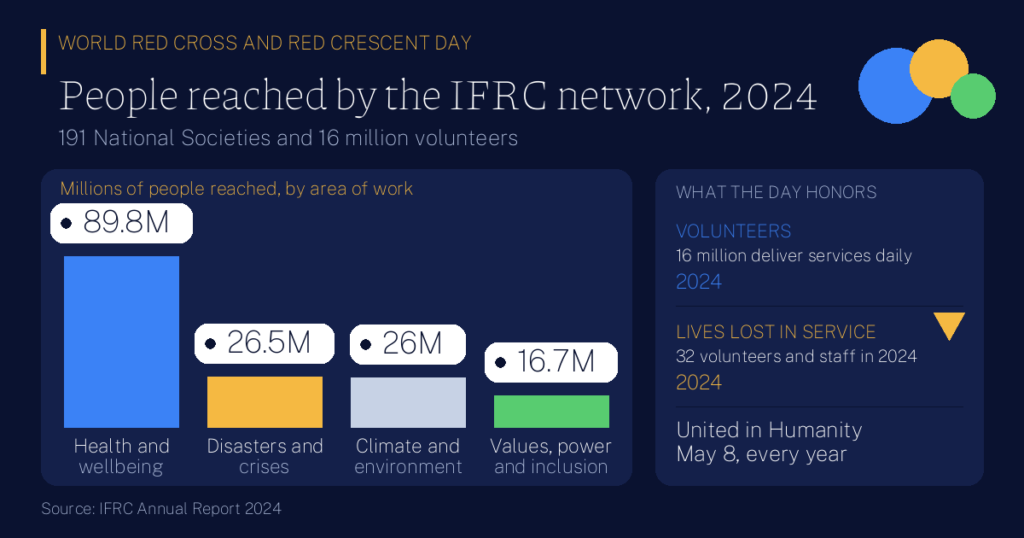
In 2024 the IFRC network reported supporting 113.3 million people in response to emergencies. It ran 265 active emergency operations, including 32 Emergency Appeals, and the IFRC Disaster Response Emergency Fund (DREF) supported 205 operations. The DREF allocated 85.3 million Swiss francs across 167 operations that year. Beyond emergencies, the IFRC’s annual report counts people reached across its main areas of work.
Health and wellbeing is by far the largest area. That surprises people who picture the Red Cross only at disaster sites, but the Movement’s daily work is often quiet: first aid, blood services, vaccination support, clean water and community clinics. Disasters are the visible part. Everyday care is the larger one.
- 191National Societies in the IFRC network, 2024
- 16 millionvolunteers who deliver services, 2024
- 113.3 millionpeople supported in emergencies, 2024
- 265active emergency operations, 2024
Example 2: what a volunteer adds up to. Suppose a National Society has 1,000 volunteers who each give four hours a month. That is 48,000 hours a year, roughly the work of 23 full-time staff. The numbers are made up and rounded, but they show why the IFRC credits its 16 million volunteers as the heart of its work.
The cost of showing up
The day also honors those who have died in service. In 2024, the IFRC reported that 32 National Society volunteers and staff died or were killed, 29 of them in violent attacks and 3 in accidents. The IFRC states that the 29 were killed even though they were clearly identified as Red Cross or Red Crescent personnel. These facts matter because the emblem is meant to protect. The red cross, the red crescent and, since the 2005 Protocol III to the Geneva Conventions, the red crystal are recognized emblems. The ICRC says the red crystal carries no national, political or religious meaning. Respecting the emblem is a legal duty in war, not a courtesy.
Preparing before the crisis
A lesson from decades of response work is that speed saves lives, and money that arrives early goes further. That is the idea behind the DREF and the Early Action Protocols, 27 of which were active in 2024. Funds are released when a forecast or an early warning shows that a hazard is coming, instead of after the damage is done.
Example 3: acting early. Imagine a forecast warns that a river will flood in three days, and a National Society can release $100,000 at once to move families, stock clean water and pre-position supplies. Waiting for the flood might mean spending far more later and reaching families after they have already lost their homes. The sums are illustrative, but the principle of acting before the harm arrives is the logic of early action funding. You can see the same preparedness idea in World Health Day, where care that arrives early protects more people.
How the day is marked
IFRC describes the day as a chance to celebrate its network of volunteers, to reaffirm a common humanity and to reflect on the Fundamental Principles. The 2026 theme, United in Humanity, celebrates the volunteers and staff who stand with communities in crisis. People mark it by thanking volunteers, learning first aid, giving blood, and taking part in local events run by their National Society.
Key Takeaways
- The day honors a birthday. May 8 is the anniversary of Henry Dunant’s birth, and the first observance was in 1948.
- It began with one witness. Dunant’s account of Solferino led to the 1863 committee and the 1864 Geneva Convention.
- It is a network of neighbors. In 2024 there were 191 National Societies and 16 million volunteers.
- Principles create access. Seven Fundamental Principles, including neutrality and impartiality, let helpers be trusted by all sides.
- Most of the work is quiet. Health and wellbeing reached 89.8 million people in 2024, far more than any other area.
- The emblem is protection. It must be respected, and 32 Red Cross and Red Crescent people died in service in 2024.
- You can take part. Learn first aid, give blood or thank a local volunteer on May 8.
How solid is this? The figures come from the IFRC Annual Report 2024 and describe the IFRC network only, not the separate work of the ICRC. Categories of people reached can overlap, and the reported numbers are the organization’s own counts. The three worked examples use round, made-up numbers to show an idea. See also the International Days hub and the International Days Calendar.
More in Society