Few things cross borders as easily as a ball. A game that needs little more than open ground and something to kick is played in schoolyards, refugee camps, stadiums and city streets on every continent. On May 25 each year the United Nations asks the world to look at that reach and to use it. World Football Day is one of the newest days on the UN calendar, and it rests on a simple idea: a sport that so many people already love can carry messages about peace, equality and development further than a speech can. It is a close relative of the International Day of Sport for Development and Peace, which makes the wider case for sport.
From a 1924 tournament to a 2024 resolution
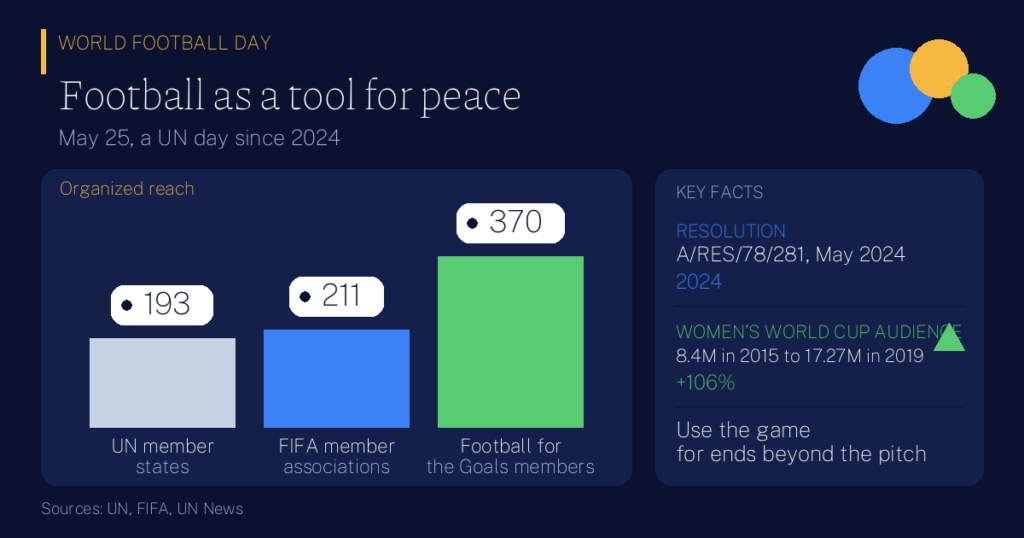
FIFA, the sport’s world body, was founded on May 21, 1904. Two decades later the Paris Summer Olympics of 1924 staged what the UN describes as the first international football tournament with the representation of all regions. That tournament is the reason for the date, since the General Assembly chose May 25 to mark its centenary. In May 2024 the Assembly adopted resolution A/RES/78/281, which proclaims May 25 as World Football Day. FIFA reports that the text was proposed by Bahrain, Libya and Tajikistan, and its president later said that all 193 UN member states adopted it unanimously.
What the resolution asks of the world
The resolution is short and practical. It acknowledges the global reach of football and its impact in many spheres, and it recognizes the fundamental role of FIFA. It encourages all countries to support football and other sports as a tool to promote peace, development and the empowerment of women and girls. It invites member states and others to observe the day in line with national priorities, so no country is handed a script. It also welcomes Football for the Goals, a UN initiative described below, and encourages UN DESA, the UN department that works on sport for development, to support the effort.
Notice what the day is not. It is not a celebration of a tournament or a trophy. It is a call to use the pull of the game for ends beyond the pitch.
Example 1: the one-ball program. Imagine a town club with 200 young players that offers one free community session a week. If 20 neighbors who never played join each week, 1,000 people take part over a 50-week year, and each session can double as a place to share a health tip or plan a litter cleanup. The numbers are round and illustrative, but they show how a club can turn a habit into community work, which is the kind of idea the day encourages.
How big is the game?
Counting football’s reach is harder than it sounds, because no single census covers everyone who plays or watches. Even the sources disagree. The UN’s sport team calls football the world’s most popular sport, with 4 billion fans, while FIFA’s own strategy report says five billion, and neither gives a year. Treat both as broad estimates, not measurements.
Organizations are easier to count. FIFA’s president cited 211 member associations in 2025, more than the 193 member states of the United Nations. The UN’s own football initiative, Football for the Goals, reported some 370 members by June 2025.
Football for the Goals: the UN’s own team
The day’s most concrete partner is Football for the Goals, launched in July 2022 to connect the sport to the 17 Sustainable Development Goals. By June 2025 it had some 370 members from over 120 countries, including all six of FIFA’s regional confederations, along with national associations, leagues, clubs, players’ associations, fan groups and media and commercial partners. UN speaker Maher Nasser said the global football industry is extremely influential and has the power to communicate with billions of people.
In May 2026 the UN named 16 Football for the Goals Champions, including coach Carlo Ancelotti, players Javier Zanetti and Eni Aluko, and Khalida Popal, an exiled Afghan women’s national team player. The role is informal and ambassadorial, aimed at sustainability, gender equality, inclusion and human rights. The announcement was made on World Football Day itself.
- 370Football for the Goals members, June 2025
- 120+countries represented among them
- 13 milliongirls and women in organized football, 2019
- 16UN Champions named, May 2026
Why women and girls sit at the center
The resolution names the empowerment of women and girls, and the data show why the focus is timely. FIFA reported that in 2019 more than 13 million girls and women were playing organized football worldwide. The average live audience of the FIFA Women’s World Cup rose 106 percent, from 8.4 million in 2015 to 17.27 million in 2019.
Those are signs of momentum, not of equality. At the 2025 UN forum, Jayathma Wickramanayake of UN Women stressed that progress has been slow, and speakers argued that sport can challenge stereotypes. The Champions list reflects the point: Popal, one of the 2026 appointees, is described by UN News as an exiled Afghan women’s national team player.
Example 2: the empty pitch. Suppose a district has 40 boys’ teams and 10 girls’ teams, each with 15 players. That is 600 boys and 150 girls, so girls hold one place in five. Adding 10 girls’ teams lifts girls to 300 of 900 players, one in three, and teams can share training slots so no new fields are needed. The figures are round and illustrative, but they show how a few teams change a ratio.
How the day is marked
There is no single required ritual. In 2025 FIFA ran World Football Week from May 21 to 25 under the theme Together, We Are Stronger. The UN held its first Champions for Change forum at Headquarters on May 21, with panels on community engagement, the North-South divide and gender equality, and the General Assembly marked the day on May 22. In 2026 the Assembly hosted a celebration at UN Headquarters on May 19 with FIFA President Gianni Infantino, including a mini-tournament on the North Lawn. A July 17 event looked at football and youth mental health, timed just ahead of the men’s World Cup final.
- 2025Together, We Are Stronger (FIFA World Football Week)
- 2025Champions for Change: Football and the UN Unite for the SDGs
- 2026One World, One Game, One Goal: Football as a Catalyst for Youth Mental Health and Well-Being
Beyond New York, the day invites clubs, schools and cities to host open matches, fund girls’ teams and join the UN initiative.
Example 3: a school kickoff. A school of 500 students holds an open match day on May 25 and asks each class to pick one global goal, such as health or equality, to display on the sidelines. If 10 classes take part, 10 goals are discussed in a single afternoon, and students can link the sport they play to the world they live in. The numbers are round and made up, but they show how little a day like this needs.
Key Takeaways
- The date has a history. May 25 marks the centenary of the 1924 Paris Olympic football tournament, the first with all regions represented.
- It is a recent UN day. Resolution A/RES/78/281 proclaimed it in May 2024.
- The goal is bigger than the game. The resolution encourages football as a tool for peace, development and the empowerment of women and girls.
- Reach is estimated, not measured. Sources cite 4 billion or five billion fans without a year, so treat both as rough.
- The UN has its own team. Football for the Goals had some 370 members from over 120 countries by June 2025.
- Women’s football shows momentum. The Women’s World Cup audience rose 106 percent between 2015 and 2019, yet speakers say progress remains slow.
How solid is this? The resolution symbol and the 1924 history come from the UN and FIFA. Fan counts are undated estimates from two different sources, and the women’s participation figure is from 2019. The UN observances page and FIFA give May 7, 2024 for the resolution, while a UN DESA page gives a March 2024 date for the draft text, so this article says May 2024. The three worked examples use round, made-up numbers. See also the International Days hub and the International Days Calendar.
More in Society
- United Nations. World Football Day, observances page (resolution A/RES/78/281).
- UN DESA, Sport for Development and Peace. World Football Day, 25 May.
- UN News. Champions for Change: World football teams up with UN development goals (May 21, 2025).
- UN News. Power of football inspires team effort towards development goals (June 18, 2025).
- UN News. Khalida Popal and Javier Zanetti among football stars appointed UN Champions (May 24, 2026).
- FIFA. “We are all one team”: UN General Assembly marks World Football Day (May 2025).
- FIFA. The Vision 2020-2023: The football landscape.