The bicycle looks almost too simple to deserve a United Nations day. Two wheels, a frame, a chain and a pair of pedals have stayed essentially unchanged for over 200 years, according to a World Bank commentary. Yet that humble machine touches some of the largest questions of our time: how we move through cities, how much exercise our bodies get, how safe our streets are, and how much pollution we create getting from one place to another. World Bicycle Day, observed every June 3, asks the world to take the bicycle seriously. It pairs naturally with World Sustainable Transport Day, since a bike is one of the cleanest vehicles ever built.
How a bicycle earned a UN day
In April 2018, the UN General Assembly adopted resolution A/RES/72/272 and decided to declare June 3 World Bicycle Day. The World Health Organization notes that the initiative was spearheaded by the Government of Turkmenistan, and that the day has been marked every year since 2018.
The resolution is short but rich. It recognizes “the uniqueness, longevity and versatility of the bicycle” and describes it as a simple, affordable, reliable, clean and environmentally fit sustainable means of transportation. It encourages the use of the bicycle to promote sustainable development, education including physical education, health, disease prevention, tolerance and social inclusion. It also welcomes bicycle ride initiatives as a way to strengthen physical and mental health.
The topic returned to the General Assembly on March 15, 2022, when it adopted resolution A/RES/76/255 on integrating mainstream bicycling into public transportation. The message was practical: a bike is not only a hobby, it is part of how a transport system should work.
What the day actually asks for
World Bicycle Day is not only a call to buy a bike. The resolution treats cycling as a means of transport, a source of exercise and a tool for inclusion, because a bicycle costs far less to own and run than a car. WHO adds a clear condition: in order to unleash the potential of cycling, roads must be safe.
WHO lists the benefits of cycling as more physical activity, fewer noncommunicable diseases such as cancer and diabetes, and less air and noise pollution. A World Bank commentary adds that cycling reduces the need for expensive roads and highways, and that the bicycle promotes physical activity, social engagement and a sense of freedom.
Example 1: the commute that counts. Suppose a worker cycles 20 minutes to work and 20 minutes home, five days a week. That is 200 minutes of riding. WHO recommends at least 150 minutes of moderate-intensity activity per week for adults, so this commute alone would meet the guideline. The numbers are round and illustrative, and actual intensity depends on the rider and the route.
The health numbers behind the day
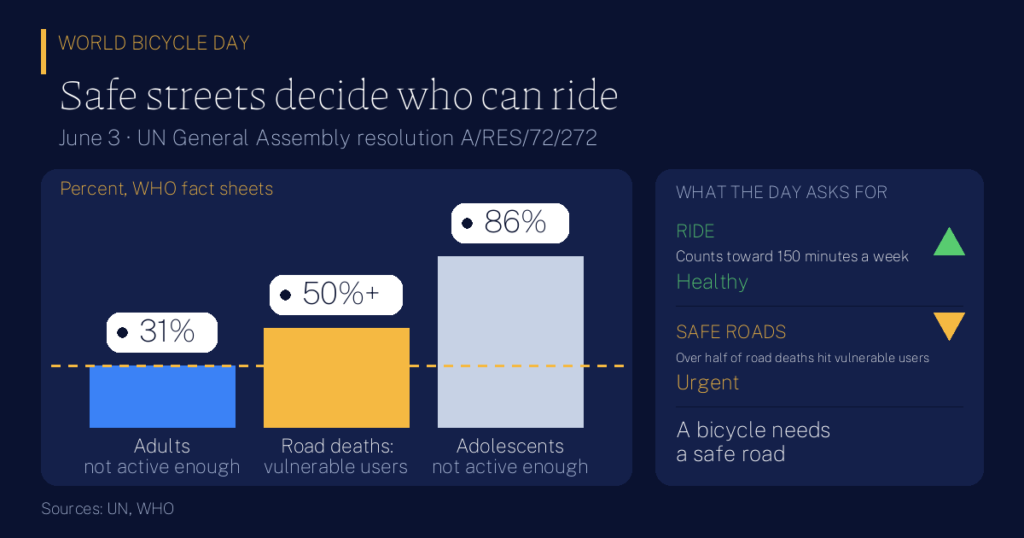
The world has a movement problem. WHO reports that nearly one third of the world’s adults, 31 percent or about 1.8 billion people, do not get enough physical activity. That is a rise of five percentage points between 2010 and 2022, drawn from a study covering 2000 to 2022. Among adolescents the share is far higher: WHO’s fact sheet puts it at 86 percent, based on a study covering 2010 to 2025.
- 31%of adults do not meet recommended activity levels
- 1.8 billionadults are physically inactive, per WHO
- 86%of adolescents do not meet recommended levels
- 150 minof moderate activity a week is the adult minimum
The stakes are real. WHO says people who are insufficiently active have a 20 to 30 percent increased risk of death compared with people who are sufficiently active. It projects that physical inactivity will cost public health care systems nearly US$300 billion between 2020 and 2030. Cycling is one of the few forms of exercise that can be folded into a day that already has to happen, because the trip to school, work or the shop becomes the workout.
Example 2: the school run. Imagine 100 children who live within a short ride of school. If 10 cycle today and a safe route lets 40 do so, then 30 more children build activity into every school day. Over a five-day week that is 150 extra active trips each way, with no gym, uniform or fee. The numbers are round and illustrative.
Safe roads decide who can ride
The biggest barrier to cycling is often fear, and the data explain why. WHO’s July 2026 road traffic fact sheet says approximately 1.16 million people die each year as a result of road traffic crashes. More than half of all road traffic deaths are among vulnerable road users, including pedestrians, cyclists and motorcyclists. Road traffic injuries are the leading cause of death for children and young adults aged 5 to 29. Crashes cost most countries 3 percent of their gross domestic product.
Notice where the burden falls: WHO reports that 92 percent of the world’s road fatalities occur in low and middle income countries. People who cannot afford a car are often the people most exposed on the road, which is why safe design, from protected lanes to lower speeds, is an equity issue as much as a transport one.
Example 3: why a lane changes behavior. Suppose 200 families live within two miles of a school, and a survey finds that 20 children ride now. After a protected lane opens, the survey finds 70. That is 50 more riders, so a street once seen as too risky becomes a daily route. The figures are round and illustrative, but they show the logic of the WHO message that safety unlocks cycling.
Who is left behind
A bicycle is affordable compared with most vehicles, which is why the UN resolution stresses social inclusion. But a bike is only useful where a rider can reach destinations safely. Children, older adults and people on low incomes are the most likely to depend on walking and cycling, and the least likely to have a safe alternative when the roads are built only for fast traffic. Closing that gap means building networks, not single lanes, and making bicycles part of public transport planning, which is exactly what the 2022 resolution encourages.
How the day is marked
The UN observance page does not assign a yearly theme. Instead the day is open to local action. In 2026, for example, UN offices in Thailand marked it with a symposium on active transit and sustainable urban mobility in Bangkok, and the World Bank has hosted its own events, including a 2024 edition described as the seventh. Schools, cities and community groups organize rides, repair workshops and safe-routes campaigns. WHO also promotes cycling and walking through its health and road safety work.
Key Takeaways
- The day has a clear legal basis. The General Assembly declared June 3 World Bicycle Day in resolution A/RES/72/272 in April 2018.
- The bicycle is a development tool. The resolution links it to health, education, inclusion and sustainable transport.
- Many people do not move enough. WHO says 31 percent of adults, about 1.8 billion people, are not sufficiently active.
- Everyday cycling can meet the guideline. A 20 minute ride each way, five days a week, adds up to 200 minutes.
- Safety comes first. About 1.16 million people die on roads each year, and more than half are vulnerable road users.
- Transport planning must include bikes. The 2022 resolution A/RES/76/255 asks for bicycling to be part of public transportation.
How solid is this? Activity figures come from WHO’s physical activity fact sheet and its underlying studies, which are modeled estimates and are revised over time. Road safety figures come from WHO’s road traffic injuries fact sheet, which gives no single year for the 1.16 million estimate. The sources give April 2018 for the resolution, and the exact adoption date varies by account. The three worked examples use round, made-up numbers. See also the International Days hub and the International Days Calendar.
More in Society
- United Nations. World Bicycle Day, General Assembly resolution A/RES/72/272.
- World Health Organization. World Bicycle Day.
- World Health Organization. Physical activity fact sheet.
- World Health Organization. Road traffic injuries fact sheet.
- World Bank. Cycling may be old but it is never been more relevant (2024).