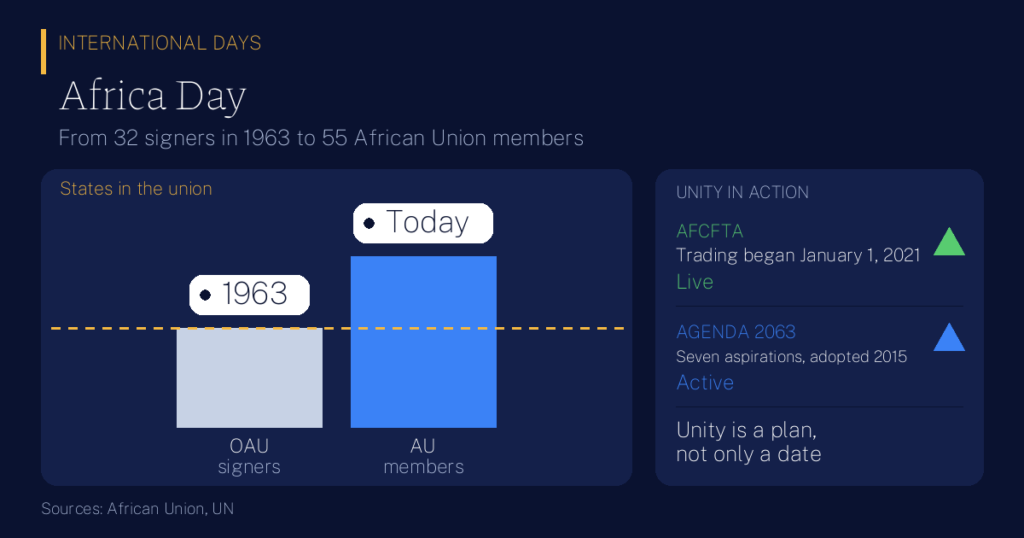
On a single day in May 1963, thirty-two leaders of newly independent African states sat down in one room and agreed that their futures were joined. Africa Day, observed every May 25, remembers that meeting. It is part history lesson, part family reunion and part checkup: a moment to ask how far the continent has come toward the unity those leaders imagined, and how far it still has to go. The African Union leads the day, and Africans on the continent and in the diaspora observe it.
The day thirty-two leaders met
The African Union describes the founding plainly. The Organization of African Unity was established on May 25, 1963, in Addis Ababa, Ethiopia, when 32 heads of independent African states met to sign the charter creating Africa’s first post-independence continental institution. The UN notes that Africa Day is an annual commemoration of that founding. It was a bold moment. Many of the signers led countries that had gained independence only a few years earlier, and they chose cooperation over going it alone.
The day is also a tribute. The African Union says it is an occasion to honor the founding fathers and mothers of the OAU and the African Union. You will sometimes hear it called African Liberation Day, a reminder that the unity project grew from the struggle against colonial rule.
From the OAU to the African Union
The organization changed with the times. On September 9, 1999, OAU leaders issued the Sirte Declaration, which called for an African Union. The African Union was officially launched in July 2002 in Durban, South Africa. Its headquarters stay in Addis Ababa, the city where the story began.
Africa by the numbers
The union has grown with the continent. Where 32 leaders signed in 1963, the African Union today counts 55 member states. South Sudan, the continent’s newest country, became independent in 2011.
The economic outlook is cautiously upbeat. The UN’s 2025 World Economic Situation and Prospects expects African growth to rise from 3.4 percent in 2024 to 3.7 percent in 2025 and 4 percent in 2026. Projections can change, so treat them as a direction of travel rather than a promise.
- 55African Union member states
- 1.3 billionpeople in the AfCFTA market, per a UN policy brief
- $3.4 trillioncombined GDP of that market, same brief
- Over 60%of Africa’s people are under 25, per a 2025 UN essay
Agenda 2063 and the free trade promise
Unity is more than a ceremony; it has a plan. Agenda 2063, adopted in January 2015, sets out seven aspirations: a prosperous Africa built on inclusive growth, an integrated continent, good governance and human rights, a peaceful and secure Africa, a strong cultural identity, development driven by people (especially women and youth), and Africa as a strong, united and influential global partner.
The most concrete economic step is the African Continental Free Trade Area, or AfCFTA. The agreement was approved by the African Union Assembly in January 2012, entered into force on May 30, 2019, and began trading on January 1, 2021. A UN policy brief says it creates a market of 1.3 billion people with a combined GDP of $3.4 trillion.
Example 1: the price of a border. Suppose a baker sells $100 of bread flour to a neighboring country and pays a 10 percent tariff. That is $10 gone at the border. If trade rules remove the tariff, the baker keeps the $10 or passes it on to customers. The numbers are round and illustrative, but this is the everyday logic behind a free trade area.
Who is counted, and who is left out
Africa is a young continent. A 2025 UN Africa Renewal essay, citing UNFPA, says over 60 percent of the population is under 25 and that women make up more than half of the continent. The same essay says youth-led initiatives receive less than 1 percent of global development financing. That gap between talent and funding is a theme of the day.
Representation is still uneven. In 2024, only seven African countries had parliaments with more than 35 percent women, and the UN reports that in 16 countries women held close to one-third of parliamentary seats in 2023. Hunger remains a challenge too: the UN says one in five people in Africa suffers from hunger.
Example 2: a young country’s job math. Imagine a country of 10 million people where 6 million are under 25. If 300,000 young people look for their first job each year but the economy creates 200,000, the gap of 100,000 adds up quickly. These figures are made up for illustration, yet they show why youth employment sits at the heart of the continent’s plans.
How the day is marked, and what progress needs
Africa Day is marked with ceremonies at African Union headquarters, speeches, cultural events, concerts and school programs across the continent and the diaspora. The African Union also names a theme each year. The 2025 theme was “Justice for Africans and People of African Descent through Reparations.” The AU’s theme of the year for 2026 is “Assuring Sustainable Water Availability and Safe Sanitation Systems to Achieve the Goals of Agenda 2063,” which connects naturally to World Water Day and World Toilet Day. Another companion is Africa Industrialization Day, which looks at the factories and jobs that growth depends on.
Example 3: why growth rates matter. If an average income of $1,000 grows 4 percent a year for ten years, it reaches about $1,480. If it grows at 3.4 percent, it reaches about $1,400. The difference looks small each year and large over a decade. The incomes are illustrative, but the compounding is real.
- 2025Justice for Africans and People of African Descent through Reparations
- 2026AU theme of the year: sustainable water and safe sanitation for Agenda 2063
Key Takeaways
- The day marks a founding. On May 25, 1963, 32 leaders signed the OAU Charter in Addis Ababa.
- Unity has evolved. The OAU became the African Union, launched in Durban in July 2002.
- The table has grown. The union now has 55 member states.
- There is a plan. Agenda 2063 sets seven aspirations, from prosperity to peace to a strong global voice.
- Trade is the practical test. The AfCFTA began trading on January 1, 2021, covering a market of 1.3 billion people.
- Youth are the opportunity. Over 60 percent of Africans are under 25, and jobs and funding must keep pace.
- Look at your own connections. Find out what your school, company or community can do to trade, learn and build with Africa.
How solid is this? Dates and membership come from African Union and UN pages. The market size and the youth share are stated by a UN policy brief and a 2025 UN essay without a precise year, and growth numbers beyond 2024 are projections. The three worked examples use round, made-up numbers to show an idea. See also the International Days hub and the International Days Calendar.
More in History
- African Union, Africa Day: 60th Anniversary of the OAU-AU (2023)
- African Union, About the African Union
- United Nations, Global Issues: Africa
- African Union, Agenda 2063 Aspirations
- African Union, The African Continental Free Trade Area
- UN Office of the Special Adviser on Africa, Policy Brief: AfCFTA
- UN Africa Renewal, Africa Day 2025: The Africa our youth and women want