Abuse of older people is one of the least discussed forms of violence. It often happens behind closed doors, and many victims depend on the very people who harm them. World Elder Abuse Awareness Day, observed every year on June 15, exists to bring the problem into view. It asks families, health workers, banks, lawmakers and neighbors to recognize the signs and to act. The topic is hard, so this article stays factual and points to where help can be found.
From a network to a United Nations day
The day began with people who worked on the problem directly. According to the United Nations, June 15 was initiated by the International Network for the Prevention of Elder Abuse (INPEA) in 2006. In 2011 the General Assembly recognized it as a United Nations day in resolution A/RES/66/127. The resolution invites Member States, the organizations of the UN system, other international and regional organizations and civil society to observe the day in an appropriate manner.
What counts as abuse
WHO describes abuse of older people broadly. The term covers physical, sexual, psychological and emotional abuse, financial and material abuse, abandonment, neglect, and serious loss of dignity and respect. That range matters, because the most common forms leave no bruises. A relative who takes control of a pension, a caregiver who withholds help, or a person who isolates an older adult from friends can all cause deep harm.
Example 1: the quiet drain. Suppose an older woman gives a trusted relative access to her bank account to help with bills. Over a year the relative withdraws an extra $300 a month for personal use. That is $3,600, a large share of a modest pension, taken without a single raised voice. The numbers are round and illustrative, but financial abuse often looks exactly like this: gradual, hidden and committed by someone close.
The numbers behind the day
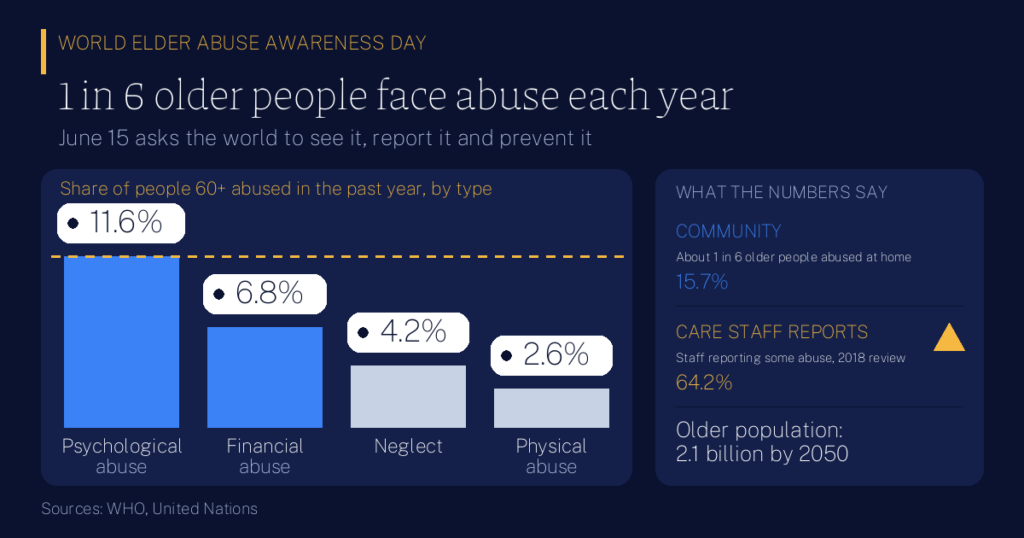
The most cited estimate comes from a 2017 review of 52 studies in 28 countries, including 12 low- and middle-income countries. It found that 15.7 percent of people aged 60 and older, about 1 in 6, had experienced some form of abuse in community settings over the past year. The figures are reported by older adults themselves. Psychological abuse was the most common type, followed by financial abuse and neglect.
Care homes and other institutions are harder to measure. WHO calls the data scarce. A 2018 review found that 64.2 percent of staff reported committing some form of abuse in the past year, including psychological abuse (32.5 percent), neglect (12.0 percent) and physical abuse (9.3 percent). Because this figure comes from staff reports and uses different methods, it cannot be compared directly with the community figure. It does show that quality of care deserves close attention.
- 15.7%of people 60+ abused in the past year at home, 2017 review
- 64.2%of care staff reported committing some abuse, 2018 review
- 320 millionprojected victims by 2050 if the share stays constant
- 84%possible rise in community rates in one US COVID-19 study
The pandemic added pressure. WHO reports emerging evidence that abuse of older people increased in both community and institutional settings during COVID-19, and one US study (Chang and Levy, 2021) suggested community rates may have risen by as much as 84 percent.
Example 2: a town of older neighbors. Imagine a town with 10,000 residents aged 60 or older. At the global estimate of 15.7 percent, roughly 1,570 of them would face some form of abuse in a single year. Local rates vary, so the figure is only a rough, illustrative guide. Even so, it suggests that most people already know someone affected, whether or not it is spoken about.
Why the issue is growing
The reason is demographic. WHO reports that in 2020 the number of people aged 60 and older outnumbered children younger than 5. By 2030, 1 in 6 people in the world will be 60 or over, and the group is expected to reach 2.1 billion by 2050. By then about 80 percent of older people will live in low- and middle-income countries, where services are often thinnest.
Who is most at risk
WHO lists risk factors on several levels. For older people they include functional dependence or disability, poor physical or mental health, cognitive impairment and low income. For those who cause harm, they include mental illness, substance abuse and, often, financial dependence on the older person. At the level of society, ageism and cultural norms that normalize violence play a role. Social support is protective. The consequences can be severe: physical injuries, premature death, depression, cognitive decline, financial devastation and placement in nursing homes. Disability is a shared thread with the International Day of Persons with Disabilities.
What helps, and how the day is marked
WHO says the most promising strategies include caregiver interventions, money management programs, helplines and emergency shelters, and multidisciplinary teams, though evidence for most is still limited. In 2022 WHO and partners published five priorities for the UN Decade of Healthy Ageing (2021 to 2030): combat ageism, generate more and better data, develop and scale up cost-effective solutions, make an investment case, and raise funds.
Example 3: an early warning. Imagine a bank that texts a second trusted contact whenever an older customer’s account sends more than $1,000 in a day. In one illustrative month the alert catches two odd transfers of $2,000 each, and a family member calls the customer before the money is gone. The numbers are made up, but safeguards of this kind show how a small design choice can protect savings.
- 2020The impact of COVID-19 on violence, abuse and neglect of older persons
- 2021Access to justice
- 2025Addressing abuse of older adults in long term care facilities: through data and action
- 2026Beyond Awareness: Making Elder Abuse Prevention Work
If someone is in immediate danger, contact local emergency services. Otherwise, a doctor, a social worker, adult protective services or an older people’s helpline in your country can advise on next steps.
Key Takeaways
- Abuse is common. About 1 in 6 people aged 60 and older experienced some form of abuse at home in the past year, by a 2017 review.
- Much of it leaves no mark. Psychological and financial abuse and neglect are the most frequent forms.
- Care settings need scrutiny. Data are scarce, but a 2018 review found 64.2 percent of staff reported committing some abuse.
- The challenge is growing. The population aged 60 and older is projected to reach 2.1 billion by 2050.
- Risk has patterns. Dependence, disability, isolation and ageism raise it, and social support protects.
- Prevention has promising tools. Caregiver support, money management programs, helplines and teams show promise, though more evidence is needed.
- Speak up. Check in on older neighbors and relatives, and report concerns to the right local service.
How solid is this? Prevalence figures are pooled estimates from self-reports and staff reports, so they vary by country and method, and abuse is widely under-reported. Projections assume the share of victims stays constant. The three worked examples use round, made-up numbers. See also the International Days hub and the International Days Calendar.
More in Society
- WHO, Abuse of older people fact sheet (June 2024)
- United Nations, World Elder Abuse Awareness Day: Background
- United Nations, World Elder Abuse Awareness Day (2026 theme)
- UN DESA, 2025 World Elder Abuse Awareness Day
- WHO, Abuse of older people on the rise: 1 in 6 affected (2017)
- WHO, Ageing and health fact sheet (October 2025)